When you envision your dream kitchen, what's the first thing that comes to mind? For most of us, it’s the cabinets. They’re far more than just storage for our dishes; they set the entire tone for the heart of your Naples home and are a cornerstone of your daily life.
Choosing the best kitchen cabinet material for Florida's coastal climate means striking a perfect balance between breathtaking style, everyday durability, and unwavering moisture resistance. While the options seem endless, materials like professionally sealed solid wood and high-quality marine-grade plywood consistently stand out for their ability to handle our unique environmental challenges with grace.
Choosing Cabinets Built for Florida's Coastal Climate
Picking out cabinets in Southwest Florida is a much bigger decision than just choosing a door style you love. Here, the salty, humid air works around the clock, trying to warp, swell, and break down inferior materials. Getting this choice right from the start is the key to protecting your investment and ensuring your kitchen remains a beautiful, functional sanctuary for years to come.
This guide is designed to be your trusted partner in that decision. We'll skip the generic advice and jump right into a detailed, friendly comparison of the top materials available. We’ll look at each one through the lens of durability, aesthetic flexibility, maintenance needs, and overall value for your family in our specific climate.
Why Material Matters More in Naples
Let's be honest: the materials that work just fine in a dry, stable climate might not even last a single season in a coastal home. Florida’s environment demands a higher level of performance from every element of your home.
Humidity Resistance: This is non-negotiable. The material absolutely must resist absorbing moisture from the air, which is the root cause of swelling, warping, and delamination. Imagine your cabinet doors sticking every summer—that's what we want to avoid.
Structural Stability: Your cabinets need to maintain their shape and strength through constant temperature shifts, all while holding up heavy countertops and stacks of your family's dishes without sagging.
Finish Durability: The finish is your first line of defense. It has to be tough enough to block out moisture while standing up to regular cleaning and the inevitable spills of a busy kitchen.
For good reason, solid wood has long been the gold standard, holding the largest market share globally because of its incredible durability and timeless look. It’s a natural fit for homeowners who want cabinets that are built to last a lifetime. In fact, the global kitchen cabinet market was valued at a staggering USD 80.72 billion in 2023 and is expected to keep growing, with wood continuing to lead the way.
This intense focus on quality materials is a cornerstone of our custom home building services, where we believe longevity and aesthetics go hand-in-hand. Now, let’s dive into the specifics of what makes each material a great—or not-so-great—fit for your dream coastal kitchen.
Comparing Top Cabinet Materials for Coastal Living
Alright, let's get down to brass tacks and compare the most popular cabinet materials head-to-head. Forget generic lists; we're going to break this down with the real-world demands of a luxury Naples kitchen in mind, from both a beauty and a practical standpoint.
We'll focus on the criteria that truly matter here: how well they hold up to our humidity, the style and finish possibilities, what it takes to keep them looking great long-term, and the overall value you get. This way, you can make a confident choice that perfectly fits your home and lifestyle.
To kick things off, this decision tree is a great way to visualize how your preferred style can point you toward the right materials.
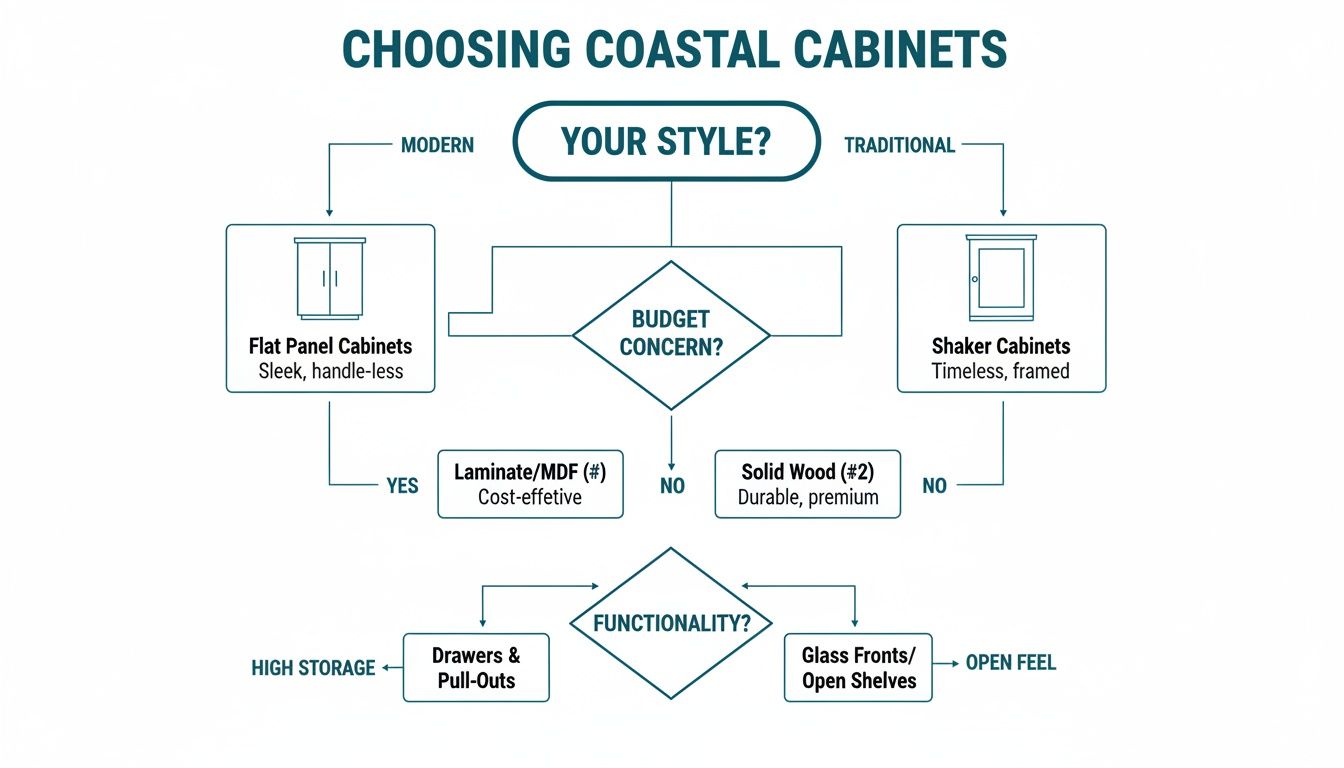
As you can see, different aesthetic goals—like a sleek, modern look versus a classic, traditional feel—naturally lead you down different paths when it comes to materials and finishes.
Solid Wood vs. Engineered Wood: A Real-World Scenario
Let's walk through a common design scenario to see this in action. Imagine you're planning a kitchen with a big, beautiful island that you want stained to show off a rich, warm wood grain. At the same time, you want the perimeter cabinets to be a crisp, clean white to keep the space feeling bright and coastal.
For that statement island, solid wood is the undeniable winner. A beautiful walnut or cherry has a deep, gorgeous grain that a stain will only make more stunning. Solid wood also brings an authentic, substantial feel that's just right for a kitchen's centerpiece.
But for those white perimeter cabinets? High-quality MDF (Medium-Density Fiberboard) is actually the smarter choice for the doors.
Wood is a natural material that expands and contracts with Florida's humidity. When you paint it, this movement can cause tiny, hairline cracks at the joints over time. MDF, being a stable, single piece, provides a flawless canvas for paint that stays smooth and seamless for years.
This "mixed-material" approach is one of the secrets to a truly high-performance luxury kitchen. You get the best of both worlds: timeless beauty and modern-engineered perfection.
Deep Dive into Durability and Moisture Resistance
In our coastal climate, a material's ability to stand up to moisture is non-negotiable. Let’s see how the top contenders really perform.
Marine-Grade Plywood: This isn't the stuff you find at a big-box store. It’s built with waterproof glue, making it exceptionally resistant to delaminating or warping from constant humidity. This is precisely why we almost always recommend it for the cabinet boxes—the very foundation of your kitchen.
Solid Hardwood: When it's properly kiln-dried and sealed with a professional-grade finish, solid wood is a beast. It can easily last 50 years or more, but that finish is everything. A top-tier catalyzed lacquer or conversion varnish creates a hard, protective shell that locks moisture out.
MDF: Your standard MDF acts like a sponge around water, which is a big problem. However, moisture-resistant varieties are available, and when they're properly sealed with primer and high-quality paint, they perform incredibly well. The trick is ensuring every single edge is perfectly sealed to prevent any water from getting in.
So, while solid wood might feel like the most robust option for doors, the structural integrity of marine-grade plywood for the cabinet boxes is often the smarter investment in a high-humidity zone like ours.
Aesthetic Flexibility and Finish Options
Your cabinets are a huge part of your kitchen's personality, and each material opens up different design doors.
Solid wood gives you a natural beauty that's impossible to replicate. The unique grain patterns in oak, maple, and cherry can be highlighted with a whole range of stains, from light and airy to deep and dramatic. It’s the perfect pick for traditional, transitional, and warm contemporary designs where the wood's character is a key feature.
MDF, on the other hand, is the undisputed champion of painted finishes. Its perfectly smooth, non-porous surface delivers a flawless, factory-like sheen that’s incredibly difficult to achieve on natural wood. This makes it ideal for modern, minimalist kitchens or for pulling off bold, saturated colors.
Cabinet Material Comparison for Naples Homes
To make this even simpler, here is a quick-reference table to help you evaluate the best kitchen cabinet material based on what matters most in our coastal environment.
Material | Ideal Use Case | Humidity Resistance | Aesthetic Flexibility | Maintenance Needs |
|---|---|---|---|---|
Solid Wood | Stained cabinet doors, face frames, architectural details | Good to Excellent | Best for stains, natural finishes | Requires proper sealing |
Marine-Grade Plywood | Cabinet boxes (the internal structure) | Excellent | Used structurally, covered by doors/panels | Very Low |
MDF | Painted cabinet doors and decorative panels | Good (when sealed) | Best for smooth, flawless painted finishes | Low, but avoid chipping |
At the end of the day, choosing the best kitchen cabinet material isn't about finding one "perfect" option. It's about strategically combining the strengths of different materials to build a kitchen that's not only stunningly beautiful but also engineered to thrive in our gorgeous Naples climate.
Ready to figure out the perfect combination for your home? Let's connect and start the conversation.
The Timeless Strength of Solid Wood Cabinets
When you walk into a beautifully designed custom kitchen, solid wood cabinets are often the star of the show. For years, they've been the gold standard for luxury and longevity, bringing a natural warmth and character that’s impossible to duplicate. For homeowners who put a premium on quality and timeless style, solid wood is almost always the first choice.
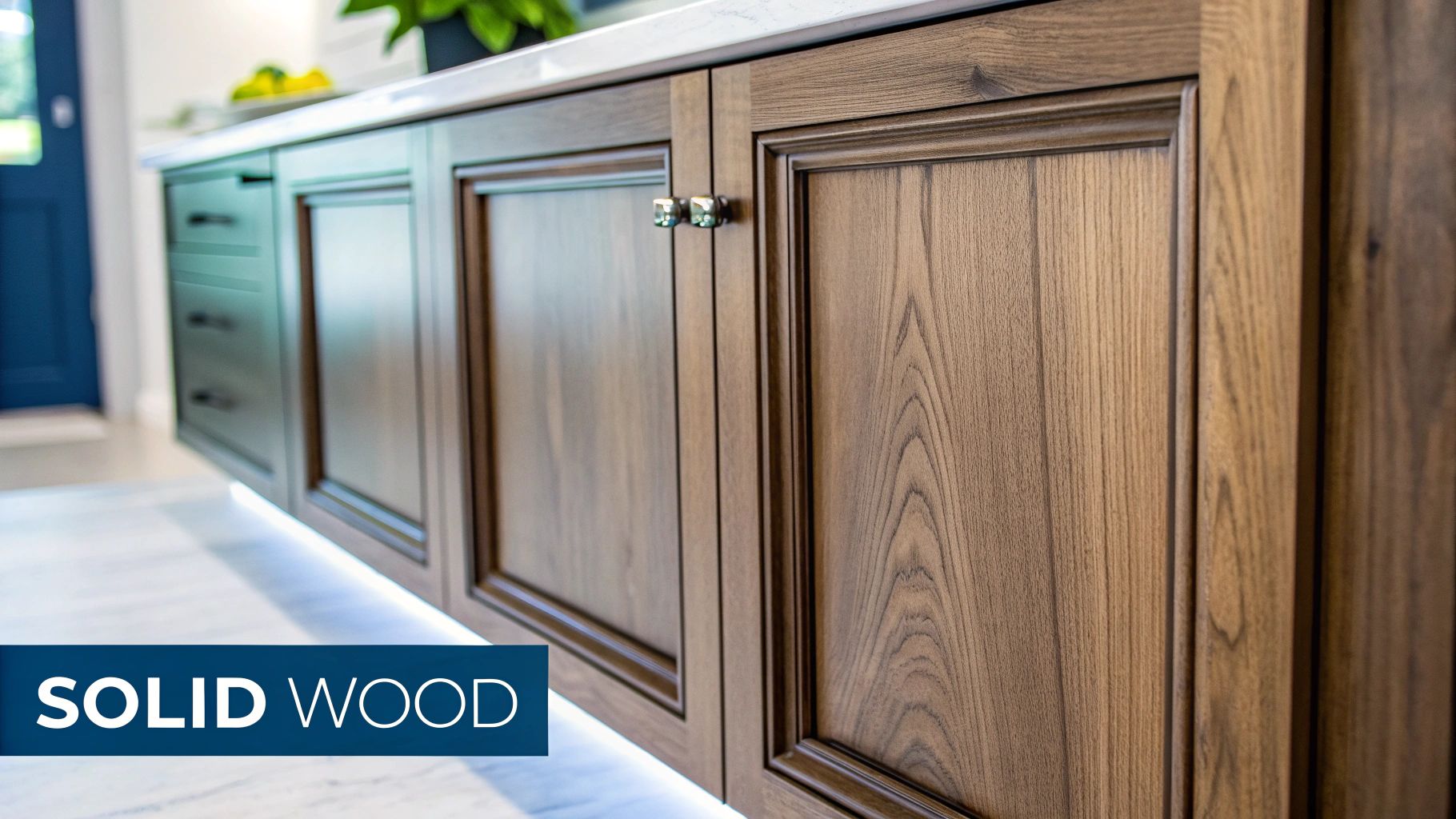
But it's not just about looks. The inherent strength of hardwoods means they can handle the daily chaos of a busy household, standing strong against dings from stray pots and holding stacks of heavy dishes without ever sagging.
Exploring the Personalities of Wood Species
Think of choosing a wood species like picking a piece of art for your home. Each one has its own story, told through its unique grain and color.
Maple: With its fine, subtle grain and creamy white color, maple is incredibly hard and resistant to dents. It’s a clean, bright canvas that looks fantastic with both light stains for a breezy coastal feel and solid paint for a classic look.
Cherry: Known for its smooth, closed grain and a rich reddish-brown color that only gets deeper and more beautiful with age. Cherry instantly adds a touch of elegance and formality to any kitchen.
Walnut: This is a premium choice, celebrated for its dramatic, sweeping grain patterns and deep, chocolatey hues. Walnut makes a bold statement and is perfect for a show-stopping kitchen island or sleek, modern cabinetry that feels incredibly luxurious.
The real magic of solid wood is that no two cabinet doors will ever be identical. The subtle variations in grain and tone create a truly custom look, adding a layer of depth and personality you just don't get with other materials.
Conquering Florida Humidity with Expert Craftsmanship
Okay, let's tackle the big question for any Naples homeowner: how does solid wood hold up in our humid, coastal climate? It's a fair question, since wood naturally expands and contracts with changes in moisture. The good news is that with modern techniques and skilled craftsmanship, this is no longer a major concern.
It all comes down to a careful, multi-step process that ensures your cabinets remain stable and beautiful for a lifetime.
Proper Kiln-Drying: It starts with lumber that has been professionally kiln-dried to the perfect moisture content. This first step is absolutely critical, as it dramatically reduces the wood's natural tendency to warp or swell.
Advanced Construction: Master cabinet makers use construction methods like frame-and-panel doors, which are specifically designed to allow for tiny, unnoticeable amounts of movement. This clever engineering prevents stress on the joints and keeps everything stable for decades.
Professional-Grade Sealing: This is the final line of defense. A top-tier, professional-grade finish, like a catalyzed conversion varnish, completely seals the wood from every angle. It creates an impermeable barrier that locks out moisture and protects the cabinet's integrity.
It’s a common myth that wood is a bad choice for humid places. The truth is, expertly crafted and finished solid wood cabinets are engineered to thrive in coastal conditions, offering unmatched durability when built by true professionals.
Wood's blend of premium strength and timeless appeal keeps it at the top of a booming market. The global kitchen cabinet sector, valued at USD 100.79 billion in 2024, is expected to skyrocket to USD 183.53 billion by 2032, with wood leading the way. You can read more about the trends in the kitchen cabinet market on Fortune Business Insights.
The Ultimate Long-Term Investment
Perhaps the single greatest benefit of solid wood is its incredible lifespan. While other materials might need to be replaced if they get damaged, solid wood can be repaired and refinished. A deep scratch can be sanded out, a dent can be filled, and years down the road, you can have the entire kitchen sanded and refinished to look brand new or to match a completely different style.
This unique quality makes solid wood cabinets a genuine long-term investment in your home. They aren't just a feature for today; they're a legacy of quality that can be enjoyed for generations, adapting to your family's changing tastes over a lifetime. When you choose solid wood, you're choosing a material that’s truly built to last.
A Closer Look at High-Performance Engineered Materials
While everyone loves the classic, timeless feel of solid wood, engineered materials bring a lot of modern problem-solving to the table. In many situations, especially in our demanding coastal environment, they can actually outperform natural wood. Let's be clear: materials like plywood and MDF aren't just "cheaper" options anymore; they're smart, strategic choices for building a kitchen that lasts.
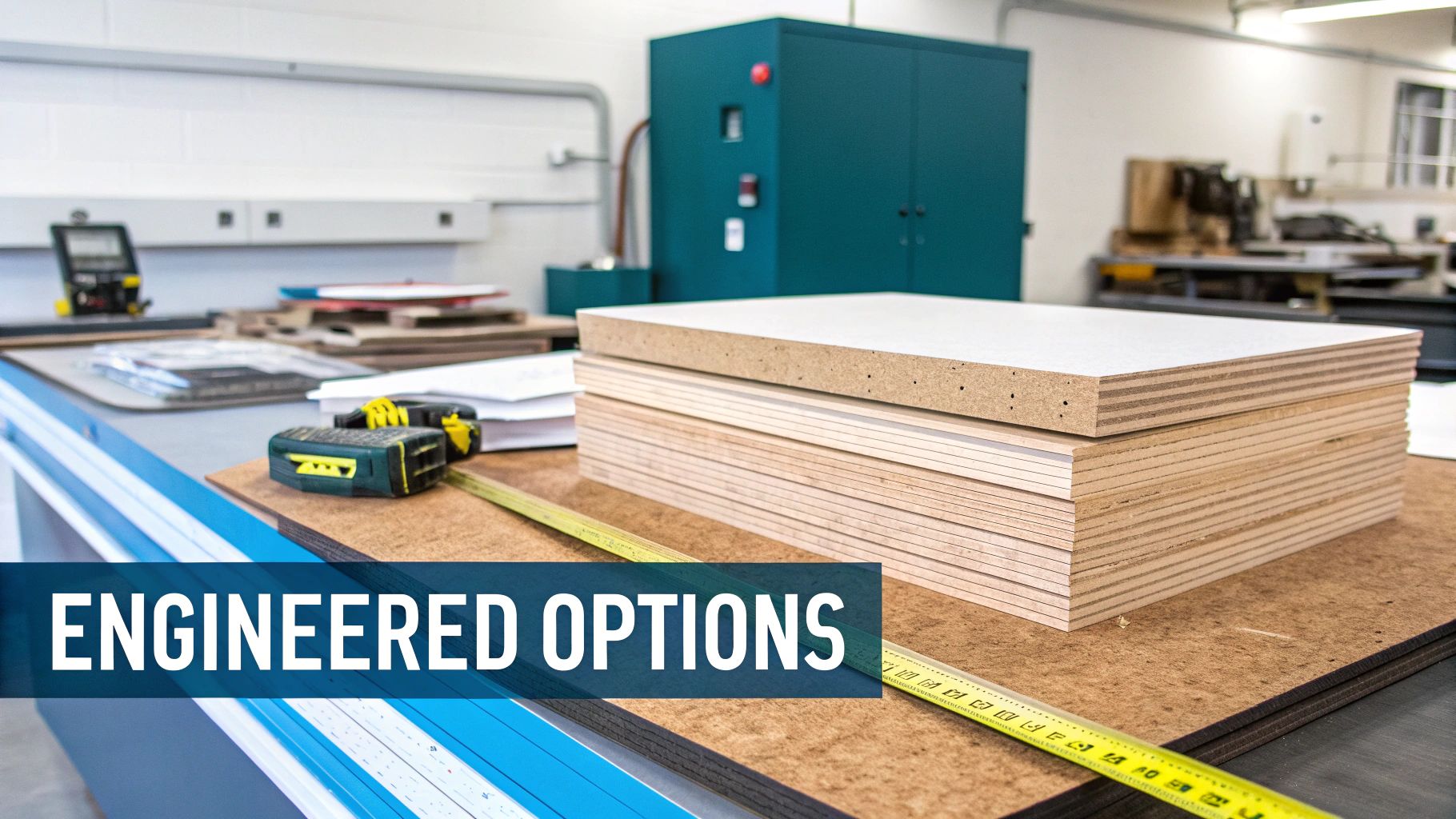
When you pull back the curtain on how these materials are made, you start to see why combining them often creates a far superior kitchen. The best designs don't just stick to one material; they use the unique strengths of each one right where it makes the biggest impact.
Plywood: The Unsung Hero of Cabinet Boxes
When it comes to the actual structure of your kitchen—the cabinet boxes—you'll find that top-tier plywood is almost always the champion. I'm not talking about the flimsy sheets you see at a big-box store. Cabinet-grade plywood is a different beast entirely, offering incredible stability.
It’s made by layering thin sheets of wood veneer, with the grain direction of each layer running perpendicular to the one below it. This cross-graining is the secret sauce. It creates a balanced, rigid panel that’s extremely resistant to the warping, expanding, and contracting that solid wood is prone to in humid places like Naples.
For our coastal homes, marine-grade plywood is the gold standard. It’s bonded with waterproof glue, making it practically immune to delamination from constant moisture exposure. This is precisely why experienced builders insist on it for cabinet carcasses; it guarantees the foundation of your kitchen will stay solid for decades to come.
MDF: The Perfect Canvas for Painted Finishes
Medium-Density Fiberboard (MDF) has a superpower that makes it the hands-down best choice for high-end painted cabinet doors. Because it’s made from fine wood fibers and resin pressed into a single, dense panel, it has no joints or wood grain.
This perfectly uniform surface is an ideal canvas for paint. You completely avoid the risk of those tiny hairline cracks that often appear at the joints of painted solid wood doors as they naturally move with humidity shifts. If you're dreaming of a flawless, durable painted finish that stays that way, MDF is the superior choice for your doors.
One of the most common strategies in high-end kitchen design is the "hybrid" approach. A designer might specify stunning solid walnut doors for a stained island centerpiece but then choose premium MDF doors for the painted perimeter cabinets. This guarantees a perfect, long-lasting painted finish where it matters most.
This practical mindset simply uses the best material for each job, delivering both beauty and engineered performance.
Real-World Scenarios and Smart Combinations
Once you understand these differences, you can design a kitchen that truly stands up to our climate over time. It’s never about which material is "better" overall, but which one is best for a specific purpose.
Here’s a typical combination you'd see in a luxury build:
Cabinet Boxes: Marine-grade plywood for its unbeatable moisture resistance and structural strength.
Stained Doors & Drawers: Solid wood, like a beautiful maple or cherry, to showcase the natural grain patterns.
Painted Doors & Drawers: High-quality, moisture-resistant MDF to achieve that seamless, stable painted look.
Face Frames: Solid wood is still the go-to for the frames that trim the front of the cabinets, giving you durability right where you need it.
This thoughtful mix ensures every part of your cabinetry is optimized for its role. You get the authentic beauty of solid wood where it’s meant to be seen and appreciated, combined with the enhanced stability and flawless finish of engineered materials where they offer a clear performance advantage. This is the secret to building a kitchen that isn’t just stunning on day one, but is built to thrive in our demanding coastal environment.
Making the Right Cabinet Choice for Your Home
Choosing the best kitchen cabinet material for your Naples home really comes down to a simple, personal equation. You're balancing your aesthetic vision, how your family actually lives, and the realities of our unique coastal climate. We've walked through how different materials hold up under pressure—from the timeless strength of solid wood to the engineered stability of high-performance plywood and MDF.
Now, let's pull it all together so you can make that final call with confidence. This isn't about finding one single "best" material; it's about putting together the perfect combination for your kitchen. Think of it as assembling a high-performance team where each player excels at their position.
Situational Recommendations for a Lasting Kitchen
Let's recap with some straightforward, real-world advice to guide your thinking:
For a Flawless Painted Finish: If you're dreaming of that seamless, durable painted look, MDF doors are the superior choice. Their stability means you won’t see the hairline joint cracks that can pop up on painted solid wood, keeping your finish looking pristine for years.
For Showcasing Natural Beauty: When you want the deep, rich character that only a stained finish can provide, solid wood is unmatched. Its natural grain brings a warmth and personality that simply can't be replicated. It’s perfect for a statement island or classic, elegant cabinetry.
For Unseen Structural Integrity: This is non-negotiable. No matter what door style you choose, the cabinet boxes—the very foundation of your kitchen—should be built from marine-grade plywood. Its cross-laminated structure and waterproof adhesives give it the essential stability needed to fight back against Florida’s humidity.
As your trusted Naples building partner, we believe this process has to be a collaboration. We work right alongside you and your designer to select materials engineered to perform flawlessly in our environment. Our commitment is to exceptional craftsmanship and complete transparency, ensuring the heart of your home is truly built to last.
For a deeper look into the latest styles, you can explore some of the current kitchen cabinet trends we're seeing.
Ready to create a kitchen that's as durable as it is stunning? Let's start the conversation about your project today.
A Few Common Questions About Cabinet Materials
Choosing the right cabinet material can feel like a huge decision, but a little bit of expert insight goes a long way. Here are the answers to some of the questions we get asked most often by homeowners here in Naples.
What’s the Most Durable Cabinet Material for a Humid Climate Like Naples, Florida?
Living in Florida means dealing with humidity, and your cabinets feel it too. The best materials to stand up to our climate are professionally sealed solid wood and, even better, marine-grade plywood.
Solid wood, when it's been properly kiln-dried and expertly finished, does a great job resisting moisture while giving you that timeless, classic look. It's a fantastic, long-lasting option.
But for the cabinet boxes—the actual structure of your kitchen—marine-grade plywood is the undisputed champion. It’s made with waterproof glue, which makes it incredibly stable. It won't delaminate or warp, even when the air gets thick and heavy with humidity.
If I Want Painted Cabinets, Is Solid Wood or MDF Better?
This one surprises a lot of people. For a perfect, long-lasting painted finish, Medium-Density Fiberboard (MDF) is the superior choice for the cabinet doors.
Natural wood breathes; it expands and contracts with changes in humidity. Over time, this movement can cause tiny hairline cracks to appear in the paint right at the joints. MDF, on the other hand, is a stable, single piece, giving you a completely smooth canvas for paint that simply won’t crack. The result is a flawless, durable finish that's ideal for those clean, seamless looks in modern and transitional kitchens.
How Can I Make Sure My Wood Cabinets Won't Warp in My Coastal Home?
Keeping wood cabinets straight and true comes down to three things: the quality of the wood itself, the skill of the cabinet maker, and a top-notch finish. It all starts with using high-quality lumber that has been properly kiln-dried to get as much moisture out as possible from the very beginning.
Your cabinet maker needs to use proven construction methods, like frame-and-panel doors. This technique is designed to let the wood move just a tiny bit, as it naturally does, without pulling the door apart. Finally, a professional-grade finish that seals every single surface—fronts, backs, and all the edges—is absolutely essential to create a barrier against our coastal air.
Getting these details right is what separates good from great. It’s always smart to know what to ask a general contractor to ensure they’re holding their team to these high standards.
Are Thermofoil or Laminate Cabinets a Good Choice for a Luxury Kitchen?
Honestly, while thermofoil and laminate have gotten better over the years, they really don't belong in a high-end luxury kitchen, especially not here. Thermofoil is just a thin vinyl film that's heat-sealed over an MDF core. In a Naples kitchen, with all the heat and humidity, it's prone to peeling and delaminating.
High-pressure laminates are tougher, but they can still chip, and repairs are nearly impossible to hide. More than that, they just don't have the authentic feel, depth, or long-term value that solid wood or a custom-painted finish provides. For a luxury property, these materials just don’t measure up to the standard of quality and permanence that discerning homeowners expect.
Your home deserves a kitchen built with precision, expertise, and materials chosen to last a lifetime in our unique climate. At JVM Construction LLC, we partner with you to create a space that is not only beautiful but engineered for coastal living.