Embarking on a home addition is a major decision, blending your personal dreams with the realities of construction. Here in Naples, it’s about more than just adding square footage; it’s about crafting a space that truly elevates the coastal lifestyle you love. It all starts with a crystal-clear vision, turning your day-to-day needs and grand ideas into a beautiful, functional blueprint. Ready to get started?
Dreaming Up Your Perfect Naples Home Addition
Every truly great home addition starts long before the first shovel hits the ground. It begins with a compelling vision. This initial "dreaming" phase is, without a doubt, the most important part of the entire process. This is where you nail down the why behind your project, making sure the new space will serve you and your family for years to come.
We're talking about much more than just adding a room. This is your chance to design an experience that makes every day feel a little more special.
Defining Your Lifestyle and Vision
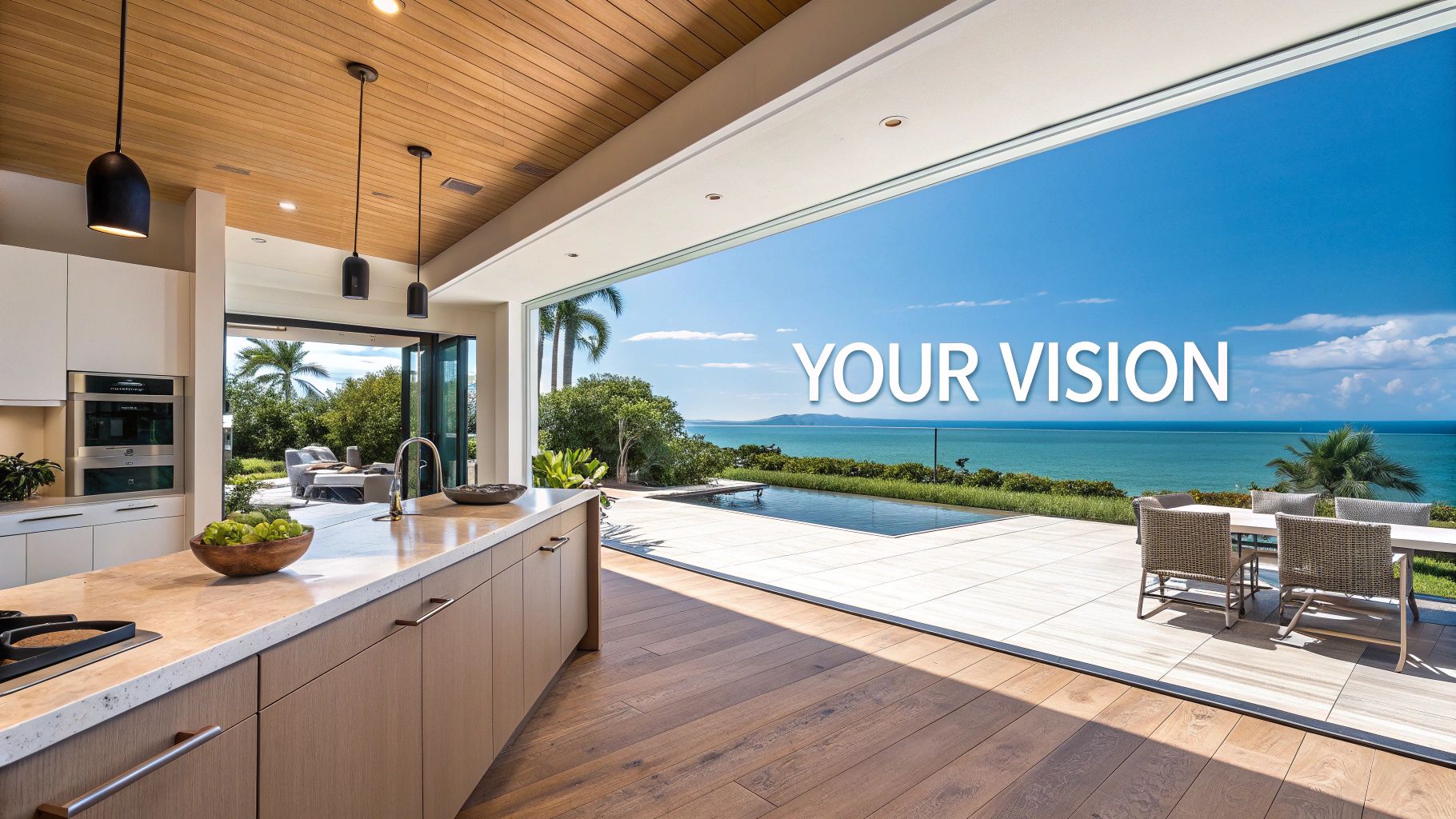
First, let's think about how you actually live. What are your daily routines, and what’s missing from your current home? Maybe you're picturing a sun-drenched gourmet kitchen that opens completely onto the lanai, perfect for seamless indoor-outdoor entertaining. Or perhaps you're dreaming of a quiet, peaceful primary suite that feels like your own private five-star retreat.
For example, a family in Port Royal recently came to us wanting to expand their outdoor living. They didn't just want a bigger patio; they envisioned a complete lifestyle change. Their dream included a full summer kitchen for weekend barbecues, a shaded lounge area with a fireplace for cooler evenings, and effortless, safe access to the pool for their grandkids. Your unique vision becomes the anchor for every single decision, from the first architectural sketch to the final light fixture.
A well-defined vision acts as your project's North Star. It keeps the design focused on solving real lifestyle challenges, preventing scope creep and ensuring the final addition is a true reflection of your goals, not just a collection of popular trends.
Gathering Inspiration with Purpose
Once you have a general direction, it's time for the fun part: gathering inspiration that speaks to your personal taste. Of course, sites like Pinterest and Houzz are fantastic for this, but don't forget to look closer to home. Take a drive through neighborhoods you love—like Aqualane Shores or Park Shore—and notice the architectural details that catch your eye. What types of rooflines or window configurations feel right for you?
To see how a vision becomes a reality, spend some time exploring a builder's portfolio. For example, looking through a gallery of luxury home additions can give you very specific ideas on everything from materials to layouts that work beautifully right here in the Naples environment. This kind of visual research helps you communicate exactly what you want to your design and build team.
Create a digital mood board or even a physical binder to keep your ideas organized. Try to capture the feeling you want the space to have, not just a list of items.
Creating a Practical Wishlist
With your inspiration in hand, the next step is to get practical and create a wishlist. This is where you draw a line in the sand between your absolute necessities and the features that would be "nice to have." Trust me, this simple exercise is critical for the budget conversations that come later.
To get started, here's a quick checklist to help you organize your initial thoughts and start building that practical wishlist.
Initial Addition Planning Checklist
Planning Area | Key Questions to Ask Yourself | Example From a Naples Homeowner |
|---|---|---|
Primary Function | What is the main purpose of this space? What problem is it solving? | "We need a true family room that connects to the pool area for entertaining." |
Key Activities | What will you do in this new space on a daily or weekly basis? | "We'll be cooking, hosting dinner parties, and the kids will do homework at the island." |
Flow & Connection | How should the new addition connect with the rest of your home? | "It must have a seamless, wide opening to the lanai and easy access from the main living room." |
Look & Feel | What's the overall aesthetic? Modern, coastal, transitional? | "We want a light, airy, coastal modern feel with natural wood tones and clean lines." |
Must-Have Features | What are the 3-5 non-negotiable items for this addition? | "A 12-foot island, a professional gas range, and impact-rated sliding glass doors." |
Future Needs | Will this space need to adapt as your family's needs change over the next 5-10 years? | "The space should be flexible enough to become a media room when the kids are older." |
This organized approach ensures your core needs are met first and gives your builder a clear hierarchy of priorities. It allows them to provide smart suggestions that protect your must-haves while finding cost-effective ways to incorporate your nice-to-haves. Ultimately, this foundational planning is what sets the stage for a successful project that perfectly captures your dream.
Getting Real About Your Naples Addition Budget
Let's talk numbers, because a realistic budget is the bedrock of a smooth and successful home addition. In a high-end market like Naples, it’s all too easy to get hung up on simple price-per-square-foot numbers, but the true cost is much more nuanced. A well-crafted budget anticipates everything, from the foundation pour to the final permit sign-off.
To get an accurate financial picture, we need to move beyond just the construction itself. I always advise clients to think about their total investment in two distinct buckets: hard costs and soft costs. Understanding the difference is the first step toward a surprise-free project.
Hard Costs vs. Soft Costs: What's the Difference?
When people think about building costs, they're usually thinking about hard costs. These are the tangible, physical expenses of your addition—everything you can see and touch.
Materials: This is the big one. It covers everything from concrete and lumber to hurricane-impact windows, marble countertops, and designer light fixtures.
Labor: This is what you pay the skilled craftspeople who physically build your addition—the framers, electricians, plumbers, and painters who bring the vision to life.
Equipment: Think scaffolding, lifts, and other machinery needed on-site to get the job done safely and efficiently.
Now for the other side of the coin: soft costs. These are the essential, behind-the-scenes services that make the project possible. They might be less visible, but they are absolutely critical.
Design & Engineering Fees: This covers the architects and engineers who draw up the blueprints and ensure your addition is structurally sound.
Permits & Inspections: These are the fees you'll pay to the City of Naples or Collier County to legally approve your plans and inspect the work as it progresses.
Surveys & Site Reports: Before a single shovel hits the ground, you'll need professional assessments of your property.
Grasping this distinction from the start helps you have much clearer conversations with your builder and avoids any confusion about where your money is going.
I see it all the time: homeowners focus exclusively on the "sticks and bricks." In reality, soft costs can easily add up to 10-20% of the total project budget. Factoring them in from day one is non-negotiable.
The Power of a Healthy Contingency Fund
Here’s a piece of advice I give every single client: a contingency fund of 10-15% of your construction cost isn’t just a good idea, it’s a necessity. No matter how perfectly you plan, construction is full of surprises.
Think of it as your project’s financial safety net. For instance, you might open up a wall and discover old wiring that isn't up to code and needs to be replaced. That's an unforeseen expense the contingency fund is designed to cover. It also gives you freedom. That fund is what allows you to say "yes" to upgrading to that stunning appliance package you fell in love with halfway through the project without derailing your entire budget.
A Real-World Budget Example in Naples
Let's ground this in reality. Imagine you're planning a 1,000 sq. ft. primary suite addition in Old Naples. The final price tag can swing wildly depending on your choices.
A beautiful, but more straightforward addition using high-quality, standard materials might fall into one price category. But if that same project involves complex engineering—like adding a second story that requires reinforcing the home's original foundation—the cost will jump significantly.
Your taste in finishes plays a huge role, too. Choosing imported Italian marble, custom automated window treatments, and a spa-grade steam shower will have a very different impact on the budget than more conventional, yet still luxurious, materials. This is exactly why constant, open communication with your builder about material allowances is so critical.
Financial planning is more important than ever right now. With the global construction market projected to hit $15.7 trillion in 2025 and North American cost inflation hovering around 3.8%, smart planning is key. Naples homeowners need to be strategic to keep a project on budget without sacrificing an ounce of quality.
One of the best tools for this is a process called value engineering, which is all about finding creative, cost-effective solutions that don't compromise the design. You can see more about current market trends on Skanska.com, or you can dive deeper into this strategic approach in our guide on what value engineering in construction is.
Building Your Project Dream Team
Think of your home addition as a team sport. You’re the captain, but you can't win the game alone. The success of your entire project hinges on the professionals you bring onto the field with you. Choosing the right partners isn't just about finding people with the right qualifications; it's about building a cohesive team that gets your vision and understands the unique challenges of building in Naples.
This team will be your guide, your expert resource, and your advocate from the first sketch to the final walkthrough. Getting this step right is arguably the most important decision you'll make.
The Key Players on Your Roster
Your project team is really a trio of specialists, each playing a distinct and vital role. When they work in harmony, the result is a seamless process and a stunning home. The core members you'll need are the architect, the interior designer, and the general contractor.
The Architect: This is your visionary translator. They take your dreams, lifestyle needs, and scattered ideas and transform them into a buildable set of blueprints that are structurally sound and fully compliant with all Naples-area codes.
The Interior Designer: While the architect shapes the structure, the interior designer crafts the soul of your new space. They handle everything from space planning and material selections to lighting and cabinetry, ensuring the addition feels cohesive, functional, and genuinely beautiful.
The General Contractor: This is your on-the-ground commander. The contractor, like us here at JVM, manages the entire construction phase. They hire and schedule all the subcontractors, oversee quality control, manage the budget, and ensure the project is built exactly to plan.
Finding the Right Partners in Naples
In a high-demand market like Naples, finding proven, reliable professionals requires more than a quick Google search. You have to look beyond the flashy websites to find genuine expertise and a personality that clicks with yours.
Start by digging into portfolios. Pay close attention to projects that have a similar scope and style to what you’re envisioning. Look for builders and designers who have a deep well of experience with luxury home additions in neighborhoods like The Moorings or Port Royal.
Next, it's time to verify credentials. Make sure your general contractor is licensed and insured in Florida—no exceptions. Don't be shy about asking for references from past clients, and absolutely call them. A confident, transparent professional will gladly connect you with homeowners who can speak to their experience. This is your chance to get the real story on communication, timeliness, and budget management.
When you're interviewing potential team members, focus on chemistry just as much as credentials. You're going to be working closely with these people for months. A team that communicates clearly, truly listens to your concerns, and operates with transparency is essential for a positive experience.
The Design-Build Advantage and Why Local Expertise Matters
Many of our clients in Naples have found success with a design-build approach. This is where the architect, designer, and contractor all work together under one roof from day one. This integrated method fosters much better communication, streamlines decision-making, and often leads to more efficient timelines and tighter cost controls.
A builder with deep local roots also gives you a massive advantage. Right now, the construction industry is facing significant labor shortages. Willis Towers Watson reports that North America could need an additional 500,000 skilled workers to meet current demand. A Naples-based contractor with long-standing relationships can secure the best subcontractors, which helps prevent your project from falling behind schedule because a specialized trade is overbooked. You can read more about these construction trends from Willis Towers Watson.
Ultimately, asking the right questions during the interview process is your best tool for building a team you can trust. To get you started, we’ve put together a list of crucial topics to cover. Check out our guide on what to ask a general contractor and walk into your meetings feeling confident.
Getting Through Naples Permitting and Design Rules
Building an addition in a beautiful coastal city like Naples is about more than just a great floor plan. You’ve got to navigate the local rules, and honestly, this is where a lot of projects can get bogged down. Think of the permitting process not as red tape, but as a system designed to protect your investment and our unique environment.
These rules exist for very good reasons. They cover everything from hurricane resistance to flood protection, and every single one is a safeguard. An experienced local builder doesn't just see these as boxes to check—we see them as the blueprint for building something that will last, saving you from headaches and expensive fixes later on.
Florida Hurricane Codes and Coastal Building
Living in paradise means you have to respect the weather. Florida's building codes are famously strict, especially when it comes to wind resistance. For any building and addition project here, that means using specific materials and construction methods that can stand up to hurricane-force winds.
This isn’t just about installing impact windows. It’s a comprehensive approach that affects everything from the shingles on your roof to the steel connectors holding your new addition to your original home.
Impact-Rated Openings: All of your windows, doors, and even skylights have to pass tough tests to prove they can handle flying debris and intense wind pressure.
Structural Connections: Your builder will use a system of specialized straps, clips, and anchors to make sure your roof, walls, and foundation are locked together as one solid structure during a major storm.
Roofing Materials: The way your roof is installed and the materials used are heavily regulated to prevent the wind from peeling it back and letting water pour in.
Zoning Laws and Community Guidelines
Before you even get to the hurricane stuff, you have to figure out what you’re allowed to build. Local zoning laws are the first hurdle. They control things like property setbacks (how close you can build to your property line), lot coverage (the percentage of your land you can cover with a structure), and even how tall your addition can be.
And it doesn't stop there. If you're in a planned community with a Homeowners Association (HOA), you'll have another set of rules to deal with. These often get very specific, dictating everything from exterior paint colors and roofing styles to landscaping choices, all to keep the neighborhood looking uniform.
I’ve seen it happen too many times: a homeowner falls in love with a design, only to find out it violates a local ordinance or HOA rule. Always check these restrictions first. A good builder can usually spot potential red flags right away, saving you from a major redesign.
A Real-World Scenario Near the Water
Let's say you want to add a gorgeous guest suite with a lanai looking out over a Naples waterway. A dream project, right? But that prime location immediately triggers two major regulations: the Coastal Construction Control Line (CCCL) and FEMA Flood Zones.
The CCCL is a line drawn by the state to protect our dunes and beaches. If you're building on the seaward side of that line, you're looking at special engineering and permitting to ensure the project doesn't harm the coastal ecosystem.
On top of that, your property will have a FEMA flood zone designation. This determines the required elevation of your addition's floor to keep it safe from storm surge. Often, this means building on a raised foundation, which needs to be part of the plan—and the budget—from day one. A builder who specializes in coastal construction will know exactly how to work these requirements into your design so your addition is not only beautiful but also resilient and fully compliant.
Feeling ready to discuss how these rules apply to your property? Let’s connect and review your vision. Contact JVM Construction today for a clear, straightforward consultation.
Bringing Your Home Addition to Life
This is where the magic happens. After all the planning, designing, and dreaming, your home addition finally breaks ground and starts taking shape. It’s an incredibly exciting time, and knowing the key steps in the process helps you appreciate the progress being made right in your backyard.
First things first, your property will be prepped for construction. This involves setting up the site for safety, organizing access for material deliveries, and getting everything ready for the crew. Before you know it, you'll see the forms go in for the foundation, followed by the concrete pour. This is literally the base for your entire vision.
Major Construction Milestones
Once that foundation is solid, the pace really picks up. You'll see the skeleton of your new space go up as the framing is built. This is a huge moment—it’s the first time you can actually walk through the rooms and get a true feel for the scale and flow of the addition.
From there, the build-out follows a pretty logical order:
Getting Dried In: The next big step is making the structure weathertight. This means installing the roof, sheathing, and, crucially for Naples, the hurricane-impact windows and doors. Once it's "dried in," the interior work can begin without worrying about the elements.
The "Rough-Ins": Before any walls are closed up, teams of electricians, plumbers, and HVAC technicians will run all the hidden systems. This is the complex, behind-the-scenes work that makes your home comfortable and functional.
Insulation and Drywall: With all the guts of the walls inspected and approved, insulation goes in to keep your home energy-efficient. Then comes the drywall, and suddenly, you have actual rooms.
The Finishing Line: This is the most rewarding part. You’ll see cabinets go in, tile being laid, walls getting their final coat of paint, and light fixtures hung. All those design choices you made months ago finally come to life.
Navigating Life During Construction
One of the most common questions we hear is, "Can we live in our home during the renovation?" The short answer is: it depends. If you're adding a distinct new wing or a second story with its own access, staying put is often very doable. A good contractor will seal off the work area with dust barriers to keep the disruption to a minimum.
However, if your project involves gutting your only kitchen or all your bathrooms, moving out for a bit is usually the best call for your sanity. Talk this through with your builder early on. They can help you figure out the most practical approach and build it right into the project schedule.
A great project manager doesn't just manage the build; they manage your peace of mind. Regular check-ins and site meetings are your best friend. They keep you in the loop, let you ask questions, and build confidence that everything is moving along as it should.
Pre- and Post-Construction Checklists
A couple of simple checklists can make a world of difference in keeping things organized. Taking a moment to tick the boxes before and after the work ensures nothing important gets lost in the shuffle.
The permitting process is a huge piece of the pre-construction puzzle. This diagram shows the typical path a project takes to get permitted in Naples, moving from zoning and codes to the final review.
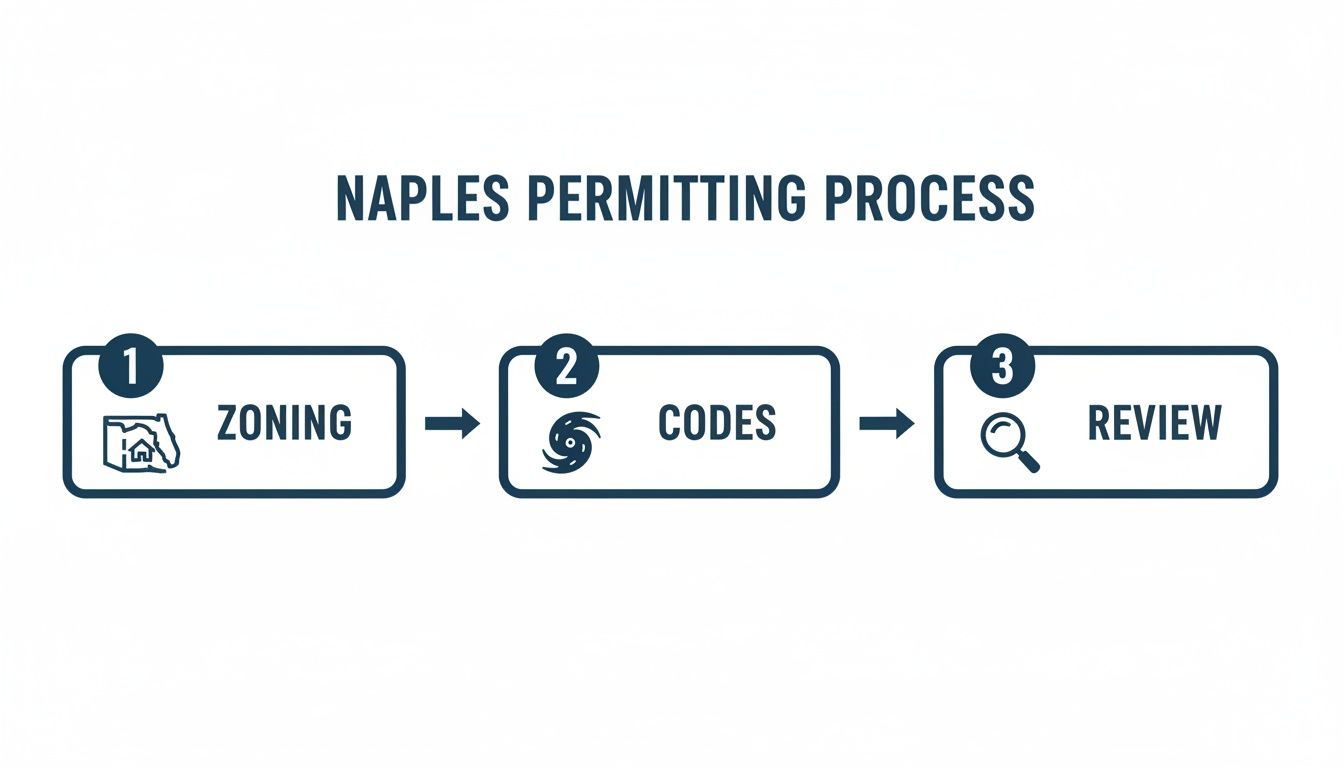
Seeing it laid out like this makes it clear why having a builder who knows the local system is so vital to avoiding frustrating delays.
Pre-Construction Final Check
Finalize Selections: Are all your major finishes—flooring, tile, countertops, fixtures—locked in and ordered?
Understand the Schedule: Do you have a clear picture of the project timeline and the dates for key milestones?
Set Up Communication: Have you and your project manager agreed on a regular time for updates and site meetings?
Prep the Area: Have you moved your personal belongings out of the construction zone and confirmed logistics like parking and storage?
Post-Construction Sign-Off
The Final Walkthrough: Walk the new space with your builder to create a "punch list" of any small fixes or adjustments.
System Tutorial: Make sure you get a hands-on tutorial for any new HVAC units, smart home tech, or appliances.
Warranty Packet: Gather all the manuals and warranty information for everything that was installed.
Closing Out: Settle the final payment and be sure to receive lien waivers from your contractor and any major subcontractors.
While brand-new builds get a lot of attention, large-scale home additions are a significant part of the construction industry's future. The AIA's construction forecast predicts a 6.1% growth in spending for institutional building projects in 2025—many of which are complex additions. This mirrors what we're seeing right here in Naples, as more homeowners choose to perfect their current homes rather than move.
Common Questions About Naples Home Additions
Embarking on a major home addition brings up a ton of questions. That’s not just normal; it’s a good sign you're taking the process seriously. To give you some clarity right from the start, we've put together answers to the questions we hear most often from Naples homeowners.
How Long Does a High-End Home Addition Take in Naples?
This is the big one, and the honest answer is: it depends on the size and complexity of your vision.
For any significant building and addition project, the design and permitting phase is a huge part of the timeline. You can realistically expect this to take anywhere from three to six months. This isn't just paperwork; it’s the critical stage where every detail gets hammered out and gets the green light from the city.
Once the crew is on-site and construction begins, a major addition—like a brand new primary suite or a sprawling kitchen and family room expansion—will typically take 8 to 14 months to build. Things like custom-ordered materials from Europe, intricate millwork, and even our notorious summer rainy season can play a role in the schedule. A good general contractor will give you a detailed project schedule upfront and keep you in the loop every single week.
What Kind of Return on Investment Can I Expect?
While you're building an addition to enjoy your home more, it's always wise to think about the financial side. The good news is that in a hot market like Naples, a thoughtfully designed and well-built addition almost always adds serious value to your property. It's an investment in your lifestyle now and in your home's marketability later.
From what we've seen over the years, some projects consistently deliver the best bang for your buck.
Kitchen Expansions: In a luxury home, the kitchen is everything. A gourmet kitchen that opens up to a family room is a massive draw.
Primary Suite Additions: Creating a true owner's retreat—think spa-like bathroom, huge walk-in closets, and a private sitting area—is exactly what buyers are looking for in Naples.
Indoor-Outdoor Living Spaces: This is quintessential Florida living. Any addition that beautifully blurs the line between the inside and your lanai or pool area is a guaranteed winner.
The secret to a great ROI isn't just about adding square footage; it's about making sure the new space feels like it was always part of the original home. That seamless integration is what truly pays off.
Is It Possible to Live at Home During Construction?
This is a very practical concern, and the answer really comes down to the scope of work and your family's tolerance for disruption. It’s a conversation you need to have with your builder right at the beginning.
In many cases, you can absolutely stay put. If you’re adding a new wing or a second story that can be accessed from the outside, it’s often very doable. Your builder will set up dust barriers and create separate zones to keep the construction chaos contained and your family safe.
On the other hand, if the project involves gutting your only kitchen or all of your bathrooms at once, finding a short-term rental is almost always the better choice. Living without a functioning kitchen for months on end gets old fast, and moving out can sometimes even help the crew work more efficiently and speed up the project.
A major building and addition project is a partnership between you and your builder. Figuring out the living situation early on makes the entire process smoother and less stressful, letting you focus on the exciting transformation ahead.
Ready to get answers to your specific project questions? The team at JVM Construction LLC is here to provide the clarity and expertise you need to move forward with confidence. Contact us today to schedule your personal consultation.