Picture this: your stunning new custom home, right here in Naples. Every elegant detail you’ve dreamed of is matched by an unseen, fortress-like strength. This isn't just wishful thinking—it's what hurricane resistant home plans deliver, giving you genuine peace of mind as you build your life in Southwest Florida. Crafting a home designed to stand strong against the most powerful storms means creating a personal sanctuary that truly protects your family and your investment.
Building a Sanctuary That Weathers Any Storm
Here in coastal Florida, designing a home goes far beyond simple curb appeal. It’s a masterclass in engineering a structure to withstand the incredible forces of nature. A hurricane isn't just a heavy rainstorm; it's a brutal assault of destructive winds and dangerous storm surges that can tear apart a standard home in moments. A truly resilient home plan creates a unified system where every single piece—from the foundation right up to the peak of the roof—works together in perfect harmony to defy those forces.
Think of this guide as your partner in that journey. We'll walk you through the essential strategies that make a home plan genuinely storm-proof. You’ll get a clear picture of the engineering that creates a fortress, the advanced materials that can take a beating from 150-mph winds, and why Florida's strict building codes should be seen as the starting line, not the finish line, for true safety and comfort.
Core Elements of a Hurricane-Resistant Home
So, what are the key ingredients for a home that won't back down from a storm? It's not just one feature, but a series of interconnected systems designed to handle specific threats. This table breaks down the essentials that work together to create a home built for the realities of our beautiful Southwest Florida coast.
Component | What It Does | A Practical Example |
|---|---|---|
Continuous Load Path | Anchors the roof to the foundation, creating a single unit to fight wind uplift. | Steel hurricane straps physically connecting roof trusses to the wall tops. |
Impact-Rated Openings | Prevents wind and flying debris from breaching the home through windows and doors. | Laminated glass windows that crack but don't shatter upon impact. |
Fortified Roofing | Resists high winds and keeps torrential rain from getting into your attic and home. | A standing seam metal roof installed over a sealed roof deck. |
Flood-Resistant Foundation | Lifts your entire living space above dangerous storm surge and floodwaters. | An elevated home built on deep-driven concrete piles. |
These components form the backbone of a home designed not just to survive, but to thrive.
While our focus is squarely on building in Southwest Florida, it can be insightful to see how other coastal areas tackle similar challenges. For instance, this detailed guide to protecting your South Carolina home offers strategies tailored to that region, highlighting the universal principles of storm-resilient design.
Ultimately, the goal is to transform these plans from a blueprint into a legacy home for your family. The right builder makes all the difference. You can learn more about how a dedicated team manages this complex process by exploring our custom home building services. It’s where you'll see how a design masterpiece can also be an unbreachable bastion of safety.
The Unsung Hero: A Continuous Load Path
When you're building to withstand a hurricane, the real strength isn't in any one flashy feature. It's in how everything works together as a single, unified system. We call this the continuous load path—and it's the secret to a truly resilient home.
Imagine it as your home’s skeleton. It's an unbroken chain of steel connections engineered to channel the incredible force of hurricane winds from your roof, down through the walls, and safely into the ground. A single weak link can compromise the entire house, but a properly built load path creates a fortress that can stand up to Mother Nature's worst.
The Anatomy of a Fortified Connection
So, what does this actually look like on a construction site? It all comes down to the hardware. You can have the strongest walls and a perfectly pitched roof, but if they aren't tied together properly, it doesn't mean much. This is where small, heavy-duty steel connectors become the unsung heroes of your home's structure.
We're talking about specific, engineered pieces that lock the structure together:
Hurricane Straps: These metal ties are what physically connect your roof trusses to the walls.
Tension Ties and Hold-Downs: These anchor the walls to the floor system and, ultimately, to the foundation itself.
Anchor Bolts: Embedded directly into the concrete foundation, these are the final, crucial link securing the entire structure to the ground.
Every single connection is carefully calculated by an engineer to leave no weak points. When a storm hits, wind creates massive uplift on the roof and pushes against the walls. Without this continuous chain, the roof can be peeled right off, leading to a total structural collapse.
This diagram shows how these different systems—foundation, walls, and roof—are tied together to create a single, resilient unit.
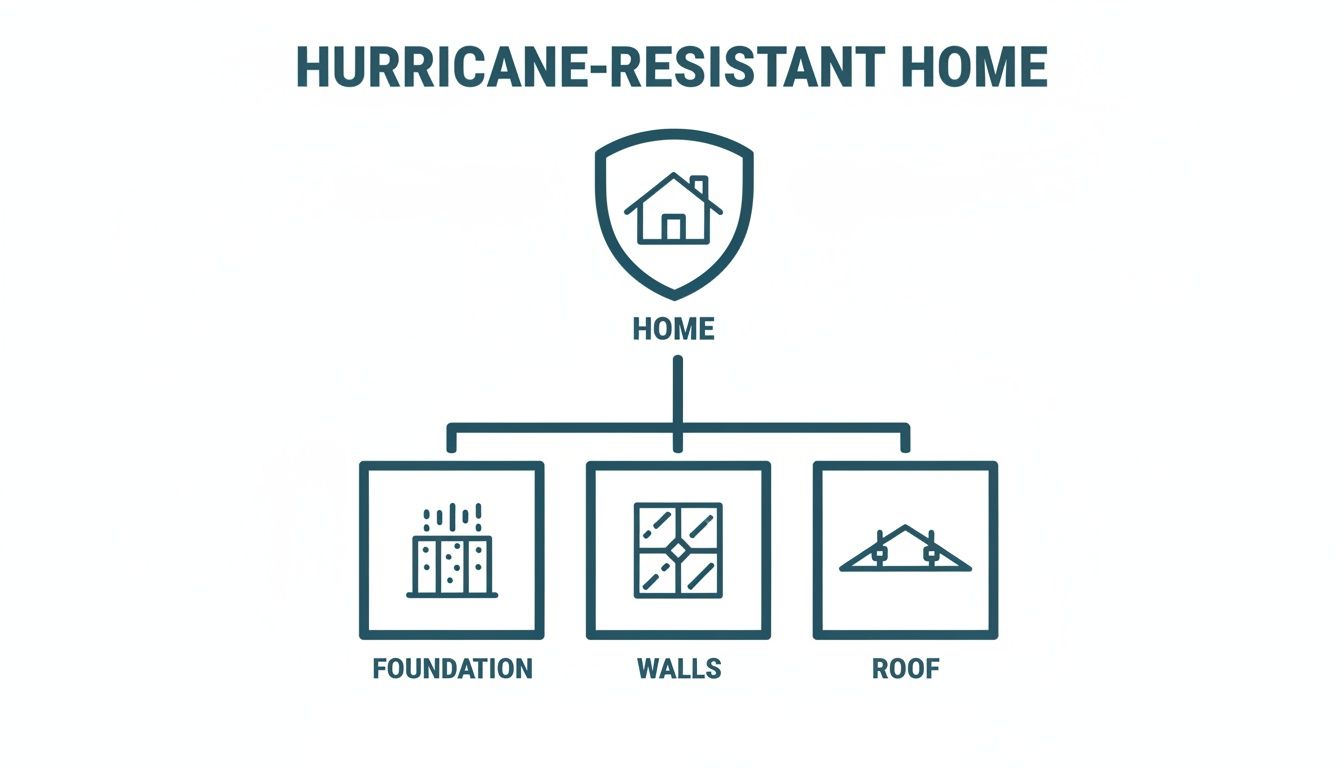
As you can see, a home’s strength really is a top-down system. Each layer depends on the one below it for stability.
Real-World Proof of a Superior System
This isn't just a theory—we see the proof every time a major storm makes landfall. After Hurricane Sally hit the Gulf Coast in 2020, an analysis of the damage was eye-opening. Homes built to the Insurance Institute for Business & Home Safety (IBHS) FORTIFIED standards performed incredibly well.
A study found these tougher homes had 55% to 73% fewer insurance claims than conventionally built homes right next door. You can read the full breakdown in the official performance report. It's a powerful testament to getting the continuous load path right.
A continuous load path transforms a house from a collection of parts into a single, unified fortress. It’s the difference between a home that fights the storm and one that succumbs to it.
This philosophy is at the core of how we at JVM Construction approach every custom home. Our team understands that the integrity of the entire house hinges on the precision of each connection. From pouring the foundation to setting the final roof truss, we ensure every link in that chain is perfect. It’s that level of detail that gives your family the ultimate defense.
Designing Your Foundation for Flood Safety
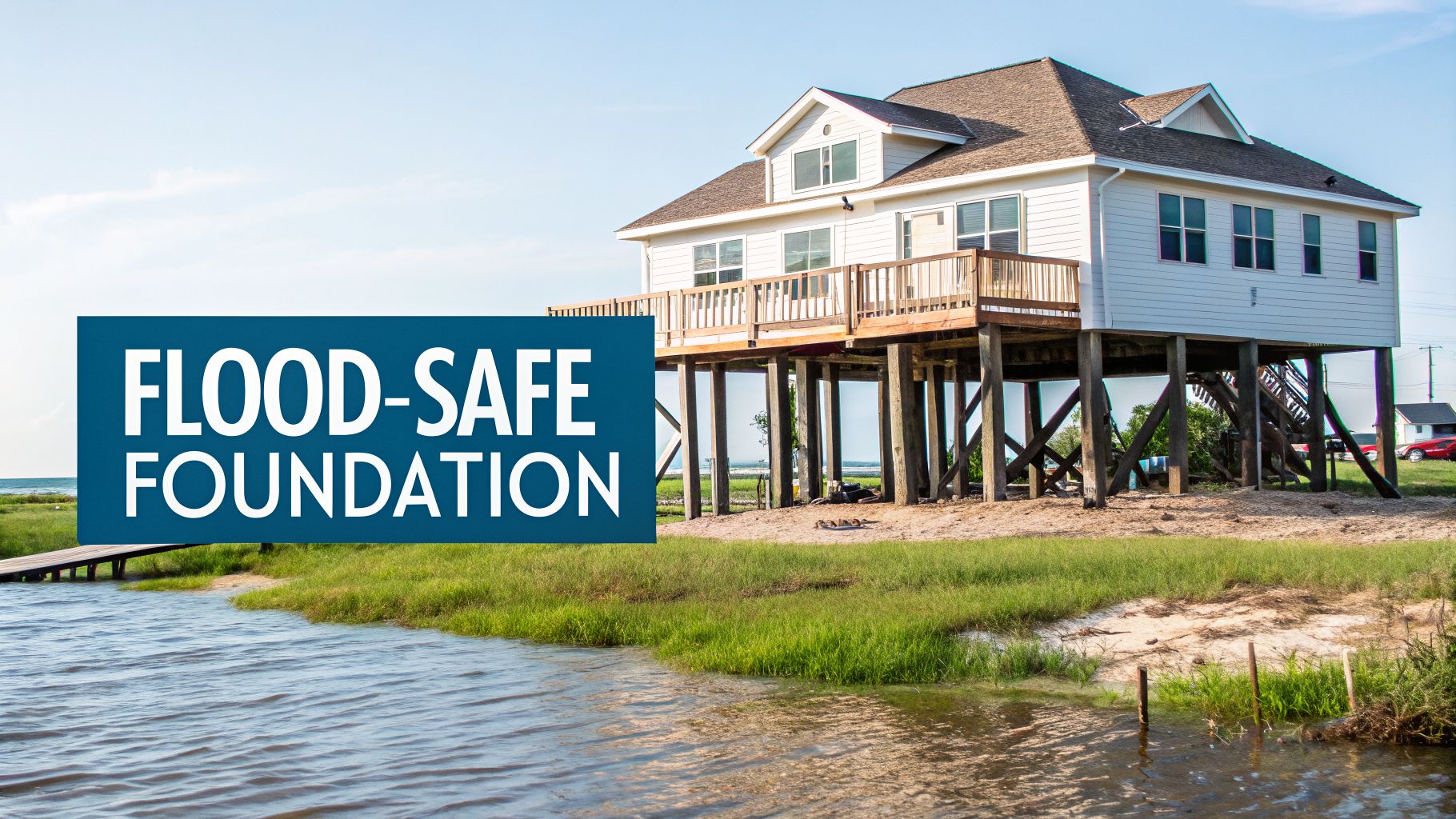
In coastal communities like Naples and Marco Island, a hurricane's high winds get all the attention, but they're only half the story. The real destructive force is often the storm surge—a powerful wall of water that can sweep inland and tear a home from its foundation.
Your foundation isn't just a slab of concrete; it's the anchor for your entire home. A well-designed foundation is all about smart elevation. It lifts your living space and everything you value above the reach of those anticipated floodwaters, which is the very first step toward building a truly resilient home.
It All Starts with Your Base Flood Elevation
Before we even think about moving dirt, the most important number we need to know is your property's Base Flood Elevation (BFE). This is the official height FEMA predicts floodwaters could reach during a major storm, and you can find it on their flood maps.
Think of the BFE as your absolute minimum starting point. Local building codes require your home’s lowest finished floor to be at or above this line. But in our experience, just meeting the minimum isn't enough. We always advise our clients to build with "freeboard"—that is, adding extra height above the BFE. For example, if your BFE is 9 feet, we might recommend setting your finished floor at 11 or 12 feet. This accounts for wave action, future sea-level rise, and frankly, gives you priceless peace of mind.
Choosing the Right Foundation for Your Florida Home
Here’s a look at common foundation types for coastal builds, helping you understand which might be right for your specific property and flood risk.
Foundation Type | Ideal For | Key Benefit | Important Consideration |
|---|---|---|---|
Elevated Slab-on-Grade | Lots with a moderate flood risk needing a few feet of elevation. | Cost-effective and provides a solid, single-piece base. | Elevation height is limited; requires lots of engineered fill. |
Stem Wall Foundation | Sloped lots or sites where more significant elevation is needed. | Creates a crawl space for utilities and allows for higher finished floors. | Needs proper flood vents and moisture control in the crawl space. |
Pile Foundation | High-risk flood zones (V-Zones) and sites with poor soil. | Offers maximum elevation by transferring the home's weight to stable ground. | Higher initial investment but offers the highest level of flood protection. |
The right choice really comes down to your specific lot. For a waterfront property in a high-risk area like Port Royal, a deep pile foundation is the only way to go. We drive concrete or steel piles deep into the ground until they hit stable bedrock, lifting the home high above the BFE so storm surge can flow harmlessly underneath.
On the other hand, a lot further inland in a community like The Moorings might be perfectly safe with an elevated slab. Understanding these nuances is key, and you can dive deeper into these choices in our guide to waterfront home plans.
Why Flood Vents Are So Critical
If your design includes any enclosed foundation walls below the BFE—like you’d find with a stem wall—you create a new danger: hydrostatic pressure. As floodwaters rise, the force of that water pushing against your foundation can be immense, easily powerful enough to make walls buckle or collapse.
That’s where flood vents come in. These are engineered openings installed in the foundation walls that let water flow freely in and out. By equalizing the pressure on both sides of the wall, they neutralize the destructive force that could otherwise compromise your home’s entire support system.
Flood vents are a non-negotiable safety feature. They act as a pressure relief valve, letting the water pass through your foundation instead of fighting a losing battle against it.
Ultimately, a flood-safe foundation is the cornerstone of any legitimate hurricane-resistant home plan. It’s a complex process that demands a deep understanding of the local environment, from FEMA maps to the unique soil on your lot. By working with a builder who prioritizes this foundational strength, you ensure your home is built on a base that can truly weather the storm.
Selecting Materials That Defy Wind and Water
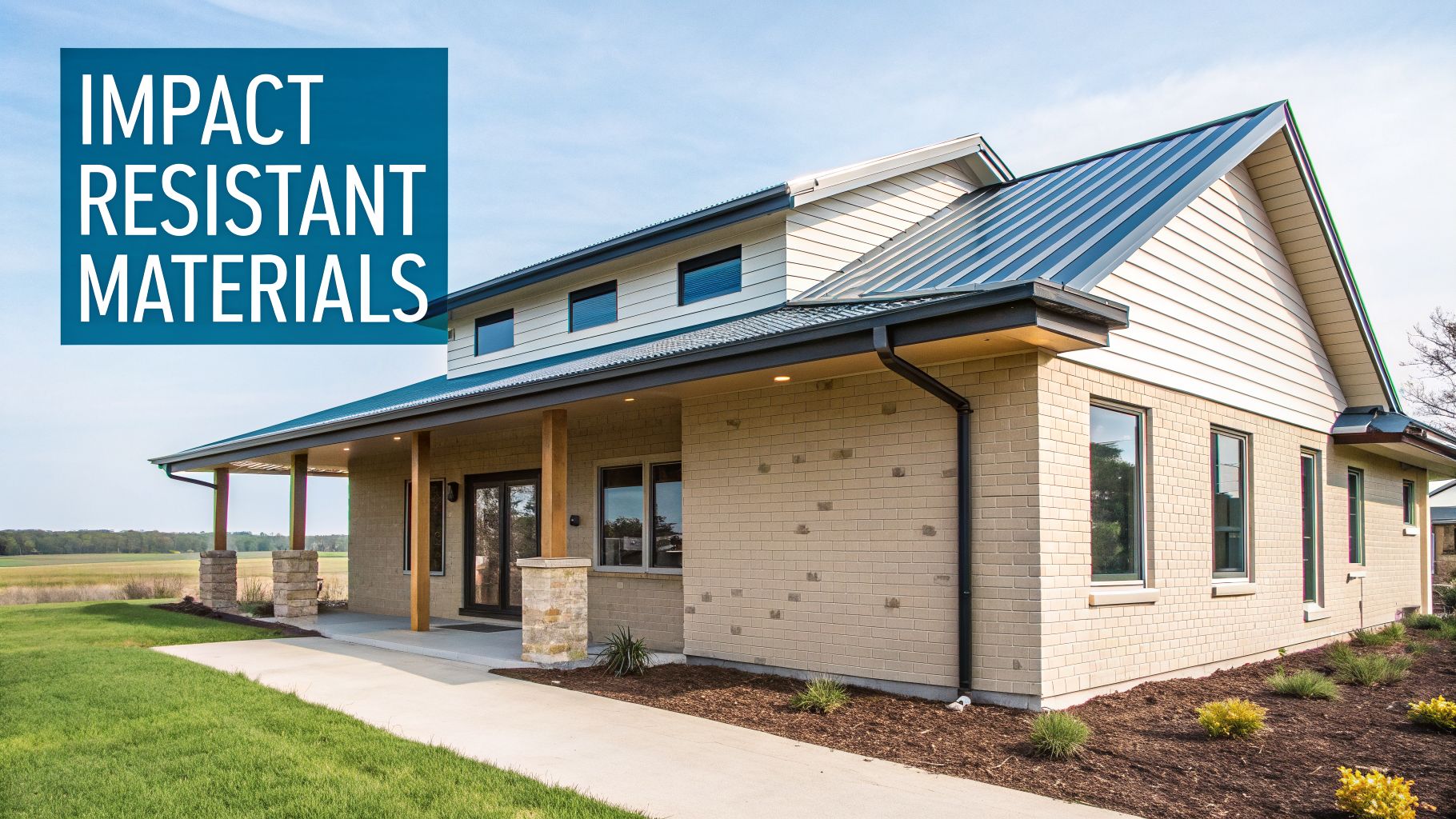
The materials on the outside of your home are its first and last line of defense. When a hurricane is bearing down, that "armor" is what stands between your family and the brutal combination of high-velocity winds and driving rain. Choosing the right materials for home plans hurricane resistant isn't just about curb appeal; it's about building a shield that can genuinely take a punch.
For a home in Southwest Florida, you have to think in terms of brute strength and long-term durability. That means picking materials that won't just survive a storm but will come out the other side with minimal battle scars, ready to protect your home for years to come.
Building Walls of Concrete and Steel
The heart of a truly resilient home begins with its walls. While a traditional wood-framed house can be built to code, it simply can't compete with the raw, inherent strength of concrete and steel when the winds really start howling. It’s why we almost exclusively recommend two superior wall systems for the custom homes we build in the Naples area.
Steel-Reinforced Concrete Block: This is the classic, time-tested method for coastal construction, and for good reason. We're talking about Concrete Masonry Units (CMUs) filled solid with concrete and reinforced with steel rebar. This creates a monolithic wall that offers incredible resistance to both extreme wind pressure and impacts from flying debris.
Insulated Concrete Forms (ICFs): A more modern approach, ICFs are essentially hollow foam blocks that are stacked like Legos and then filled with steel-reinforced concrete. The result is a high-performance wall system that is not only immensely strong but also provides fantastic insulation, which helps keep your energy bills down all year long.
Either choice gives you a formidable barrier that is far less likely to fail under stress than a standard wood-frame wall.
The Critical Role of Roofing Materials
Your roof is ground zero during a hurricane. If it fails, you're looking at catastrophic water damage throughout your entire home. That's why picking the right roofing material—and just as importantly, ensuring it's installed meticulously—is non-negotiable.
For real peace of mind, we guide our clients toward much more robust solutions. A standing-seam metal roof is an outstanding choice. Its interlocking panels and concealed fasteners create a sleek, tough surface that is highly resistant to wind uplift. Another fantastic option is concrete tile, which is not only beautiful but also incredibly heavy and durable, making it resistant to both wind and impacts.
A sealed roof deck is a must-have for any hurricane-resistant home. This is a secondary water barrier applied directly to the decking before the metal or tile goes on. It's your backup plan—if you do lose some roofing material, this layer ensures water doesn't pour into your attic and home.
This one simple step can be the difference between a few minor repairs and a complete interior gutting after a storm passes.
It's interesting to note that while Florida's residential building codes are top-tier, scoring 95 out of 100 on a national report, the adoption of superior materials isn't universal. Only about 8% of single-family homes built nationwide in 2017 used concrete frames, a key feature for resilience. This really underscores the importance of working with builders who go beyond the bare minimum to incorporate stronger materials and FORTIFIED building practices.
Securing Your Home’s Weakest Points
No matter how strong your walls and roof are, your home is only as secure as its most vulnerable spots: the windows and doors. All it takes is one broken window for hurricane-force winds to rush inside, creating massive internal pressure that can literally blow the roof off from within.
This is exactly why impact-rated openings are an absolute must. These aren't your average windows and doors. They are highly engineered systems designed and tested to withstand both punishing winds and direct hits from flying debris.
Impact Glass: Most impact windows use laminated glass, which works a lot like your car's windshield. It's made of two panes of glass bonded to a tough, clear inner layer. If a piece of debris hits it, the glass might crack, but it stays in one piece within the frame, keeping the wind and water out.
Reinforced Frames: The special glass is only half the battle. Impact-rated windows and doors have much stronger, heavier frames that are securely anchored into the home's structure to keep them from being blown out entirely.
The Garage Door: Think about it—your garage door is often the largest and weakest opening in your home. A flimsy, standard door is a recipe for disaster. An impact-rated and wind-rated garage door with reinforced tracks and heavy-duty bracing is essential to prevent a catastrophic failure.
By weaving these carefully chosen materials together—from solid concrete walls and a metal roof to impact-rated glass—we create a complete, integrated system. Every element works in concert to form a protective envelope, ensuring your beautiful custom home is also a safe and secure sanctuary when you need it most.
Protecting Your Home's Critical Systems
A hurricane-proof home is more than just a fortress of concrete and impact glass. Real resilience is about protecting the things that make your house livable—the mechanical, electrical, and plumbing (MEP) systems that are essentially your home's circulatory and nervous systems. When a storm finally passes, what you want most is to get your power, AC, and water back. That's the first real step back to normal.
This is where thoughtful planning really pays off. A smart design doesn’t just react; it anticipates what could go wrong and builds in protection from the very beginning. We have to look at every single system, from the air conditioner humming away outside to the electrical panel in the garage, and ask a simple question: "What happens to this when the wind and water show up?"
Elevating Your Essential Equipment
In a coastal storm, the most immediate danger to your home’s systems is flooding. Saltwater is brutally corrosive and will absolutely destroy sensitive mechanical and electrical gear. It doesn't take much—even a few inches of storm surge can fry expensive units, leaving you with huge replacement bills and a long wait for repairs right when everyone else needs them too.
The solution is actually pretty simple: get it up high.
We lift the main living area of a home above the Base Flood Elevation (BFE), and we need to do the exact same thing for its critical components.
HVAC Units: We never, ever place outdoor air conditioning condensers on a simple slab at ground level in a flood zone. Instead, we design sturdy, raised platforms made of concrete or corrosion-resistant metal to lift them well above where we expect the floodwaters to reach.
Water Heaters & Electrical Panels: These are often tucked away in ground-floor garages or utility closets. In our hurricane-resistant plans, we make a point to locate these systems on an elevated floor. If that’s not possible, we’ll build a raised concrete curb right inside the garage to keep them high and dry.
Taking this one step is one of the single most effective things you can do to slash potential damage and get your life back to normal faster after a storm.
Ensuring Uninterrupted Power
Losing power for days—or even weeks—is just a part of life here after a major hurricane hits. But it's more than just an annoyance. It means spoiled food, a dangerously hot house, and your entire routine thrown into chaos. That's why building in a backup power source is now a cornerstone of modern, resilient design.
A whole-home generator paired with an automatic transfer switch (ATS) is the undisputed champion here.
Think about it: instead of wrestling with a portable generator in the wind and rain, a whole-home system senses the outage and kicks on by itself in seconds. The transition is so seamless you might not even notice it. Your lights, refrigerator, and most importantly, your AC, keep running without you having to do a thing.
This isn't just a luxury; it’s a matter of security. A home with power is a much safer place to be, letting you stay informed and comfortable while the utility crews work to get the grid back online.
Fortifying Your Home's Exterior Systems
Beyond just lifting things up, other details are just as critical for protecting your home. All that outdoor equipment needs to be bolted down so it doesn't become a missile in 150+ mph winds. This means physically strapping HVAC units and pool equipment to their concrete pads.
We also have to be meticulous about sealing every single pipe or wire that goes through an exterior wall. If you leave a gap, wind-driven rain will find it. It's also critical to understand how to prepare your roof for hurricane season, because even a small leak can cascade down and ruin interior electrical and mechanical systems.
This is where working with a builder who thinks holistically really matters. It's about sweating all the small stuff to ensure your home isn't just strong, but also fully functional when it counts. Make sure you talk through these system protections with your builder—it’s a conversation that will pay for itself many times over.
Choosing the Right Builder for a Resilient Future
Turning those expertly designed home plans hurricane resistant into a home that can actually stand up to a storm takes more than just good blueprints. This is where the rubber meets the road, and it all comes down to the builder you choose. Honestly, this is probably the single most important decision you'll make in the entire process.
Your builder isn't just a project manager. They're your advocate, your quality control expert on the ground, and your guide through what can be a very complicated building journey. You need a partner who is just as obsessed with your family's safety as you are—someone who will ensure every connection is perfect and every material not only meets but exceeds the code.
Finding a True Partner for Your Journey
When you start interviewing builders, you need to go beyond the basics. You have to ask questions that get to the heart of their experience with true resilient construction. Don't be shy; dig into their process and see what they're really made of.
Here are a few questions I always recommend starting with:
What's your direct experience with FORTIFIED Home standards? Don't just take their word for it. Ask to see specific projects they've built to these rigorous, third-party-verified standards.
How do you feel about independent inspections? A builder who is confident in their work will welcome them. They see it as another set of expert eyes confirming the quality, not as a hassle.
Who are the engineers you work with? They should have a go-to list of local structural engineers who live and breathe coastal design and understand the specific wind and flood loads we face here in Southwest Florida.
A transparent, client-focused process is non-negotiable. You should feel involved and informed every step of the way, from wrestling with local permits to the final walkthrough. For a more exhaustive list of questions, our guide on what to ask a general contractor gives you a great checklist to take with you.
Investing in a builder with a proven track record in resilient construction isn't an expense; it's the ultimate insurance policy for your home and your peace of mind.
At the end of the day, you're not just looking for someone to build a house. You're looking for a craftsman who sees your home as a legacy—a beautiful, enduring structure built to protect your family for generations, no matter what the Gulf throws at it.
Got Questions About Hurricane-Resistant Homes?
If you're thinking about building a custom home here in Southwest Florida, you've probably got a lot on your mind. Let's tackle some of the most common questions we hear from clients about what it really takes to build a home that stands up to hurricanes.
So, How Much More Does a Hurricane-Resistant Home Actually Cost?
Great question. Building to a higher standard, like the IBHS FORTIFIED program, usually adds about 3-5% to the total construction cost. I know that might sound like a lot at first, but it’s crucial to see the bigger picture.
That initial investment often pays for itself, and then some. Homeowners can see some serious savings on their insurance premiums—we're talking 35% or more every year. The real win, though, is avoiding those astronomical repair bills after a storm blows through. The peace of mind that comes with that? Priceless.
Is It Possible to Make My Existing Home Stronger?
Absolutely. While building a new custom home from the ground up is the ideal way to get every detail right, you can still make massive improvements to an existing property. A strategic, high-end remodel can completely transform your home's resilience.
Some of the most impactful upgrades we see are:
Swapping out old windows and doors for impact-rated versions. This shores up the most vulnerable spots in your home.
Putting on a new FORTIFIED-standard roof. A sealed roof deck is your best defense against catastrophic water damage from above.
Bracing the garage door. It's the biggest hole in your house, and high winds love to target it.
A good builder can walk through your home, spot the weak points, and put together a plan to dramatically increase its ability to handle whatever Mother Nature throws at it.
Will Building a Fortress-Like Home Cramp My Style?
Not a chance. This is a myth we hear all the time. The truth is, modern resilient materials and building techniques can be worked into virtually any architectural style you love.
Whether you're dreaming of a sprawling Mediterranean estate or a sleek, contemporary coastal design, you don't have to sacrifice aesthetics for safety.
From impact glass that looks just like regular glass to reinforced concrete walls and stylish, durable roofing materials, the options are endless. A skilled custom builder knows how to work hand-in-glove with your architect to make sure the final product is both beautiful and bulletproof.
Your dream home should be your safe haven—a place that’s as beautiful as it is strong. Here at JVM Construction LLC, that’s exactly what we do. We build legacy homes in Naples and across Southwest Florida that are designed to be both stunning and steadfast.
Ready to build with true confidence? Reach out to our team today and let’s talk about your vision.