A lot of Naples buyers start in the same place. They know the lifestyle they want. Morning coffee on a shaded lanai. A pool that gets the right sun. A home office that doesn’t feel like an afterthought. Space for visiting family, grown children, or grandkids. Then the search begins, and suddenly every listing and builder conversation throws out different terms. Spec home. Inventory home. Custom home. Quick move-in.
That’s where confusion creeps in.
You might tour a polished new house and wonder if it’s close enough to what you want. You might look at a vacant lot and think a custom build sounds exciting, then worry it will take too long or become too complicated. Both reactions are reasonable. The right answer depends on how you live, how much control you want, and how important long-term performance is in a coastal market like Naples.
The timing matters too. In late 2024, the supply of completed new spec homes increased 49% year over year, reaching the highest inventory level since 2009, according to Wolf Street’s report on the spec home inventory surge. That gives buyers more ready-made options, but it also raises sharper questions about whether convenience today is worth compromise tomorrow.
A helpful way to start is by looking at how builders present homes and lifestyles online. If you want to see how different firms frame design, process, and finished work, browsing Constructo Marketing website designs can be useful. You’ll quickly notice which builders sell a product and which ones communicate a more collaborative building experience.
If location is still part of your decision, it also helps to compare where you want to live before you decide how you want to build. Our guide to the best Naples neighborhoods is a smart place to start.
Your Dream Home in Naples Finding the Right Path
A couple relocates from the Midwest. They’ve rented for a season in Naples, driven through Port Royal, Old Naples, and The Moorings, and they’re ready to stop browsing and make a move. One home is finished and available now. Another option is a lot with an architect’s concept. A third is a nearly completed house where the sales agent says they may still be able to choose a few finishes.
Those are not the same path.
One route gives you speed. Another gives you authorship. The third sits somewhere in the middle and often gets described in a way that sounds more flexible than it really is.
Straight answer: If you care deeply about layout, orientation, materials, and long-term coastal performance, you need to look past the staged furniture and ask how the house was conceived.
Naples buyers aren’t usually shopping for shelter alone. They’re buying a setting for daily life. That changes the math. A house that looks polished at first glance can still miss the things that matter most once you live in it, such as privacy from the street, how the indoor-outdoor spaces connect, whether the kitchen works for entertaining, or whether the glass and insulation package make sense for the climate.
That’s why the spec versus custom question matters so much here. In some markets, a spec home is a practical shortcut. In Naples, it can be that, but it can also be a mismatch if your standards are high and your expectations are specific.
What most families are really deciding
Some buyers think they’re deciding between “new” and “used.” They’re not. They’re deciding between these priorities:
Speed and certainty: You can often move sooner and know the purchase price up front.
Control and fit: You can shape the home around your routines, taste, site, and future plans.
Convenience versus alignment: A house can be available now and still not be right for the way your family lives.
That distinction saves people from expensive regret.
What is a Builder Spec Home Anyway
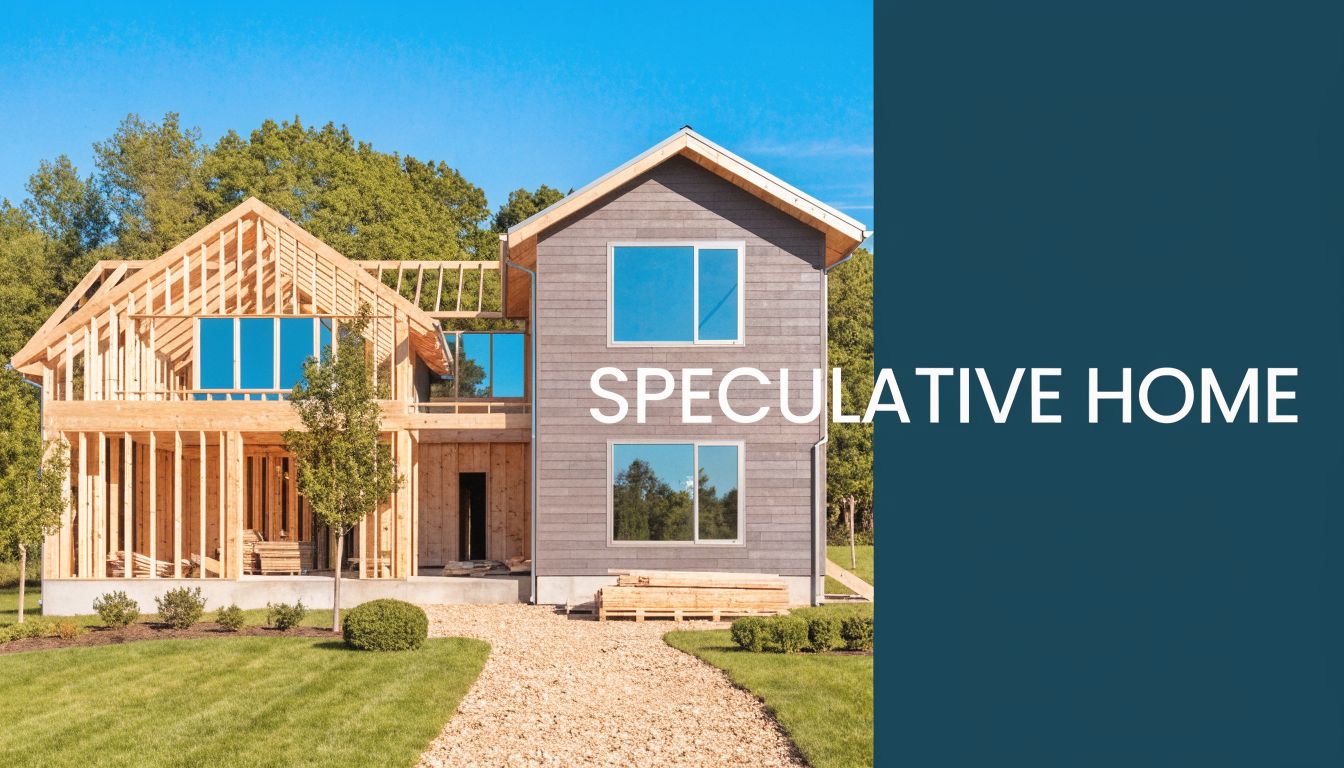
A builder spec home is a house built on speculation. The builder starts construction before a buyer is committed, based on what they think the market will want. In plain language, it’s an off-the-rack home, not a bespoke one.
That doesn’t make it bad. It just makes it different.
Off the rack versus bespoke
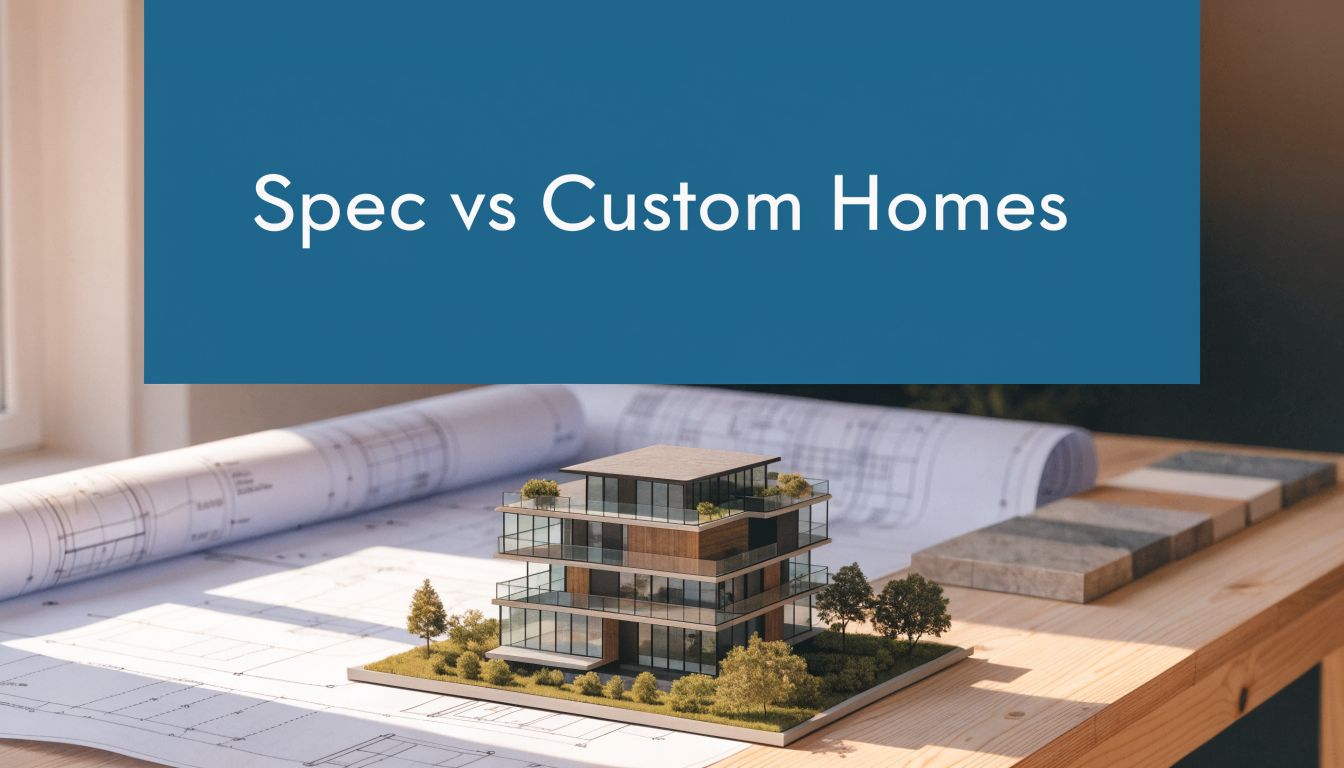
A good analogy is clothing. A spec home is like a well-made suit purchased off the rack. It may be attractive, current, and convenient. You may even be able to tailor the cuffs or choose a different lining if you catch it early enough. But the cut, structure, and proportions were decided before you walked in.
A custom home is bespoke. The fit starts with you, the site, and the way you intend to live.
That’s the core difference. A spec home is designed for a broad buyer. A custom home is designed for a specific household.
Spec home versus inventory home
People often use these terms interchangeably, but there’s a practical distinction:
Builder spec home: Usually means the builder started the house without a buyer in place. It may still be under construction when you find it.
Inventory home or quick move-in home: Usually means the house is already finished, or close enough that meaningful choices are gone.
If you tour an unfinished house and the builder says you can still pick countertops, appliances, or lighting, that’s still a spec home. It’s just one where a few finish selections may still be open.
If the flooring is installed, the cabinetry is in, and the mechanical systems are already set, you’re buying inventory. At that point, you’re choosing the home, not shaping it.
Buy early if you want any influence at all. Buy late if speed matters more than personalization.
What a spec home is not
It is not a custom home with less paperwork.
It is not a collaborative design process.
And it is not usually the right vehicle for someone who cares about exact room proportions, ceiling details, natural light patterns, storage strategy, outdoor living flow, or site-specific architecture.
That last point matters in Naples. Buyers here often want a house that feels considered from the street to the waterline, not just completed.
Spec vs Custom Homes A Naples Buyer's Comparison
Luxury buyers don’t need a generic list of pros and cons. You need a side-by-side comparison that reflects how people make this decision in Naples.
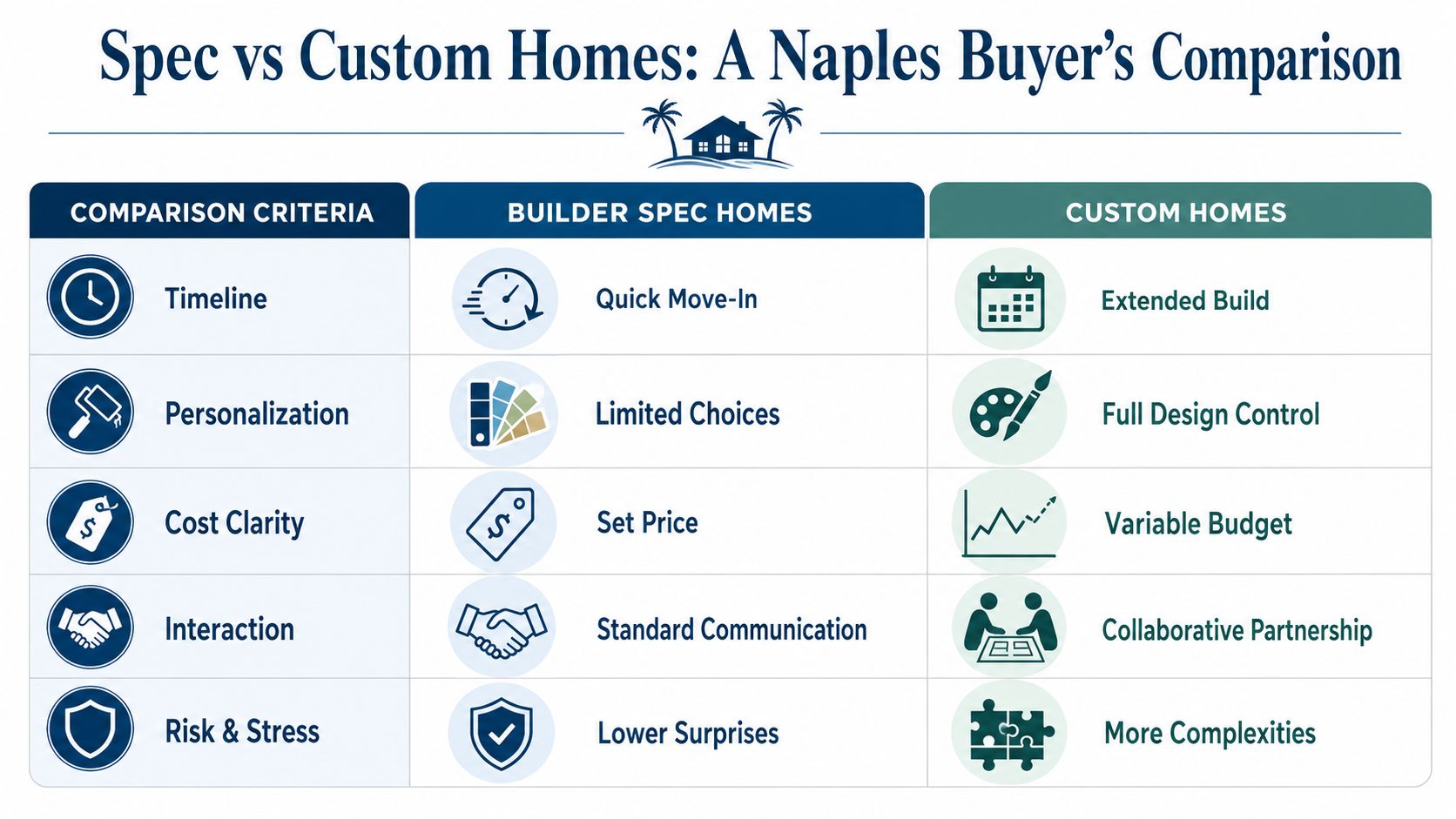
The four issues that decide the outcome
The debate usually comes down to four things.
First, design freedom. Spec homes offer limited influence, usually at the finish level if you come in early enough. Custom homes let you shape the plan, circulation, elevation, outdoor spaces, storage, and material palette from the start.
Second, timeline. Spec homes move faster because the builder already made the major decisions. If you’re comparing timelines in more depth, our article on how long it takes to build a custom home breaks down what affects pace and sequencing.
Third, quality control and material selection. In a spec home, the builder decides what most buyers will accept. In a custom home, you decide what’s worth paying for and where performance matters.
Fourth, overall value. That isn’t just price. It’s how well the house fits your life, how much you’ll want to change later, and whether the construction choices make sense for Naples.
Spec Home vs. Custom Home What's the Right Fit for You?
Factor | Builder Spec Home | Custom Home |
|---|---|---|
Design freedom | Builder-led plan with limited buyer input | Buyer-led design from the ground up |
Move-in timing | Faster path if the home is already underway or completed | Longer process with more decision points |
Material selection | Preselected packages and broad-market choices | Tailored materials based on lifestyle and priorities |
Layout control | Structural decisions usually locked before you arrive | Floor plan shaped around your routines and goals |
Communication style | More transactional and schedule-driven | More collaborative across builder, architect, and designer |
Fit for Naples luxury living | Can work if the home already aligns with your needs | Better fit for buyers with specific site, design, and performance goals |
My direct recommendation
Choose a spec home if your top priority is moving quickly and you find one that already matches most of what you want.
Choose custom if any of the following are essential:
Site-driven design: You care where the pool sits, how the lanai faces, and how privacy is handled.
Architectural clarity: You don’t want a house that feels assembled from standard market assumptions.
Material intent: You want to select windows, insulation, doors, finishes, and systems with purpose.
Long-term satisfaction: You don’t want to spend the first years of ownership noticing compromises.
A luxury home should feel inevitable once it’s built, like it could only have been designed for that lot and that family.
That’s rarely what builder spec homes are designed to do.
The Spec Home Buying Process and Timeline
Buying a spec home feels simpler because much of the work happened before you entered the picture. That’s the appeal. It’s also the limitation.
According to Charleston Homes’ explanation of the spec home process, the spec timeline is compressed because builders pre-lock major decisions like the floor plan, foundation, and primary systems before a buyer gets involved. That speeds construction by 30% to 50% compared with a custom project, but it removes the buyer from foundational design choices.
How the sequence usually works
Here’s the practical version of the process:
You tour the home or plans
Sometimes the house is framed. Sometimes drywall is in. Sometimes it’s complete and staged.You learn what’s still open
Here, many buyers overestimate flexibility. If cabinetry, slab selections, electrical layouts, or plumbing placements are already ordered or installed, your choices shrink fast.You go under contract
The contract usually reflects a builder-controlled process, not an open-ended design collaboration.The builder finishes the house
Their schedule drives the sequencing. You’re not approving each stage the way you would in custom construction.You do walkthroughs and close
At this point, the focus is punch-list quality and contract compliance, not redesign.
Where buyers still get input
Your input, if available, usually lands near the end of the sequence:
Surface finishes: Flooring, paint, hardware, lighting, or appliance upgrades may still be open.
Minor options: Sometimes a builder will allow limited package changes if procurement timing permits.
No structural changes: Stair locations, garage depth, ceiling layout, window strategy, and core systems are usually already locked.
That’s why buying a spec home is less like commissioning a residence and more like boarding a train already moving down the track.
Review the scope carefully. In home projects, confusion usually starts when buyers assume a conversation changed the work, but the contract never did.
That’s also why legal clarity matters. If you want a good overview of how scope disputes can develop in residential work, Kendall business lawyers at Coto & Waddington offer a useful discussion of how expectations and written scope can diverge.
What this means for a Naples buyer
If you don’t want to make dozens of decisions, the spec process can feel efficient and refreshing.
If you care about getting foundational things right, it can feel late from the day you walk in.
That’s the trade. Speed comes from decisions you didn’t make.
The Financial Realities of Spec Homes in Coastal Florida
The cleanest number in a spec home deal is usually the purchase price. Buyers like that because it feels definite. But the most important costs often show up later.
The builder’s risk premium is real
A spec builder takes on land cost, carrying cost, construction management, and market risk before a buyer signs anything. That risk doesn’t disappear. It gets priced into the home.
As explained in Ottawa General Contractors’ discussion of spec home economics, spec homes are built to be profitable and fast, often to minimum code rather than performance goals. Buyers are paying for convenience, but they’re also paying for the builder to have taken the speculative risk.
That’s why a spec home can look competitively priced and still not be the better value for a long-term owner.
Sticker price versus ownership cost
In Naples, the bigger issue is total cost of ownership.
A home can satisfy code and still fall short of what a coastal luxury buyer should want. If the window package isn’t strong enough for your comfort expectations, if insulation choices are basic, or if the house wasn’t thought through as a performance system, you may end up paying to improve a house you just bought new.
The same source notes that retrofitting high-performance windows and better insulation can cost tens of thousands of dollars, and owners may also face higher annual utility costs. That’s not a minor issue. It’s the difference between a house that merely passes inspection and one that actually supports the way you want to live.
What matters in coastal Florida
For Naples buyers, I’d push hard on these questions before buying any spec property:
Windows and glass strategy: Are the selections appropriate for heat, sun exposure, and overall comfort?
Envelope performance: Was insulation chosen as a code exercise or as part of a long-term comfort plan?
Mechanical design: Does the HVAC approach fit the size, glass, and layout of the home?
Durability decisions: Were materials selected for broad market appeal or for coastal conditions and longevity?
Practical rule: Never assume “new” means “optimized.”
A lot of buyers only discover that after they’ve moved in. They start changing shades, reworking lighting, upgrading doors, or questioning why some spaces never feel quite right at certain times of day.
My financial advice
If you expect to hold the home for years and you care about comfort, resilience, and fewer compromises, don’t judge a spec home by the asking price alone.
Judge it by what you’ll need to accept, and what you’ll eventually want to redo.
Why Naples Buyers Often Choose Custom Construction
Naples is not a market where people want merely a house. They want a home that belongs to the lot, the climate, and the way they live. That’s why many buyers with the budget to choose don’t stop at builder spec homes.
They go custom.
The local demands are different
In a luxury coastal setting, details that seem optional elsewhere become central here. Sun angle matters. Privacy matters. Outdoor living matters. Storm readiness matters. The relationship between the primary suite, guest areas, pool, kitchen, and entertaining spaces matters every single day.
A spec home can approximate those things. A custom home can integrate them.
That difference is even more relevant as buyer preferences continue shifting toward personalization. In the second quarter of 2025, custom home building grew 4%, and custom homes reached about 19% of single-family starts, their highest market share since 2022, according to the NAHB’s update on custom home building growth.
What custom gets right in Naples
Custom construction gives you control over decisions that directly affect daily life:
Site orientation: You can place major rooms and outdoor spaces around light, views, and privacy.
Lifestyle planning: A home office, wellness room, wine storage, cabana bath, or guest suite can be integrated cleanly instead of squeezed in.
Material strategy: You can prioritize products and assemblies that make sense for humidity, weather exposure, and longevity.
Architectural consistency: The house can feel cohesive from exterior massing to interior trim, rather than assembled from standard selections.
Why this matters more than buyers expect
Many homeowners think customization means choosing prettier finishes. That’s the shallow version.
The value of custom homes is that they solve problems before they’re built. You’re not trying to “improve” a generic plan after the fact. You’re making sure circulation, scale, storage, lighting, comfort, and outdoor use are right from the beginning.
That’s why custom often feels calmer once complete. The house supports your routines instead of asking you to adjust to its limitations.
If your standards are high, customization isn’t indulgence. It’s quality control.
For discerning Naples buyers, that’s often the deciding factor.
Realizing Your Vision with JVM Construction
If you’ve read this far, you probably don’t want a house that merely checks boxes. You want a home that feels resolved. That usually requires a custom process with clear communication, disciplined planning, and a team that can carry design intent through construction without losing the details.
That process should start before materials are ordered and long before finishes are installed.
What a better process looks like
A strong custom builder helps coordinate the moving parts that spec construction largely bypasses:
Early collaboration: Builder, architect, designer, and homeowner align before costly assumptions harden into field conditions.
Preconstruction clarity: Budget, scope, scheduling logic, and material priorities are discussed early, not discovered midstream.
Decision sequencing: Selections happen in the order construction needs them.
Field accountability: The drawings matter, but so do site supervision, trade coordination, and finish execution.
For buyers who want a custom home in Naples, JVM Construction’s custom home building services outline that type of full-process involvement, from planning through completion.
Seeing the home before it exists
One of the smartest ways to protect a custom project is to visualize it before crews start building. That’s especially important for exterior massing, room proportions, sightlines, and indoor-outdoor flow. If you want to understand how visualization supports better decisions, The Render Pros' rendering expertise is a useful reference for what quality architectural rendering can add to planning.
That kind of front-end clarity is the opposite of the spec model. In a spec home, many of the biggest decisions have already been made for you. In a custom home, the point is to make those decisions deliberately.
My closing advice
Buy a spec home if it already fits your life, your standards, and your timeline. Don’t buy one because the process feels easier in the moment.
Build custom if you care about how the house lives, how it performs, and whether it still feels right years from now.
That’s the real question. Not whether a home is new, but whether it was built for you.
If you’re weighing builder spec homes against a fully custom home in Naples, talk with JVM Construction LLC about your lot, priorities, timeline, and must-haves. A clear conversation early can save months of second-guessing and help you decide whether to buy what’s available or build what suits your family.