Commercial build-out costs in Naples, FL can range from $150 to over $500 per square foot, depending on the type of business and the level of finish. In today’s market, national mid-2026 build-out averages have risen to $280 to $950 per square foot for some project types, and specialized high-end spaces like medical offices can exceed $300 per square foot.
A lot of owners hit the same moment. They find a promising lease, walk the space, start picturing the finished business, and then a key question shows up fast: what will it cost to make this place usable, polished, and ready to open?
In Naples, that question deserves a local answer. A clean professional office, a restaurant with a serious back-of-house, and a medical suite with code-heavy systems are three very different projects. The build-out process also isn’t just about drywall and paint. It’s about planning the job with the same discipline you’d expect in a custom luxury home, where finishes, systems, sequencing, permits, and trade coordination all have to line up if you want quality without budget surprises.
Your Guide to Commercial Build Out Costs in 2026
A commercial build-out usually starts with optimism. You’ve secured a location, the footprint looks right, and the address fits your brand. Then the landlord’s plan set lands in your inbox, your designer starts asking questions about utilities and code use, and the budget suddenly feels less straightforward.
That uncertainty is understandable. Post-2025 cost pressure has been real, and it has affected everything from lead times to system selections. The 2026 commercial construction cost outlook notes that commercial build-out costs rose 12% to 18% year over year, with mid-2026 averages at $280 to $950 per square foot. That same source notes that specialized high-end projects, including medical offices in Naples, can exceed $300 per square foot because of Florida energy code requirements and smart-building integrations.
Why owners get surprised
The biggest mistake isn’t underestimating one line item. It’s assuming the number should be simple.
A small office refresh can be fairly direct. A restaurant or healthcare suite usually isn’t. Once a project needs upgraded power, plumbing relocations, ventilation changes, specialty millwork, or stricter inspections, the commercial build out cost per square foot moves fast.
Practical rule: The earlier you define layout, systems, and finish expectations, the more reliable your budget becomes.
Why Naples projects need tighter planning
Naples owners often want spaces that feel upscale, not generic. That’s especially true in medical offices, professional suites, and hospitality-driven environments where the interior has to support both function and brand. Coastal conditions also affect material choices, durability, and approvals in ways national averages don’t fully capture.
That’s why the best build-out process looks a lot like custom home planning. You don’t start by chasing the lowest rough number. You start by getting clear on scope, understanding what’s already in the shell, and aligning design decisions with the budget before the job is too far along to change cleanly.
What a Commercial Build Out Actually Includes
Before talking about price, it helps to define what you’re buying. Many owners use “build-out” to mean everything needed before opening day, but in construction, the scope usually stops before furniture, décor, and business equipment.
Shell condition matters
The starting condition of the space has a huge effect on cost. A cold dark shell is close to an empty box. It may have limited interior finish work and minimal ready-to-use systems. A vanilla shell often has more basic infrastructure in place, such as finished walls or ceilings in certain areas. A white box usually means a cleaner, more leasable condition, but that still doesn’t mean it’s business-ready.
It's comparable to buying a home. One property has framing and rough systems. Another has painted walls and finished flooring. A third is furnished and ready to live in. Those are very different starting points, and commercial spaces work the same way.
What the contractor typically builds
A commercial build-out generally includes the construction work needed to turn the shell into an operating business space, such as:
Interior layout work including framing, drywall, doors, and room configuration
Core systems like electrical, plumbing, lighting, and HVAC distribution
Surface finishes such as flooring, wall treatments, ceilings, and trim
Life-safety and code items including accessibility updates, fire-rated assemblies, and inspection coordination
Final readiness work tied to approvals, punch list completion, and occupancy preparation
If you’re unfamiliar with the final approval stage, this overview of what a certificate of occupancy means is worth reading before lease negotiations are finalized.
If the lease says the landlord delivers a “white box,” ask what that includes in writing. Don’t rely on the phrase alone.
What usually falls outside the build-out
Owners often assume these items are included unless someone says otherwise:
FF&E such as desks, seating, loose shelving, decorative lighting, and artwork
Business equipment like dental chairs, commercial kitchen equipment, point-of-sale hardware, or exam room devices
Branding elements including specialty signage packages and some graphic installations
That separation matters. A contractor may build the kitchen infrastructure but not supply the cooking line. The same goes for a medical office. The walls, sinks, power, and support systems may be part of the project, while the medical equipment is owner-furnished.
When everybody uses the same vocabulary early, estimates get cleaner and change orders become less likely.
Typical Build Out Cost Ranges by Business Type
Not every business should budget the same way. The commercial build out cost per square foot depends heavily on how much infrastructure the space needs and how refined the finished environment must feel.
One useful benchmark comes from the Southeast retail market. Cushman & Wakefield’s 2025 retail fit-out guide reports that retail fit-out costs in the Southeast, including Florida, average $117 per square foot, compared with a national average of $155 per square foot. That regional advantage helps, but it doesn’t mean every Naples project lands near the low end. Restaurants, medical suites, and luxury-oriented interiors often run much higher.
A practical Naples budgeting table
Estimated Commercial Build Out Costs in Naples, FL (Per Square Foot) | ||
|---|---|---|
Commercial Space Type | Standard Finish Cost / Sq. Ft. | High-End/Luxury Finish Cost / Sq. Ft. |
Professional office | $150 to $250 | $250 to $400 |
High-end retail | $150 to $250 | $250 to $400 |
Full-service restaurant | $200 to $350 | $350 to over $500 |
Medical or dental clinic | $250 to $350 | $350 to over $500 |
These are planning ranges for Naples-type projects, not universal bid prices. They’re useful for early decision-making, especially when you’re comparing spaces or weighing whether a second-generation suite is worth a higher lease rate because the infrastructure is already in place.
What usually lands where
A professional office tends to stay more controlled if the floor plan is straightforward and the HVAC and electrical systems need only moderate rework. Law offices, financial firms, and general administrative suites often fit here.
A high-end retail space can look simple at first but still carry a substantial finish budget. Lighting, storefront details, fitting areas, custom display millwork, and flooring transitions can move the price upward quickly.
A full-service restaurant usually brings the widest spread. The dining room may look like the expensive part, but the kitchen exhaust, plumbing, electrical loads, and code coordination often drive the budget harder than the front-of-house aesthetic.
A medical or dental clinic generally starts higher because the systems are denser and the approvals are stricter. Exam rooms, specialty plumbing, dedicated power, air distribution, and code-sensitive layouts all affect cost.
A cheap shell can become an expensive project if the existing systems don’t support your use.
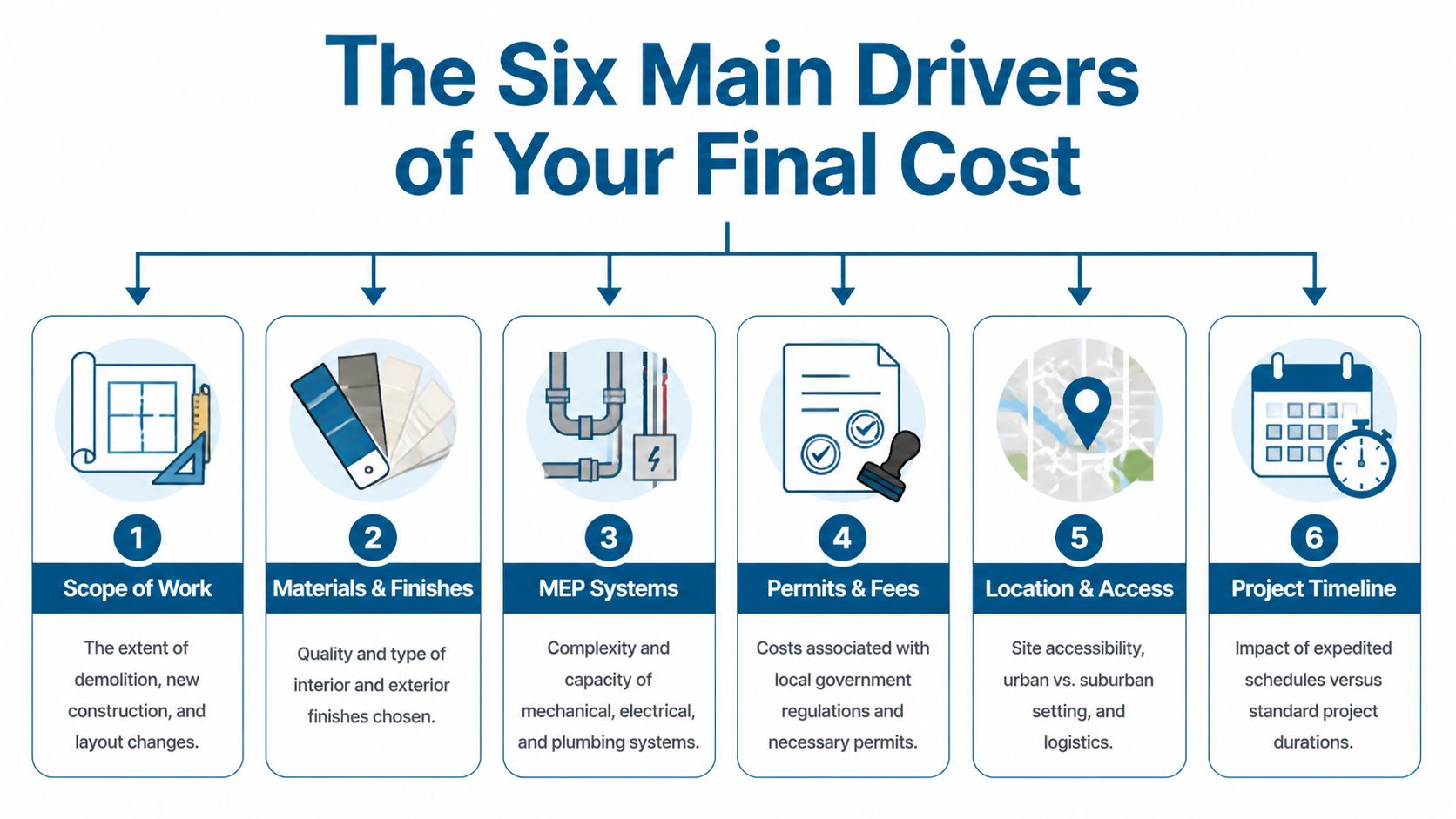
The Six Main Drivers of Your Final Cost
The range only makes sense when you understand what pushes a project up or down. In Naples, six factors tend to decide where your final number lands.
Scope and size
Bigger spaces don’t always cost more per square foot, but complicated small spaces often do. A simple open office can spread cost efficiently. A compact suite with many rooms, plumbing points, soffits, and specialty areas concentrates labor and coordination into a tighter footprint.
Layout changes are another driver. If you’re demolishing heavily, relocating doors, adding restrooms, or changing the use classification, your pricing changes before finish selections even begin.
Finishes and visual detail
Naples projects often separate from generic build-outs based on finish choices. Standard flooring, paint, basic lighting, and stock doors keep the budget controlled. Custom millwork, premium wall treatments, specialty tile, integrated lighting, and refined trim packages move the project toward a luxury finish level.
Owners familiar with custom home building usually understand this instinctively. The room may be the same size, but the finish language changes everything.
MEP systems
MEP stands for mechanical, electrical, and plumbing, and it’s often the biggest swing factor in commercial work. The WeWork build-out cost guide notes that MEP systems can account for 25% to 40% of total build-out expense. It also notes that a standard office may carry $15 to $25 per square foot in MEP cost, while a healthcare facility in Naples with specialized systems and hurricane-code compliance can exceed $80 per square foot.
That’s why experienced builders spend so much time studying reflected ceiling plans, equipment schedules, riser locations, and existing service capacity before they promise a number.
For teams trying to understand how HVAC scope affects budgeting before bidding, Exayard HVAC estimating software is a helpful example of how trade-specific estimating tools break mechanical scope into something more measurable.
Code compliance and permitting
Not all code costs are obvious on day one. Accessibility upgrades, fire-rated assemblies, emergency lighting, life-safety revisions, and energy-code compliance can become major budget items if they aren’t identified early.
This is also where value engineering matters. The right substitutions protect function and appearance without spending where the client won’t see meaningful return. This guide on value engineering in construction gives a solid overview of how those decisions should be made.
Existing conditions and access
An older suite can hide expensive problems. Uneven slabs, undersized electrical service, outdated ductwork, poor drainage locations, and undocumented prior work all create friction. In occupied centers, limited delivery windows, restricted staging, and noise constraints can also increase labor effort.
Timeline and procurement pressure
Fast-track schedules sound appealing, but they rarely come free. If trades have to work around each other, materials need acceleration, or approvals are still moving while field work starts, the budget usually feels that strain.
The smoothest projects don’t start the fastest. They start the clearest.
Budgeting for Your Naples Commercial Project
A Naples budget should start with the intended use, then adjust for local realities. Generic online calculators can help with broad planning, but they often miss the coastal conditions and finish expectations that define this market.
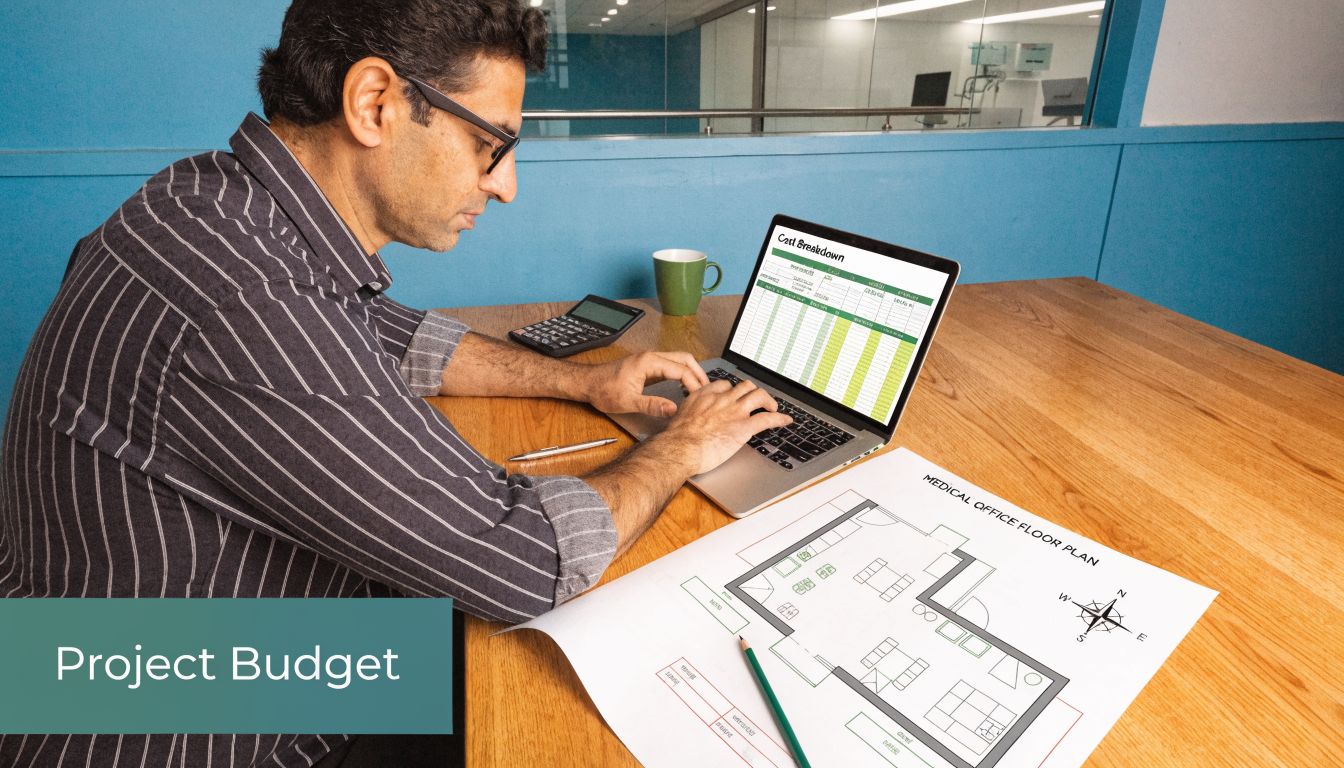
A working example for a medical office
Take a 2,500-square-foot medical office. Early in planning, many owners try to multiply square footage by a generic office number and call it done. That usually underestimates the job.
For a Naples medical suite, a more realistic planning framework is to begin with the medical-office range discussed earlier, then test the design against actual system demands. If the suite needs multiple exam rooms, upgraded HVAC zoning, specialty plumbing, premium waiting-room finishes, and integrated casework, it may trend toward the high-end side of the range instead of the low side.
That’s why preliminary budgeting should include:
Use-specific rooms such as consult rooms, treatment rooms, reception, staff areas, and storage
System intensity including dedicated sinks, power density, low-voltage coordination, and HVAC distribution
Finish intent for flooring transitions, wall protection, millwork, and branded front-desk detailing
Approval pathway tied to local permitting, inspections, and occupancy timing
Naples costs that broad averages miss
One of the biggest problems with national content is that it treats all “Florida projects” like they’re the same. They’re not. This regional cost discussion for coastal build-outs points out that there is a lack of region-specific data for high-end coastal markets like Naples, and that a build-out in Old Naples can add $75 to $150 per square foot above national averages for coastal resilience and high-end millwork.
Those local premiums often come from factors like:
Hurricane-rated assemblies including impact-resistant glazing and more durable exterior components
Coastal durability choices such as materials that better tolerate humidity, salt exposure, and corrosion risk
Luxury-market expectations where reception areas, restrooms, and common spaces need a more polished finish package
Permit and consultant coordination that takes experience with local review processes and sequencing
In Naples, the budget isn’t just about square footage. It’s about what the space has to do, what it has to withstand, and what standard it has to reflect.
How to budget without getting trapped
Start with a planning range, not a wish number. Then narrow it by reviewing existing conditions, confirming your use classification, and selecting finishes earlier than you think you need to. Owners save money when they make fewer late decisions, not when they delay every decision.
A strong preconstruction process should leave you with a budget that feels detailed enough to trust, while still giving room to refine the design before procurement begins.
Beyond the Build Out Maximizing Your Investment
A build-out isn’t only a construction expense. It becomes part of how your business operates every day.
A professional office with clean circulation, acoustic privacy, and durable finishes feels more organized to clients and easier for staff to use. A restaurant with the right front-of-house flow and back-of-house support runs better under pressure. A medical office that feels calm, clean, and intentional builds confidence before the appointment even starts.
Spend where the business feels it
Owners sometimes overfocus on reducing visible line items and underfocus on operational friction. Saving on the wrong flooring, lighting layout, or millwork detail can create maintenance headaches or a weaker customer impression. The better approach is to trim cost where the business won’t lose value.
Good examples include simplifying hidden framing conditions, standardizing door hardware, or reducing unnecessary ceiling transitions while preserving the parts of the space that shape client experience.
Use your lease as a cost tool
If you’re leasing, your build-out strategy should include the landlord conversation early. A tenant improvement allowance can offset a meaningful portion of upfront costs if it’s negotiated properly and documented clearly in the lease. The exact amount varies by property, market, and deal structure, so this is less about a universal benchmark and more about negotiation.
Bring a real scope outline to the table. Landlords respond better when they can see that the request is tied to concrete improvements that add long-term value to the property.
For owners, brokers, and leasing teams thinking through property positioning, this comprehensive guide for real estate brokers is useful because it frames commercial property value around presentation, marketability, and practical deal preparation.
The best build-out investments are the ones your staff can work in, your customers can feel, and your maintenance team doesn’t have to fight with later.
Think past opening day
The cheapest initial option isn’t always the best long-term one. Durability, serviceability, code compliance, and thoughtful layout planning often pay back in fewer disruptions and a better day-to-day experience.
That mindset should feel familiar to anyone who has built or renovated a custom home. The work that looks invisible on the plans often decides how the space performs after the grand opening.
Finding the Right Contractor for Your Naples Build Out
Choosing a contractor for a commercial build-out shouldn’t come down to the lowest bid alone. Low numbers often hide scope gaps, vague allowances, or unrealistic assumptions about existing conditions. Those issues usually show up later, when changes are harder and more expensive to absorb.
A better filter is transparency. Ask how the contractor handles preconstruction, what they need to verify before final pricing, and how they communicate when field conditions differ from the plan. In a market like Naples, local subcontractor coordination matters just as much as the base estimate.
The broader cost picture supports that local approach. This 2025 commercial construction cost guide notes that the national midpoint for U.S. commercial construction is about $560 per square foot, while costs in the South, including Florida, are more moderate. It also notes that local labor availability and high-end finish demand still require strong subcontractor coordination to keep budgets under control.
What to ask before you sign
How complete is the scope? Ask whether the bid clearly addresses permits, MEP modifications, finish levels, and code-related items.
Who is managing the trades? Coordination quality affects schedule, finish quality, and change-order risk.
What local experience applies? Naples projects often need a builder who understands coastal conditions, finish expectations, and local review processes.
How are allowances handled? If too much of the proposal is vague, the number may not be dependable.
For owners who want a clearer path from budgeting to execution, it helps to review a contractor’s commercial construction services before the first meeting so you can compare process, not just price.
The right contractor should make the project feel more understandable, not more confusing. That’s the standard to hold.
If you're planning a build-out for a medical office, professional suite, restaurant, or other commercial space in Naples, JVM Construction LLC can help you evaluate the space, define the scope, and build a realistic path from concept to completion. Reach out for a consultation if you want clear guidance, disciplined budgeting, and a finished result that reflects the same care and craftsmanship expected in a luxury custom build.