So, you're ready to build your dream home in Fort Myers or Naples. That's a huge, exciting step! But it all hinges on one make-or-break decision: finding the right builder. This isn’t just about hiring a crew with hammers and nails; it’s about finding a partner who understands your vision and, just as importantly, knows how to build for our unique Southwest Florida coast.
Kicking Off Your Custom Home Journey in Fort Myers
Building a custom home is a different beast entirely, especially when it’s your forever home. This is about pouring your family's lifestyle, your personal taste, and your future dreams into a blueprint and then into reality. Imagine designing a kitchen specifically for your love of hosting, with a large island where friends can gather, or creating a quiet home office with a view of the lanai. The right builder becomes your guide, your collaborator, and your biggest advocate through it all, from the first napkin sketch to the day they hand you the keys.
This guide is here to walk you through that process. We’re going to get way beyond a simple Google search and show you how to truly vet the house builders Fort Myers has to offer. My goal is to give you practical, no-fluff advice so you can feel confident in your choice.
What to Expect Inside
We’ll break this down into clear, manageable steps. Here’s a little preview of what we’ll cover:
Finding & Shortlisting: I'll share some proven ways to find the best local builders whose style and quality match what you’re looking for.
Checking Them Out: You'll learn the right way to verify licenses, confirm insurance, and really gauge craftsmanship by visiting past projects and even active job sites.
Building for the Coast: We'll dive into the non-negotiables of building here—hurricane-rated construction, FEMA flood zone rules, and choosing materials that won't surrender to Florida's humidity.
The Nitty-Gritty: We’ll talk about what to look for in contracts and warranties, how to approach budgeting, and why setting clear communication expectations from day one is key.
The relationship you have with your builder is just as crucial as the foundation they pour. It's built on trust, open communication, and a shared passion for getting every detail right—long after the project is finished.
As you start planning, remember that a beautiful home also needs to function perfectly. A quality build includes top-notch mechanicals, which is why working with pros who provide comprehensive HVAC, plumbing, and electrical services in Fort Myers is essential for long-term comfort and efficiency.
Ultimately, we want you to have the tools to choose a true partner for one of the biggest investments you’ll ever make. To see what’s possible, take a look at our custom home building services and get a feel for how a dedicated team can bring your vision to life.
Alright, let's get started.
How to Find and Shortlist the Best Local Builders
Finding the right person to build your dream home isn't like a typical Google search. The very best house builders Fort Myers has to offer are often found through trusted local networks and a little old-fashioned legwork, not just algorithms. You’re not just hiring a contractor; you're choosing a partner for one of the biggest projects of your life.
A fantastic place to start is by talking to the other professionals in the field. Reach out to local architects, engineers, and interior designers. These folks are in the trenches every day and have firsthand knowledge of which builders are great communicators, deliver on their promises, and produce stunning work. They also know who to avoid.
Another surprisingly effective tactic? Get in your car. Spend a weekend driving through neighborhoods you love, like the waterfront communities along McGregor Boulevard or the beautiful new developments in the Daniels Corridor. Look for builder signs on active job sites. This is a real-time, on-the-ground way to see who is building the kind of homes that catch your eye.
Expanding Your Search with Local Resources
Once you've got a few names, it's time to dig a little deeper with some organized resources. Tapping into these will help you turn a few ideas into a solid list of potential candidates.
Industry Associations: Check out the member directories for the Collier Building Industry Association (CBIA) and the Lee Building Industry Association (Lee BIA). Membership often means the builder is established and invested in the local community.
Parade of Homes Events: These annual events are an absolute goldmine. You get to walk through brand-new custom homes, inspect the craftsmanship up close, and chat with the builders and their teams in a casual, no-pressure environment.
Luxury Real Estate Agents: A great realtor who specializes in luxury new construction will have a go-to list of builders they've worked with and trust. Their reputation is on the line, too, so they'll only recommend the best.
The Southwest Florida market is booming. The Fort Myers/Cape Coral area recently saw 14,090 home sales, a 4.3% increase from the previous year, which is one of the strongest sales records we've seen. All this activity means the best builders are incredibly busy. My advice? Start your search sooner rather than later. Discover more insights into the Fort Myers housing market.
From Longlist to Shortlist
At this point, you should have a "longlist" of about 8-10 builders. Now, the real work begins—whittling that down to the best of the best. The goal isn't to find the cheapest bid, but to find the perfect fit for your vision, budget, and personality. You're aiming to land on 3-5 top contenders you'll want to interview.
Your first screening can be done right from your computer. Dive into each builder's website and really study their portfolio. Does their style match what you envision? For example, if you're dreaming of a clean, modern coastal design with open spaces and lots of natural light, a builder whose portfolio is filled exclusively with traditional Mediterranean homes probably isn't the right one for you.
A builder's portfolio is their resume. Look for consistency in quality, attention to detail, and a style that resonates with your own aesthetic. Their past projects are the single best predictor of your future home.
Next, it's time to make a few calls. This isn’t the formal interview just yet; think of it as a quick pre-screening. You want to get a feel for their professionalism, find out what their current workload is, and see if they're even taking on projects like yours. Ask about their typical project size and price point. A professional will be happy to answer these questions upfront, and this simple step can save you a ton of time by quickly weeding out builders who aren't a good match.
Vetting Your Builder and Assessing Their Work
You’ve done the initial legwork and have a solid shortlist. Fantastic. Now comes the most critical part of the process: the deep-dive vetting. This is where you move past the glossy brochures and really get to know who you might be partnering with for the next year or more.
Don't rush this. Taking your time here is the single best way to head off problems down the road and ensure the home you’ve been dreaming of becomes a reality.
The Non-Negotiables: Licenses and Insurance
First things first, let's get the official stuff out of the way. Every single builder on your list needs to have their credentials verified. This isn't about trust—it's standard operating procedure for protecting your family and your investment.
You can easily check if a builder's state license is active and in good standing right on the Florida Department of Business and Professional Regulation (DBPR) website. No active license? Cross them off the list. Period.
Next up is insurance. Any professional custom home builder must carry both general liability insurance and workers' compensation insurance. Ask for their current certificates. If they hesitate or can't produce them immediately, that’s a massive red flag. This isn't just paperwork; it’s what protects you from financial disaster if something goes wrong on-site.
This handy checklist can keep you organized as you verify each potential builder.
Builder Vetting Checklist
Use this checklist to ensure any potential builder meets the critical standards for professionalism, insurance, and quality.
Verification Step | What to Look For | Red Flags to Watch For |
|---|---|---|
State License | An active, current license with the Florida DBPR. | An expired license, pending complaints, or no license at all. |
General Liability | A current certificate of insurance with adequate coverage. | Reluctance to provide the certificate; low coverage limits. |
Workers' Comp | A current certificate proving all on-site workers are covered. | Claiming they don't need it; hesitation to show proof. |
Portfolio Review | High-quality, consistent work that matches your style. | A very small portfolio; photos that look like stock images. |
Job Site Visit | A clean, organized, and safe work environment. | A messy, chaotic site with obvious safety hazards. |
Client References | Eagerness to provide a list of recent, happy clients. | Providing only old references or being unable to provide any. |
Completing these checks gives you a baseline of professionalism and eliminates any unqualified candidates right away.
Beyond the Polished Portfolio
A builder’s website is their highlight reel, and that’s fine. But to get a true sense of their craftsmanship, you have to see the work for yourself, up close and personal.
Ask your top contenders to arrange visits to two key sites:
A Recently Completed Home: This is your chance to play detective. Look at the fine details—the crispness of the paint lines, the precision of the tile work, how the cabinet doors align. Open and close doors and drawers. Does it feel solid? This is where true quality shows.
A Home Under Construction: I’d argue this is even more revealing. A construction site tells you everything about a builder’s process. Is it organized and clean, or is it a chaotic mess? A well-managed job site reflects a professional who respects the project and, ultimately, your future home.
Think of this whole process as a funnel. You start with a wide pool of options, do your research, and then carefully narrow it down to the very best fits.
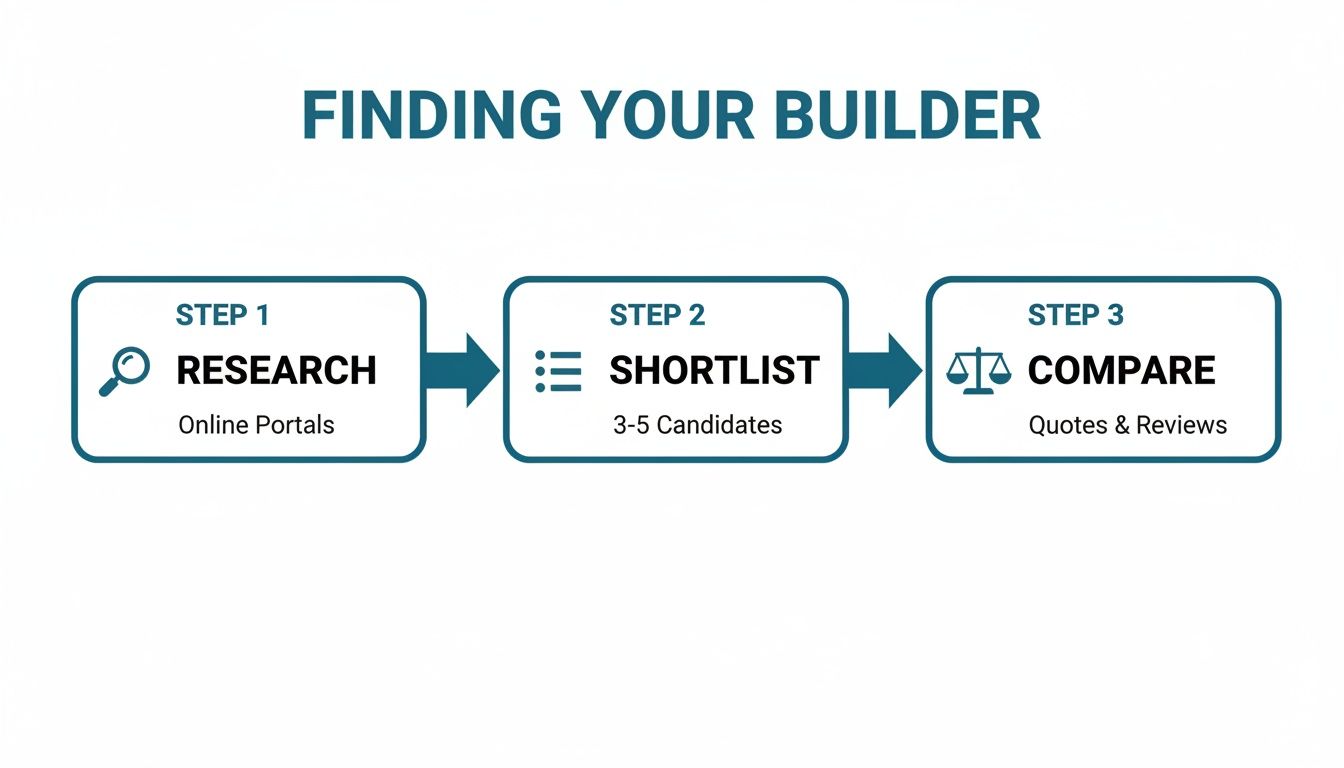
This simple visual shows how you move from a broad search to a focused comparison to find that one perfect builder.
The Real Story: Speaking with Past Clients
The final piece of the puzzle is hearing from people who have already walked this path. A builder who is proud of their work will be happy to connect you with recent clients. Don't be shy about making these calls; they are pure gold.
You want the unvarnished truth about the entire experience. Was communication clear and consistent? Did they stay on budget? And, crucially, how did they handle surprises? Because trust me, there are always surprises in a custom build.
One of my favorite questions to ask is, "How did the builder handle change orders?" The answer tells you volumes about their process for managing costs, communicating shifts in the plan, and keeping the schedule on track.
These conversations are less about the house and more about the relationship. You're about to enter a long-term partnership, and you need to know what it’s really like working with them day in and day out. For more ideas on this, we've put together a full guide on what to ask a general contractor that you can use as a script.
By putting in this effort upfront—verifying credentials, walking job sites, and talking to real clients—you trade guesswork for confidence. You'll know the builder you choose has a proven track record of excellence and integrity, setting the stage for a partnership that results in a home you’ll absolutely love.
Getting Real About Coastal Codes and Your Budget
Building a custom home in a place like Fort Myers is a different ballgame. We’re not just building for aesthetics; we’re building for resilience. Florida’s building codes are some of the toughest in the country, especially right here on the coast, and for good reason. Your builder needs to be an absolute authority on these rules, not just someone who can look them up.
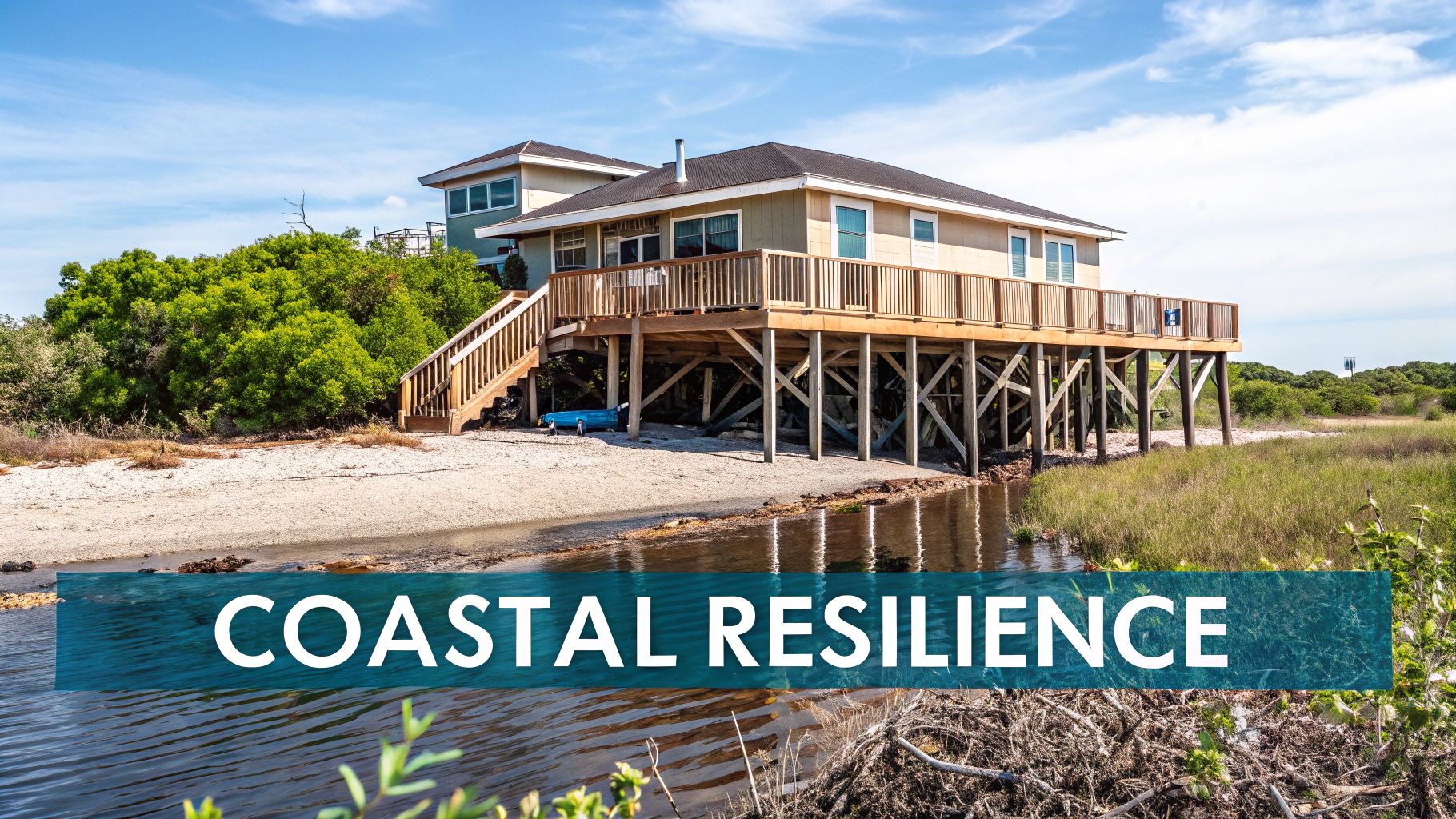
This isn’t about just checking a box to pass an inspection. It’s about making sure your home—and your family—are safe when the next hurricane inevitably tracks our way. A truly experienced local builder will talk your ear off about wind-load calculations, hurricane-rated construction, and the unique hurdles of building in FEMA flood zones. It should be second nature to them.
What Building for the Coast Really Means
You can spot a builder’s true expertise in the materials they choose and the techniques they use every day. They should be able to walk you through why a particular window or fastener is non-negotiable for a home that needs to stand up to our humid, salt-filled air for decades to come.
A few things a seasoned coastal builder will have mastered:
Elevated Foundations: Many lots around here demand that a home be built on stilts or another type of elevated foundation. This isn't just about meeting flood elevation requirements; it can drastically lower your insurance premiums.
Impact-Resistant Windows and Doors: These are simply not optional. They are the key to keeping your home’s "envelope" sealed tight against intense winds and flying debris during a storm.
Corrosion-Proof Everything: From stainless steel screws to specially treated light fixtures, every single component has to be selected to fight off the relentless effects of saltwater and humidity.
Building on the Southwest Florida coast is a science. You're creating a structure designed to work with our environment, not fight against it. Your builder's deep knowledge of these local codes is the true foundation of a safe, lasting, and beautiful home.
Untangling the Project Budget
Okay, once you feel confident a builder can handle the technical side, the conversation quickly turns to money. A professional builder will give you a transparent, line-by-line budget that shows exactly where every dollar is going. If you get a vague, one-page estimate, that’s a red flag. This level of detail is essential for comparing bids apples-to-apples and preventing shocking overages down the road.
One of the first financial conversations will be about the type of contract. For custom homes, you'll generally see two main options:
Fixed-Price Contract: You lock in a total price for the project upfront. This gives you budget certainty, which is great, but it can be a bit rigid if you want to make changes along the way.
Cost-Plus Contract: Here, you pay the actual costs for labor and materials, plus a pre-agreed builder's fee (either a flat rate or a percentage). This model offers more flexibility and transparency, but the final price isn't set in stone.
Getting a handle on these two approaches is your first step toward a healthy financial partnership with your builder.
Managing Allowances and Inevitable Changes
A proper budget will also include allowances—dedicated funds for items you’ll pick out later, like your kitchen appliances, countertops, or bathroom fixtures. A great builder sets realistic allowances from the beginning so you aren't disappointed to find out the high-end finishes you envisioned don't fit the initial numbers.
And let’s be honest, changes happen in every custom project. The key is having a clearly defined change order process written into your contract. For example, deciding to upgrade from quartz to quartzite countertops mid-project should trigger a formal change order. This ensures the new cost is approved in writing by everyone before the work actually starts, keeping communication clear and budgets in check. When mapping out your finances, don't forget that projects in our state often require specific protections, so it’s wise to understand the details of builders risk insurance Florida.
As you plan, it's also smart to keep an eye on the local market. The median sale price in Fort Myers is currently $385,000, and homes are selling more quickly than they were last year. This uptick suggests a healthy, growing market—a great sign when you're looking to build value with a new home. You can dig deeper into the Fort Myers housing market trends on Redfin.com. And if you're looking for ways to maximize every dollar in your budget without compromising quality, we have a helpful guide on what is value engineering in construction.
Making It Official and Kicking Off Your Project
You’ve done the hard work—the research, the interviews, the site visits. Now, you’re standing at the finish line of the selection process with a builder you genuinely trust and feel good about. It’s time to make it official.
This final step is all about cementing that partnership and laying down the ground rules for the incredible journey ahead. The construction contract is far more than just a piece of paper; it’s the blueprint for your entire project.
A truly professional builder will provide a contract that is airtight, detailed, and protects everyone involved. It’s always a wise move to have a real estate attorney look it over before you sign. Think of that small legal fee as an insurance policy on what is likely one of the largest investments of your life. It’s worth every penny.
The Anatomy of a Solid Construction Contract
Don't even think about signing on the dotted line until you’ve confirmed the contract nails down a few critical details. A wishy-washy agreement is a guaranteed path to headaches and budget battles down the road.
Your contract should be a crystal-clear roadmap for the build. Make sure it includes:
A Super-Detailed Scope of Work: This part needs to be specific. We're talking brand names for windows, model numbers for appliances, and even the type of finish on the doorknobs. The goal is to leave zero room for interpretation.
A Milestone-Based Payment Schedule: Payments should be tied to tangible progress. Think "foundation poured" or "roof on." Be wary of any builder asking for a massive upfront deposit that isn't directly tied to initial materials or permits.
A Realistic Project Timeline: Look for a clear start date, a target completion date, and key benchmarks throughout the process.
Comprehensive Warranty Information: The gold standard for a new custom home warranty is often a 1-2-10 structure. This typically covers one year for workmanship and materials, two years for systems (like plumbing, electrical, and HVAC), and a full ten years for major structural defects.
A Clear Dispute Resolution Process: Let's be realistic—disagreements can happen. This clause outlines exactly how you'll handle them, which can save a world of stress if a problem ever pops up.
Once that contract is signed, the project shifts from planning to action. The focus turns to project management and, arguably the most important element, communication.
Setting the Stage for Great Communication
For the next several months, the construction of your home is going to be a huge part of your life. Knowing how, when, and from whom you’ll get updates is absolutely essential for your sanity.
Get these communication protocols squared away from day one.
Who is your go-to person? Will you be dealing directly with the company owner, a dedicated project manager, or the on-site supervisor? Pinpointing your single point of contact for daily questions is a simple step that prevents a ton of confusion.
Next, talk about the rhythm of your updates. Will you have a scheduled weekly phone call? Can you expect a summary email with progress photos every Friday afternoon? The very best house builders Fort Myers has to offer are now using incredible project management software to keep clients in the loop.
These online portals are fantastic. They give you a real-time window into your project where you can see the schedule, check out daily photo logs, approve change orders, and track financials right from your laptop or phone.
This kind of transparency is what builds real trust and keeps the entire team—you included—on the same page. It turns what could be a stressful process into an exciting, collaborative experience. A strong relationship with your builder, founded on open and consistent communication, is just as crucial as the foundation of your stunning new Southwest Florida home.
Your Top Questions About Building a Home in Fort Myers
If you're thinking about building a custom home, your head is probably swimming with questions. That’s completely normal. You're about to embark on a massive project, and you deserve clear, honest answers. We get asked these same questions all the time, so let's walk through them one by one.
How Long Does It Really Take to Build a Custom Home Here?
This is usually the first thing everyone wants to know, and the most truthful answer is, "it depends." For a genuine custom home in the Fort Myers or Naples area, you should plan for about 12 to 18 months from the moment we break ground until we hand you the keys.
But that’s only half the story. The pre-construction phase—where all the magic happens with design, architectural plans, engineering, and navigating the permitting process—can easily take another 6 to 9 months. A builder who’s worth their salt will lay out a realistic timeline for you from the very beginning, making sure you see the full picture.
Is There a "Best" Time of Year to Start Building in Florida?
Believe it or not, the seasons here in Florida have a big impact on construction. If you're looking for the smoothest path forward, the sweet spot for starting a build is typically in the fall or winter, somewhere between October and February.
Why then? A few good reasons:
Drier Days: You’re dodging the worst of the summer's daily downpours and the peak of hurricane season, which means fewer weather delays.
Less Humidity: Pouring concrete and framing a house is just better in lower humidity. It makes for better working conditions and a better final product.
Scheduling breathing room: While the best builders are always in demand, you might find a little more flexibility with top-tier subcontractors during this period compared to the spring rush.
Can you start in the summer? Absolutely. It just means you need a builder who's a master at scheduling around Mother Nature.
What’s the Real Deal on Cost Per Square Foot?
Ah, the "price per square foot" question. It's a tricky one because, frankly, it can be really misleading. For a high-end, truly custom home in our area, you’re likely looking at a starting point around $350 per square foot, and it can climb significantly from there.
Here's the thing: the final cost per square foot has less to do with the builder and everything to do with your choices. The architectural complexity, the quality of finishes you select, and the unique features you want all drive that number.
Think of it like buying a car. The base model and the fully loaded luxury edition might be the same size, but they come with vastly different price tags. Your home is no different. A detailed, line-item budget from your builder is infinitely more valuable than a simple square-foot estimate.
What Should I Know About Mold in a New Build?
Living in Southwest Florida means living with humidity. It’s just a fact of life, and it makes mold prevention a non-negotiable priority for any good builder. A brand-new home shouldn't have mold, but the construction process itself can create opportunities for moisture to sneak in.
A proactive builder is already thinking about this from day one. They'll be:
Making sure all lumber is dry before it’s sealed up inside walls.
Using modern building materials, like integrated wall sheathing that acts as a built-in moisture barrier.
Meticulously sealing the entire building envelope—every window, door, and roof penetration.
Even with a new build, it's wise to know what to look for when it comes to moisture intrusion. It’s just part of being a smart homeowner in our beautiful, humid climate.
How Does the Fort Myers Market Affect My Building Costs?
The local real estate market definitely plays a role. As we look ahead, the Southwest Florida market is expected to stabilize a bit. While some reports suggest a potential dip in regional prices, the most desirable neighborhoods in Fort Myers are holding strong, pointing to sustained demand. You can find more details on this in the 2026 Fort Myers market forecast from Cachon Realty Group.
What this means for you as a homebuyer is that while land prices might not be skyrocketing, the cost for quality materials and, more importantly, skilled labor, isn't going down. The demand for the top house builders Fort Myers has to offer is as strong as ever. Choosing to build now allows you to lock in your costs and start building equity in a market with a proven track record of long-term strength.
Building a home is a journey filled with a thousand questions, but you shouldn't have to find the answers alone. At JVM Construction LLC, we believe in building relationships that are just as solid as the homes we create.
If you’re ready to have a real conversation with a team that puts transparency and craftsmanship first, we’re here to listen.