So, what exactly is construction scheduling? Let's skip the jargon. Imagine you're building your dream home. The schedule is the detailed, step-by-step roadmap that turns your architectural drawings into a beautiful, finished space.
It’s the conductor of a complex orchestra, making sure the foundation crew, electricians, plumbers, and painters all show up and play their part at precisely the right moment. Without it, you'd have chaos—with it, you get a symphony.
Decoding Your Project's Master Plan
At its core, construction scheduling is the art and science of laying out the timeline for a build. It’s way more than just a calendar with a few deadlines jotted down. It’s a living, breathing document that strategically lines up every single task, material delivery, and trade partner to keep the project flowing smoothly.
For a custom home or a major remodel, a solid schedule is a promise. It's our commitment to you for transparency, quality, and a headache-free journey from the first shovel in the ground to the day we hand you the keys.
This careful planning anticipates the domino effect of construction. For example, we know the drywall must be installed, taped, and painted before your beautiful new kitchen cabinets can be installed. This kind of thoughtful coordination is what separates a seamless project from a frustrating, stop-and-go nightmare.
The Building Blocks of a Solid Schedule
To really get what goes into a construction schedule, it helps to peek under the hood at its essential parts. Here are the core components that make up the plan for your home.
Tasks and Activities: This is a full breakdown of every single job that needs to be done, from digging the foundation to installing the very last cabinet pull. No detail is too small.
Duration and Deadlines: We attach realistic time estimates to each task, setting clear start and finish dates. This isn’t guesswork; it's based on years of experience building homes just like yours.
Resources and Materials: The schedule ensures materials like your custom flooring arrive just-in-time and specialized subcontractors (like our trusted tile setters) are booked and ready when their phase comes up.
Dependencies: This is the logic of the build. It maps out which tasks must be completed before others can even start. For instance, the roof must be on before we can begin installing interior drywall.
To give you a clearer picture, here’s a quick summary of what these components mean for you and your project.
Key Elements of a Construction Schedule at a Glance
Component | What It Means for You | Why It's Critical |
|---|---|---|
Tasks & Activities | You see a complete, transparent list of every action required to build your home. | It prevents anything from being overlooked and ensures total project clarity. |
Duration & Deadlines | You know how long each phase should take and can track progress against clear milestones. | This holds the entire team accountable and manages your expectations for the timeline. |
Resources & Materials | You can rest easy knowing your custom tile or windows will be on-site when needed. | It prevents costly delays caused by missing materials or unavailable trade partners. |
Dependencies | You understand why framing has to finish before the electricians can start their work. | This logical flow is the key to preventing out-of-sequence work, which causes rework and wasted time. |
This systematic approach is the bedrock of a well-managed project, ensuring every piece of the puzzle fits together perfectly.
We also use modern tools to sharpen our accuracy. For instance, projects that incorporate Building Information Modeling (BIM) often see huge gains, finishing an average of 20 percent faster and 15 percent cheaper than projects that don't. This technology lets us build your home virtually first, spotting potential clashes between plumbing and electrical systems on a computer screen instead of on the job site. You can explore more construction industry trends and how technology is shaping the future of building.
Why a Detailed Schedule Is Your Project's Best Friend
So, we've established that a construction schedule is the GPS for your project. But why is having a detailed one so critical for your custom home or remodel? Think of it less like a simple calendar and more like a comprehensive insurance policy—one that protects your investment, your time, and your sanity.
A project without a schedule is just drifting. A project with a schedule is marching forward with purpose. The most obvious benefit? It gives you financial clarity and control. A tight, well-managed schedule means less wasted time on site, and that translates directly into lower labor costs. It’s the single best defense against the budget blowouts that plague poorly planned projects.
Protecting Your Time and Your Peace of Mind
Beyond the bottom line, a reliable schedule is essential for your own life. Knowing your completion date isn’t just a fuzzy target but a calculated milestone means you can actually plan your life around it. You can line up movers, order furniture that will arrive on time, and manage your family’s transition without all the last-minute chaos. It turns what could be a stressful scramble into a predictable, manageable process.
And maybe most importantly, a proper schedule is the ultimate guardian of quality.
A rushed project is rarely a well-built one. When you give skilled craftspeople the breathing room they need to do their best work, you get craftsmanship, not corner-cutting.
By mapping out the right amount of time for each and every phase, the schedule ensures that every detail—from the foundation pour to the final paint touch-ups—is done right. It's the difference between a home that’s simply done and a home that’s built to last.
A Tale of Two Projects
Let’s look at how this plays out in the real world with two custom home builds.
Project A: The "Wing It" Approach. This project kicks off with a ton of excitement but no real schedule. The builder makes a few phone calls to get things started. The drywall crew shows up, but the electricians aren't finished yet, so they sit around for two days—on the homeowner's dime. The custom windows are delayed, which pushes back the siding, which then delays the painters. It’s a domino effect of frustration, surprise invoices, and a move-in date that feels like a moving target.
Project B: The Proactive Approach. This project starts with a schedule that’s been dialed in for weeks. The builder has already confirmed lead times on materials and has every subcontractor lined up. Each team knows exactly when they need to be on-site and what needs to be finished before they can start. When a lumber delivery gets pushed back by a storm, the builder seamlessly pivots, re-assigning crews to interior framing that can be done in the meantime. No downtime, no wasted money.
The difference is night and day. Project B doesn't just finish on time and on budget; it gives the homeowners a sense of calm and confidence from start to finish. That's the kind of peace of mind that comes from knowing an expert is steering the ship with precision.
Ready to see how a detailed schedule can bring your vision to life? Let's start the conversation about your project.
How Builders Keep Your Project on Track
So, you understand why a schedule is crucial. But how does your builder actually create and manage one? Let's pull back the curtain on the tools of the trade. These aren’t just fancy charts; they’re the strategic game plans that transform a chaotic list of tasks into a smooth, predictable process.
The good news? You don't need a degree in project management to understand the logic. Most experienced builders lean on a few proven methods, each with a specific job to do.
Comparing Popular Construction Scheduling Methods
To make sense of it all, it helps to see how these different techniques stack up. Each one offers a unique view of the project, and a good builder knows how to blend them to keep everything moving forward. For a homeowner, understanding the basics helps you follow along and ask the right questions.
Method | Best Use Case | Homeowner Benefit |
|---|---|---|
Gantt Chart | Visualizing the entire project timeline from start to finish. | You get a clear, easy-to-read "calendar" of what’s happening and when. |
Critical Path (CPM) | Identifying the essential tasks that must happen on time to avoid delays. | You understand why certain tasks (like framing) are prioritized over others. |
Master Schedule | Outlining the major project phases and key milestones. | You can see the big-picture journey without getting lost in the daily details. |
Lookahead Schedule | Planning the specific day-to-day and week-to-week activities. | You know exactly what’s planned for the next few weeks, making site visits more informative. |
As you can see, it’s not about choosing just one method. It's about using the right tool for the right level of detail, from the 30,000-foot view down to the daily grind.
The Project’s Visual Calendar: Gantt Charts
One of the most common tools you'll come across is the Gantt Chart. The simplest way to think of it is as a super-detailed calendar for your entire project. It’s basically a bar chart that lists every single task—from "Pour Foundation" to "Install Kitchen Faucets"—and maps them out on a timeline.
Each bar shows what the task is and how long it’s expected to take. This makes it incredibly easy for you, the homeowner, to see what’s happening, when it’s happening, and how different jobs overlap. A quick glance tells you the painters are set to arrive the week after the drywall crew finishes up. Simple and effective.
The Domino Rally: Critical Path Method (CPM)
While a Gantt chart shows the what and when, the Critical Path Method (CPM) reveals why the sequence of events is so important.
Imagine you’ve set up a long, intricate line of dominoes. For that final domino to fall, every single one before it has to topple in perfect order. That's the essence of CPM. It identifies the non-negotiable sequence of tasks—the "critical path"—that have zero wiggle room. If even one task on this path gets delayed, your final move-in date gets pushed back.
In a custom home build, things like the foundation, framing, and roofing are almost always on the critical path. Why? Because you can't start plumbing or electrical work until the house is framed and shielded from the rain.
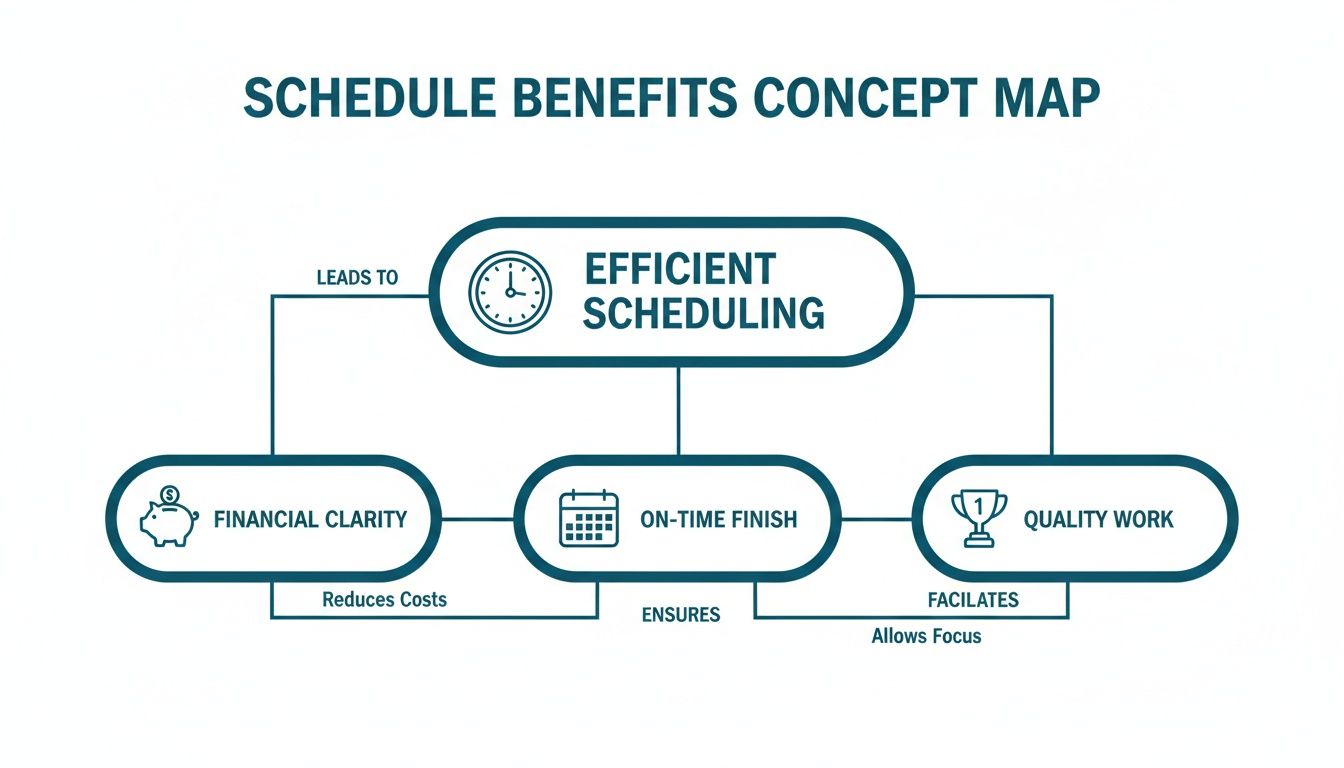
This really brings it home: a well-managed schedule isn't just about speed. It directly leads to better financial control, a predictable finish date, and ultimately, a higher standard of work.
The Big Picture vs. The To-Do List
Finally, builders use schedules with different "zoom levels" to manage both the long-term vision and the immediate work.
The Master Schedule: This is the high-level roadmap for the entire project. It lays out the major phases and key milestones, giving everyone the "big picture" of the journey from groundbreaking to getting the keys.
Lookahead Schedules: These are the opposite—they're highly detailed, short-term plans, often looking just 2 to 4 weeks into the future. This is the team’s weekly action plan, used to confirm subcontractors, check on material deliveries, and handle all the logistics for the tasks right around the corner.
By combining these different methods, a builder creates a powerful system that keeps your project humming along. It all starts with great planning, which is why builders often rely on tools like the Exayard construction estimating platform to dial in costs and timelines before the first shovel ever hits the ground. This kind of detailed prep work is directly linked to quality, a topic we explore more in our construction quality control checklist.
The Team and Timeline Behind Your Dream Home
A great construction schedule is more than just a document—it’s a living, breathing plan executed by a team of real people. Knowing who’s who and understanding the typical journey your home will take can demystify the whole process, turning what feels complex into an exciting, collaborative adventure.
Think of it as getting to know the cast and crew before the show begins.

It’s an intricate dance, and for it to work, everyone needs to know their steps perfectly. This coordination ensures a seamless flow from one phase to the next, keeping your project on track.
Meet Your Project Leadership Team
While dozens of skilled tradespeople will have a hand in building your home, a core leadership team guides the entire process from start to finish. These are the folks responsible for executing the schedule with precision and keeping you in the loop every step of the way.
The General Contractor (GC): You can think of the GC as the conductor of the orchestra. They have the ultimate responsibility for the project's success—managing the budget, timeline, and overall quality from a bird's-eye view. They are your primary partner in bringing the vision to life.
The Project Manager (PM): The PM is the daily director on set and your main point of contact. They’re the logistics guru, coordinating with subcontractors, ordering materials, and making sure the schedule is being followed day in and day out.
The Site Superintendent: This is our on-the-ground commander. The superintendent is on-site every day, supervising the crews, ensuring the work meets our high standards, and tackling any immediate challenges that pop up during construction.
This clear chain of command is essential. It means that from the big-picture strategy down to the daily on-site execution, every single detail is being managed by an expert.
The Typical Journey of a Custom Home Build
So, how does this team take your project from an empty plot of land to a finished home? While every custom build has its own unique quirks, the schedule almost always follows a logical, phased progression. Seeing these stages laid out helps you appreciate the careful choreography involved.
Pre-Construction and Permitting: This is the crucial planning phase that happens before a single shovel hits the dirt. We're finalizing architectural plans, helping you make key material selections, and navigating the local permitting process. A smooth pre-construction phase sets the entire project up for success.
Site Work and Foundation: The first visible signs of progress! This stage includes clearing the land, grading for proper drainage, and pouring the concrete foundation that will support your home for decades to come.
Framing and Rough-Ins: Suddenly, it looks like a house! Your home’s skeleton takes shape as walls go up and the roof structure is built. Right after, plumbers, electricians, and HVAC technicians come in to run all the necessary pipes, wires, and ductwork through the walls.
Exterior and Interior Finishes: This is where the personality of your home really starts to shine through. Windows, siding, and roofing get installed outside, while inside, drywall, flooring, cabinets, and paint transform the spaces.
Final Walkthrough and Handover: After the last fixtures are installed and the home gets a thorough cleaning, we’ll do a detailed walkthrough with you to make sure every detail is absolutely perfect. Once you’re completely happy, we hand over the keys to your new home.
This step-by-step progression is the heart of construction scheduling. It's a carefully planned sequence designed to deliver your vision with the quality and precision it deserves.
Ready to see how our team can bring your dream home to life on a clear, transparent timeline? Let's discuss your project today.
Navigating Common Scheduling Hurdles
Look, even the best-laid plans can hit a snag. In construction, that’s just a fact of life. An experienced builder knows this and doesn't just cross their fingers and hope for the best; they plan for the unexpected right from the start. We believe that being upfront about these potential bumps in the road is the cornerstone of a trusting, transparent partnership.
Building a custom home is a massive undertaking, and it’s only fair you understand how a professional team prepares for what might go wrong. Whether it’s a global supply chain hiccup or just a classic Florida thunderstorm, we have strategies baked into our process to keep your project on track.
Proactive Solutions for Common Risks
Instead of just reacting to problems as they pop up, we build proactive solutions directly into the schedule. This foresight is what separates a smooth, well-managed project from a chaotic, stressful one.
Here are a few of the most common hurdles we see and exactly how we get ahead of them:
Material and Supply Chain Delays: Getting your hands on custom windows, specialty tile, or high-end cabinetry can take months. We identify these long-lead items way back in the pre-construction phase. Orders are placed well in advance so that everything shows up right when we need it, not weeks later, holding up the whole show.
Unpredictable Weather: Here in Florida, you can almost set your watch by the afternoon downpours, not to mention hurricane season. We don't let this catch us by surprise. We build weather contingency days right into the schedule for critical outdoor phases like pouring the foundation, framing, and roofing. It's a simple buffer that absorbs delays without throwing the entire timeline into a tailspin.
Homeowner-Requested Changes: It’s your dream home, and sometimes you’ll see something and realize you want to make a change. We get it! To handle this without creating chaos, we use a formal change order process. This system clearly documents how a change will affect the timeline and budget, so you can make a fully informed decision. This is all part of the same strategic thinking we use when exploring what is value engineering in construction to protect your budget.
By planning for what could go wrong, we ensure more things go right. This foresight is the difference between a project that’s constantly fighting fires and one that progresses with calm and confidence.
Our commitment is to guide you through every possibility with clear communication and expert management, keeping you in the loop every step of the way.
How We Do Scheduling at JVM Construction
At JVM Construction, we see a schedule as much more than a list of tasks and dates. For us, it’s a promise. It’s the roadmap we create together to deliver an exceptional building experience, keeping you informed, involved, and confident every step of the way.
Our entire process is built around your key milestones. We also take a proactive approach to the unique challenges of building in our area, like navigating complex city permits or specific HOA requirements. We get ahead of these things so they don’t cause delays down the road.
A Partnership Built on Communication
We don’t just see you as a client; you're our partner in bringing your vision to life. To make that partnership work, our process is built on a foundation of crystal-clear communication and total transparency. We use modern tools that give you a direct window into your project’s progress anytime you want to look.
Here’s what that looks like in practice:
Regular Progress Updates: You’ll get consistent, easy-to-understand updates showing exactly where we are in the schedule and what’s coming up next. No jargon, just clear information.
Clear Communication Channels: You’ll always know exactly who to call with questions. Our team is here to give you timely and accurate answers.
Milestone-Driven Planning: We structure the timeline around big, exciting moments—like the foundation being poured or the framing going up—so you can see and celebrate real, tangible progress.
For us, a construction schedule isn't just a management tool. It's how we show respect for your time, your investment, and your vision. It’s our integrity made visible.
This belief in transparency touches every part of our work. It’s so important that you feel comfortable and empowered, which is why we encourage homeowners to learn what to ask a general contractor before even starting a project. An informed partner makes for a successful project, every time.
Ultimately, our goal is to turn the often-chaotic process of construction scheduling into something smooth, predictable, and even enjoyable for you. We sweat the details so you can focus on the excitement of watching your dream home take shape.
Ready to talk about your project and experience a building process built on trust and clarity? Contact our team today.
Got Questions About Your Construction Schedule? We’ve Got Answers.
We know that diving into a custom build or major remodel can feel like stepping into a whole new world. You're bound to have questions, especially about the timeline. To give you some peace of mind, here are a few of the most common things we talk through with homeowners.
How Long Does It Really Take to Build a Custom Home?
This is the big one, isn't it? While every project has its own unique rhythm, a good rule of thumb for building a custom home around here is 12 to 18 months from the day we break ground. Factors like the home's final size, how complex the design is, and even the specific challenges of your lot can all nudge that timeline.
And don't forget the prep work! The pre-construction phase—where we nail down the design and navigate the permitting process—can easily add several more months to the very beginning. We'll map all of this out in a detailed schedule for you, so you know exactly what to expect from the get-go.
What Happens If the Schedule Hits a Snag?
Life happens. Sometimes it’s a week of non-stop rain, other times it’s a key material getting stuck in transit. When a delay pops up, our first move is to get on the phone with you. We believe in total transparency.
We’ll lay out what’s going on, how it affects the timeline, and what our plan is to get things moving again. We always build a little buffer time into our schedules for small hiccups, but for anything bigger, we’ll work with you directly to adjust the plan and keep the project on the right track.
Can I Change My Mind After We Start Building?
Of course! It’s your home, and we want you to love every inch of it. We fully expect you might want to make a tweak here or there once you see things taking shape.
When you have an idea for a change, we’ll put together a simple change order. This just makes everything clear for both of us—it details how the change will affect the project's cost and schedule. Once you give it the green light, we'll weave that new work right into the master schedule so the whole team is on the same page.
Ready to build with a team that puts clear communication and a solid plan first? The experts at JVM Construction LLC are here to guide you through a smooth, transparent, and high-quality building process. Start the conversation about your project today.