When you hear the phrase "hurricane-resistant home plans," don't picture a windowless bunker. Instead, imagine a beautifully designed home where every element—from the foundation anchoring it to the earth to the peak of its roof—is engineered to work in harmony. It's a design philosophy that creates a cohesive, powerful system capable of standing strong against the fiercest coastal storms.
This is where elegant architecture meets intelligent engineering, resulting in a home that's fortified from the ground up, giving you and your family true peace of mind.
Why Resilient Home Plans Are a Must-Have in Naples
Imagine the feeling of settling in for the evening, knowing your home isn't just a beautiful place to live—it's a sanctuary, meticulously planned to handle whatever Southwest Florida’s storm season might bring. This isn't about living in fear; it's about building with the confidence that you've prepared for the reality of coastal life.
For anyone dreaming of building a home in a coastal paradise like Naples, choosing a hurricane-resistant plan isn't a luxury upgrade. It's the very foundation of a smart investment. You're not just building a house; you're creating a legacy that protects your family and your financial future for generations to come.
Going Way Beyond "Meeting Code"
Think of standard building codes as the absolute minimum requirement for safety—the "C" you need to pass the class. A truly resilient home, on the other hand, is the "A+" student, built to a much higher standard. Every single component, from the steel straps in the attic to the bolts in the foundation, is designed to work together, resisting the incredible forces of wind and water.
This proactive approach transforms a house from a simple collection of parts into a deeply integrated fortress.
Many people mistakenly believe that a "hurricane-proof" house has to look like a concrete box. That couldn't be further from the truth. The most important protective features—like a continuous load path, reinforced connections, and advanced wall systems—are completely invisible, hidden within the home's structure. This means you can have any architectural style you dream of, from coastal contemporary to classic Mediterranean, and still have an exceptionally strong and safe home.
The Core Ideas Behind a Fortified Home
Building for resilience is all about playing offense, not defense. It's a design strategy that anticipates the challenges of our coastal weather from the very first sketch. The goal isn’t just to build a home that survives a storm, but one that remains largely intact and livable afterward, allowing your life to get back to normal as quickly as possible.
This entire philosophy boils down to a few key areas:
Structural Integrity: This is the big one. It's about ensuring the entire home, from the roof down to the foundation slab, is tied together with steel connectors. This creates a single, solid unit that can resist hurricane-force winds trying to lift it up or push it over.
Building Envelope Protection: We use high-performance materials and smart construction techniques to create a shell that prevents wind-driven rain and debris from getting inside. This is what keeps your family—and your belongings—safe and dry during the storm.
Site-Specific Design: Every property is unique. We must consider your lot’s elevation, its proximity to the water, and other environmental factors. A home on the beach requires a different approach than one a few miles inland. You can learn more about how location impacts design in our guide to waterfront home design in Naples.
When you embrace this comprehensive approach, you're not just putting up a house. You're creating a lasting sanctuary engineered for its beautiful coastal environment. That proactive mindset is the real key to enjoying life in Naples with genuine peace of mind.
What Really Makes a Home Hurricane-Resistant?
So, what’s the secret sauce that makes a house truly ready for a storm? It's not just one thing. It’s a smart combination of clever engineering, specific design choices, and tough materials all working in concert. Together, these features create a hidden strength that shields your home from the incredible forces a hurricane can unleash.
Think of it as a three-legged stool: design, engineering, and materials. If one leg is weak, the whole structure becomes vulnerable.
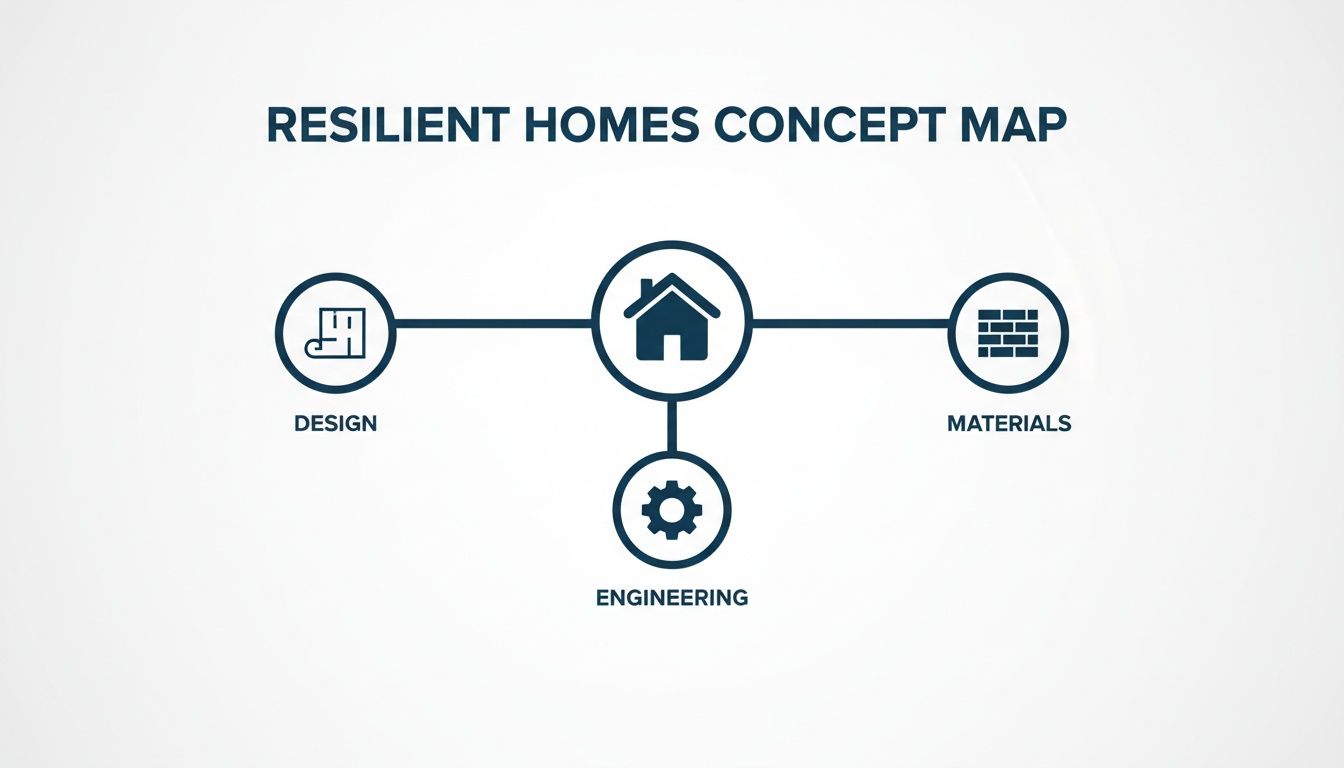
This is a great way to visualize how a truly resilient home is built. Superior design, solid engineering, and durable materials are all interconnected. A failure in one area compromises the entire structure's ability to stand strong.
To really get a feel for how these upgrades work, let's look at a side-by-side comparison of standard building practices versus what's needed to stand up to a hurricane.
Key Features of Hurricane-Resistant Construction
Feature | Standard Construction | Hurricane-Resistant Upgrade | Why It Matters For You |
|---|---|---|---|
Structural Frame | Wood framing with basic nails and staples. | Continuous Load Path with steel straps, clips, and anchor bolts. | Creates an unbreakable chain from roof to foundation, preventing the roof from being lifted off by high winds, keeping your family safe inside. |
Roof Shape | Often a gable roof (A-frame). | Hip roof (sloped on all four sides). | The aerodynamic shape of a hip roof deflects powerful winds instead of catching them like a sail, dramatically reducing the dangerous lifting forces. |
Windows & Doors | Standard single-pane or double-pane glass. | Impact-resistant laminated glass and reinforced frames. | Stops windows from shattering when hit by flying debris, which is the #1 way wind and rain get inside and cause catastrophic damage. |
Garage Door | Basic, unbraced metal door. | Wind-rated, reinforced garage door with heavy-duty bracing. | Protects one of the largest and most vulnerable openings in your home from buckling under intense wind pressure, a common point of failure. |
Wall System | Traditional wood stud walls. | Insulated Concrete Forms (ICF) or reinforced masonry. | Creates a super-strong, solid wall that can withstand impacts from flying debris and extreme wind loads, acting as your home's armor. |
As you can see, every component is deliberately chosen and engineered not just to meet basic code, but to perform when it matters most. It's a holistic approach to building a fortress for your family.
The Unbreakable Chain: A Continuous Load Path
If there's one concept to really grasp, it's the continuous load path. Imagine it as a steel chain that literally connects every piece of your home—from the very top of your roof, down through the walls, all the way to the concrete foundation it sits on. Every "link" in that chain is a specialized steel connector, like a hurricane strap or clip, that fastens the structure together.
When hurricane winds batter your roof, they create a powerful upward suction, trying to rip it right off. In a typical home, that force can cause the connections to fail. But with a continuous load path, all that energy gets channeled safely down through the walls and is anchored securely into the foundation. It keeps the whole house locked down.
Smart Roof Design Deflects Wind
Not all roofs are created equal when it comes to wind. The shape of your roof plays a massive role in how it behaves in a storm.
Hip Roofs: These roofs have four slopes, making them naturally more aerodynamic. Wind flows over and around the house much more smoothly, which dramatically reduces that dangerous upward pressure. It's a huge built-in advantage.
Gable Roofs: While very common, their flat, vertical ends act like a giant sail in the wind. Without serious extra bracing, they are far more likely to be peeled off or collapse during a hurricane.
Starting with a shape that works with the wind, not against it, is half the battle.
Fortifying Your Home’s Weakest Links
Even the strongest fortress has its vulnerable spots. For a house, those are the openings: windows, doors, and especially the garage door. These are almost always the first things to fail. Once an opening is breached, wind rushes inside, and the internal pressure can literally blow the roof off or knock down walls from the inside out.
A fascinating 2022 MIT study highlighted that we've been seriously underestimating the value of hurricane-resistant features. Researchers found that the way nearby buildings are arranged can actually funnel wind and increase the load on a home by up to 50%—a factor most risk models completely miss. By simply upgrading to stronger walls, impact-resistant windows, and a well-anchored roof, homeowners can cut their potential losses by far more than anyone thought. You can read more about how resilient construction is undervalued by billions on the MIT News website.
This is why hurricane-resistant plans focus so heavily on beefing up these areas. Tools like Exayard glazing takeoff software are even used by professionals to accurately spec out and quantify the impact-resistant glass needed for a project.
Here’s how a resilient home plan deals with these weak points:
Impact-Resistant Windows and Doors: Often called "hurricane windows," they're made with laminated glass that has a tough polymer layer sandwiched inside. If a piece of debris hits it, the glass might crack, but it won't shatter. It holds together, keeping wind and water out.
Reinforced Garage Doors: Your garage door is a massive target. A standard one will buckle easily. Wind-rated doors are built with heavy-duty bracing to withstand extreme pressure, securing what is often the biggest hole in your home.
Advanced Wall Systems: The walls are your home's armor. Cutting-edge systems like Insulated Concrete Forms (ICF) are a game-changer. They are essentially hollow foam blocks that are stacked like Legos and then filled with steel-reinforced concrete. The result is a solid, ultra-strong wall that can take a beating from both wind and flying debris.
By zeroing in on these core features, a hurricane-resistant plan elevates a standard house into something that can genuinely protect you. It’s this deep-seated commitment to engineering and quality that delivers real peace of mind when the weather turns ugly.
Choosing the Best Resilient Building Materials
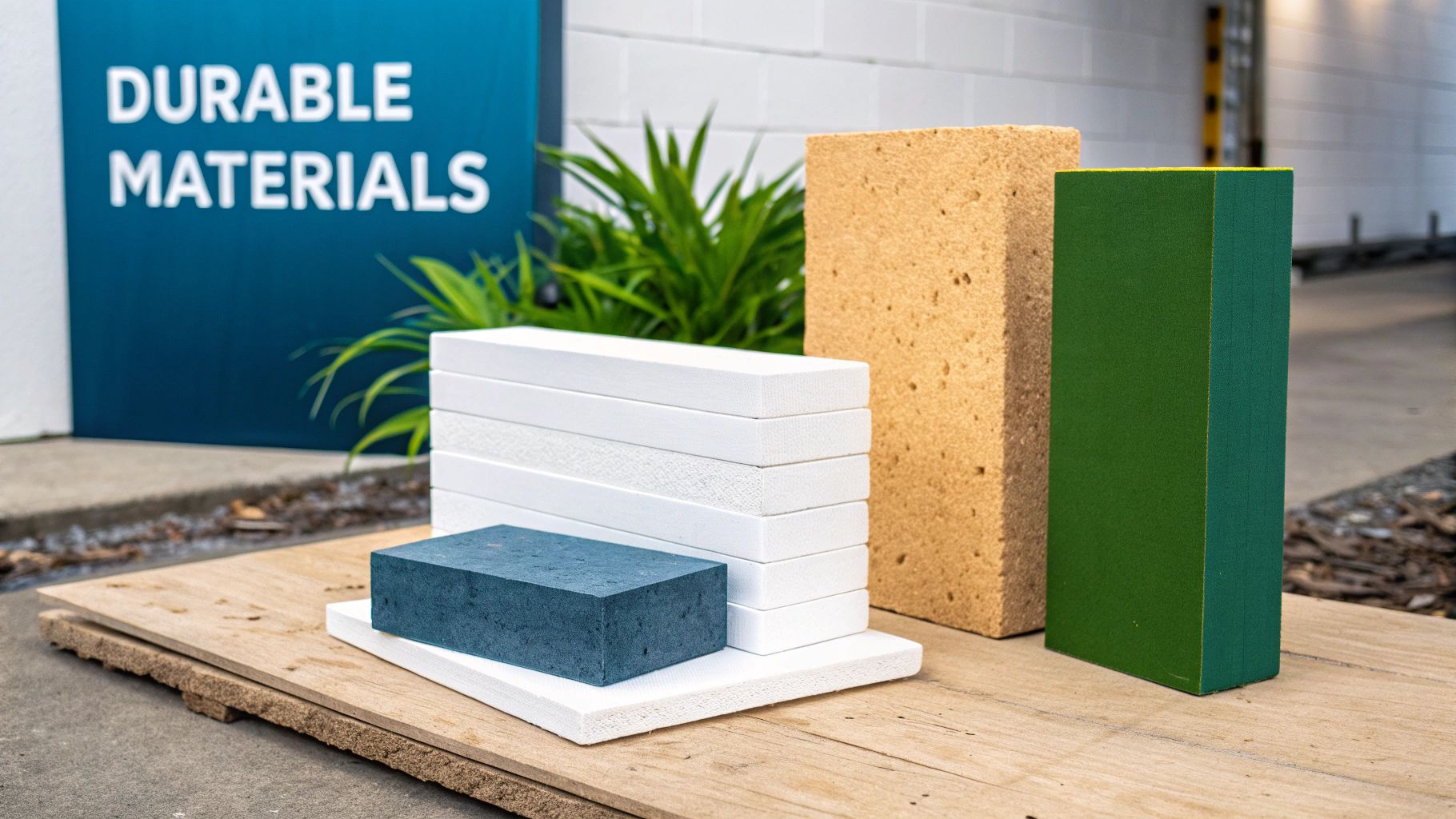
The materials you choose for your home are its first line of defense against severe weather, acting as its armor. When we're putting together hurricane-resistant home plans, picking materials with serious strength and durability isn't just an upgrade—it's the heart of the whole strategy. Let's dig into the components that give a coastal home its backbone.
Think of it like packing for a major expedition. You wouldn't take a flimsy tent to climb Mount Everest, right? In the same way, you can't use standard, run-of-the-mill materials when building in a high-wind zone like Naples.
The Power of Concrete Construction
When it comes to sheer, brute strength, concrete is king. It offers a kind of mass and rigidity that traditional wood-frame construction just can't touch, making it the go-to choice for homes in hurricane country. Two methods in particular really stand out for their incredible resilience.
Insulated Concrete Forms (ICF): This system is a real game-changer. We stack hollow foam blocks, reinforce them with steel rebar, and then pour solid concrete into the core. What you get is a monolithic wall of incredible strength, buffered on both sides by high-performance insulation. A practical benefit? Not only is it strong, but it also makes your home incredibly quiet and energy-efficient.
Concrete Masonry Units (CMU): You probably know these as concrete blocks. CMUs are a time-tested, proven material for Florida construction. Once they're reinforced with rebar and filled with concrete, they create a formidable barrier against both wind and impacts.
Both of these methods create walls that are exceptionally resistant to the immense wind pressure and flying debris that cause so much structural failure during a major storm.
Protecting Your Home from the Top Down
While solid walls are absolutely critical, it's the roof and exterior cladding that face the first wave of a storm's assault. Choosing the right materials here is non-negotiable if you want to keep the elements out and maintain the integrity of your home's protective shell.
A truly durable roofing system is about much more than just the shingles you can see from the street. It's an entire system that includes a sealed roof deck, a super-strong underlayment, and materials specifically designed to handle high-velocity winds and impacts.
Top Choices for Resilient Roofing and Siding:
Metal Roofing: Standing seam metal roofs are exceptionally tough and can withstand wind speeds of 140 mph or more. They are highly resistant to impacts, and their interlocking panels make it incredibly difficult for wind to get underneath and cause uplift.
Concrete or Clay Tiles: When they're installed correctly to meet high-wind standards, tile roofs offer fantastic protection and have a long lifespan that's perfectly suited for Florida's climate.
Fiber Cement Siding: This stuff is a brilliant alternative to wood or vinyl. It resists rot, pests, and fire, and it won’t warp or buckle under the intense sun and rain we get on the coast. Most importantly, it stands up incredibly well to impacts from wind-blown debris.
Don't Overlook the Details
Even with the best primary materials, a home is only as strong as its weakest link. The small details in how everything is connected and sealed can make a massive difference in whether your home stays dry and secure.
For instance, we use advanced framing techniques to ensure that every single connection point is reinforced to handle immense stress. This includes specialized fasteners and corrosion-resistant coatings to fight back against the salty air. Just as vital is making sure every component is installed perfectly. Our guide on a construction quality control checklist gives you a better look at why a meticulous process is so important.
When you're thinking about how to strengthen vulnerable spots, exploring options like hurricane protection window film can provide an extra layer of defense against debris. By combining robust foundational materials with high-performance exterior finishes and a laser focus on the details, you create a home that is truly built to last.
Getting to Grips with Florida’s Building Codes
There’s a reason Florida has some of the most rigorous building codes in the world. They weren't just dreamed up in an office; they were written in the aftermath of devastating storms like Hurricane Andrew, a storm that fundamentally changed how we build along the coast. Think of these codes less as red tape and more as a battle-tested blueprint for survival.
Getting your head around all the regulations can seem daunting, but it’s really about understanding the why behind them. These rules dictate the very skeleton of your home, ensuring it’s designed to stand strong when the wind howls and the water rises. A seasoned builder sees these codes not as the ceiling, but as the solid floor on which to build a truly resilient home.
Why Naples is in a "High-Velocity Hurricane Zone"
If you're building in Naples, you’re in what’s known as a High-Velocity Hurricane Zone (HVHZ). This isn't just a fancy name; it's a special designation for areas that face the greatest threat. It means the rulebook for construction here is even stricter than in many other parts of the state.
This is where things get serious with wind load design. It’s not as simple as just building a strong wall. Engineers have to account for the complex physics of a hurricane—the terrifying uplift that wants to tear your roof off, the immense sideways (lateral) pressure pushing on your walls, and the downward forces trying to crush the structure. Every single component, from the smallest connector to the largest window, has to be designed to handle this multi-directional assault.
Understanding Flood Zones and Building High
After the wind, water is a hurricane’s most destructive weapon. That's why figuring out your property's flood risk is a critical first step. FEMA flood maps tell us which areas are most vulnerable, and from that, the local building department sets a Base Flood Elevation (BFE).
The BFE is the height that scientists predict floodwater could reach during a major storm. In Naples, your home's lowest living floor must be built above this line, and often with an extra cushion of a foot or more called "freeboard." This simple act of elevation is one of the most powerful defenses against flood damage.
A great builder doesn’t just meet the minimum height. They look at your entire property, designing the foundation and landscape to actively shed water away from the house. Lifting the home is a cornerstone of smart coastal design, turning a potential disaster into a manageable event.
We’ve seen proof that this kind of forward-thinking engineering works. Back in the early 2000s, a partnership between a major builder and the U.S. Department of Energy pioneered an advanced Concrete Screen Wall System (SWS). Thousands of these homes were put up just before the intense 2005 hurricane season. The storms came, and the results were stunning: these concrete homes held up remarkably well, shrugging off high winds and flying debris far better than their traditionally-built neighbors. You can dive into the specifics by reading the official Department of Energy report on their performance.
Going Beyond the Bare Minimum
Meeting the building code is just the legal requirement—it’s the C-grade you need to pass. A truly fortified home is built to a much higher standard. This is where an expert builder really shows their value, using materials and techniques that go above and beyond what the code demands. This commitment to a higher standard is what gives you real security and peace of mind, knowing your home isn't just compliant, it's genuinely prepared.
Ready to discuss a home that doesn't just meet the codes, but masters them? Let's start the conversation about building your resilient sanctuary in Naples.
The Financial Payoff of Building a Hurricane-Resistant Home
Let's be honest: building a hurricane-resistant home is about protecting your family, first and foremost. But right behind that is the powerful financial logic. This isn't just an expense; it's one of the smartest investments you can make, especially here in Naples. The long-term savings and value it creates are simply too big to ignore.
Sure, you might spend a little more on the front end for things like impact windows or a stronger roof. But that initial investment starts paying you back almost immediately through lower ownership costs, avoiding disastrous repair bills, and a major boost to your home's market value. It's a crystal-clear case for building better than the bare minimum.
Slash Your Homeowners Insurance Premiums
One of the first places you'll see the payoff is in your insurance bill. Insurance companies are all about managing risk, and a house built to shrug off a hurricane is a much safer bet for them. To encourage smart building, they offer some seriously deep discounts to homeowners who reduce that risk.
We're not talking about a few bucks here and there. Homes that earn a FORTIFIED designation from the Insurance Institute for Business & Home Safety (IBHS) can see their premiums drop by 20-50%, sometimes even more. This certification is like a gold star for your home—it’s verifiable proof for your insurer that your house was built to a much higher, safer standard.
Think about that over the life of a 30-year mortgage. Those savings can easily add up to tens of thousands of dollars. Suddenly, the cost of those upgraded features doesn't just get paid back; it starts putting money back in your pocket. It’s a powerful financial reason to build it right the first time.
Increase Your Home’s Resale Value
In a place like Southwest Florida, "storm-ready" is quickly becoming a top feature on a homebuyer's checklist. A fortified home isn't just another bullet point on a sales flyer; it's a huge selling point that makes your property stand out and command a higher price.
Put yourself in a buyer's shoes for a moment. They're looking at two beautiful homes. One is built to standard code. The other is a certified hurricane-resistant home. Which one offers more?
Real Peace of Mind: They know the home is engineered to keep their family safe.
Lower Bills from Day One: They get to inherit your low insurance premiums.
Fewer Future Headaches: They're not worried about facing a six-figure repair bill after the next big storm.
This demand translates directly into real dollars. Your investment in quality construction will pay you back again when it's time to sell.
Avoiding the Crushing Cost of Storm Repairs
The real financial test comes when a hurricane finally passes through. While your neighbors might be dealing with destroyed roofs, shattered windows, and crippling water damage—and the massive bills that follow—a hurricane-resistant home is designed to come through with minimal, if any, damage.
Investing in a continuous load path, impact glass, and a sealed roof deck is like pre-paying for your home's survival. You're sidestepping the catastrophic repair costs that can derail a family's finances for years. It's an investment in your financial stability and your ability to get back to normal life quickly when it matters most.
Your Path to a Resilient Custom Home
Taking your hurricane-resistant house plans from a blueprint to a beautiful, livable reality is where the real magic happens. This final step is all about finding a partner who genuinely shares your vision for safety, quality, and fine craftsmanship. It’s a process that should feel like a true collaboration, transparent and clear from the very first chat to the moment you walk through the finished home.
The journey starts with a deep-dive design consultation. This is where we sit down and talk about your lifestyle, your design tastes, and pinpoint the specific resiliency features that will bring you the most peace of mind. It goes way beyond just picking out paint colors; it’s about understanding how your home will function as your ultimate sanctuary.
From that conversation, we move into selecting the right materials and managing the construction with an eagle eye. Every single choice is made with intention—from the specific concrete mix for the walls to the brand of fasteners holding down your roof. Our hands-on management style guarantees that every detail is executed to the absolute highest standards of resilient building.
Questions to Ask Your Builder
Before you sign on the dotted line, you need to feel confident you're working with a team that has real, boots-on-the-ground experience. A builder's answers to these questions will tell you a lot about their expertise and whether they're truly committed to building a fortified home.
"What's your experience building to FORTIFIED standards?" This shows you if they understand construction methods that go well beyond just meeting the bare minimum of the code.
"Can you show me examples of homes you've built in High-Velocity Hurricane Zones?" This is crucial. It confirms they have firsthand experience with the demanding regulations right here in places like Naples.
"How do you personally ensure a continuous load path is installed correctly?" This gets technical, but it tests their understanding of the single most important structural detail for wind resistance.
"What specific materials do you recommend for roofing and siding in our climate, and why?" Their answer should reveal a deep knowledge of what holds up to Florida's intense combination of wind, rain, and sun.
Picking the right builder is arguably the most important decision you'll make in this entire process. Our approach to custom home building services is built around giving you clarity and confidence every step of the way.
Your dream home in Naples can be both a stunning coastal retreat and a powerful fortress against the storm. Contact us today to begin a conversation about building a resilient custom home designed to stand strong for generations.
Answering Your Questions About Hurricane-Resistant Homes
Thinking about building a home that can stand up to a hurricane brings up a lot of questions. It's a big investment, and you want to get it right. To help you feel more confident, I've answered some of the most common questions we hear from homeowners in Naples and other coastal areas.
How Much More Does a Hurricane-Resistant Home Cost to Build?
This is usually the first thing people ask, and it's a fair question. Building a truly hurricane-resistant home typically adds about 3-10% to the total construction cost compared to a standard home.
But you have to look at the bigger picture. That upfront cost often pays for itself over time, sometimes surprisingly quickly. For instance, the superior insulation in systems like Insulated Concrete Forms (ICF) means you'll see lower energy bills every single month.
The real game-changer, though, comes from the massive savings on homeowners insurance and, most importantly, avoiding the catastrophic repair bills that can follow a major storm. When you add in the higher resale value, building for resilience isn't just about safety—it's one of the smartest financial decisions you can make for a coastal property.
Can I Make My Existing Home More Hurricane-Resistant?
Yes, absolutely. While you probably aren't going to tear down your walls and start over, you can make targeted upgrades that dramatically improve your home's ability to withstand a storm.
Some of the most effective retrofits we recommend include:
Installing Impact-Resistant Windows and Doors: This is your first line of defense. Protecting these openings is critical to keeping wind and water out.
Reinforcing Roof-to-Wall Connections: This means adding hurricane straps and clips to create that solid, continuous connection from the roof down to the foundation.
Bracing Your Garage Door: Your garage door is a huge, vulnerable opening. Upgrading to a modern, wind-rated door is a non-negotiable for storm safety.
A good builder can walk through your home and point out the weakest links, helping you prioritize the upgrades that will give you the most bang for your buck.
Do Hurricane-Resistant Homes Look Different?
Not at all, and this is a huge misconception. The features that make a home hurricane-resistant are almost entirely structural—they're hidden inside the walls, the roof, and the foundation.
You can have any architectural style you dream of, whether it's sleek coastal modern or a classic Mediterranean villa. Resilience comes from smart engineering and better materials, not a specific look. You never have to choose between a beautiful home and a safe one.
What Is the FORTIFIED Home Program?
The FORTIFIED Home™ program is a building standard developed by the Insurance Institute for Business & Home Safety (IBHS). Think of it as going above and beyond the minimum requirements of local building codes to create a home that is scientifically proven to be stronger against hurricanes, high winds, and hail.
A home that earns a FORTIFIED certification has been inspected and verified by an independent third party. It’s not just a claim—it's proof that your home was built to a higher standard. This certification can unlock significant insurance discounts and gives you incredible peace of mind.
Ready to build a home that offers both stunning design and the strength to weather any storm? At JVM Construction LLC, we specialize in creating custom resilient homes that blend luxury with lasting security. Contact us to start planning your Naples sanctuary today.