You're probably at the stage where the bathroom still functions, but it no longer feels like it belongs in the rest of your home. The layout wastes space. The shower is undersized. The vanity looks dated beside the quality of the rest of the property. In Naples, that gap becomes obvious fast, especially in homes where every other room has already been upgraded to a higher standard.
A luxury bathroom remodel in Naples should do more than add a freestanding tub and better tile. It should fit the architecture of the home, hold up to coastal conditions, and feel intentional in the same way a well-built custom residence does. The right project improves daily living, but it also corrects weak points in layout, ventilation, waterproofing, and finish selection that often get ignored in quick remodels.
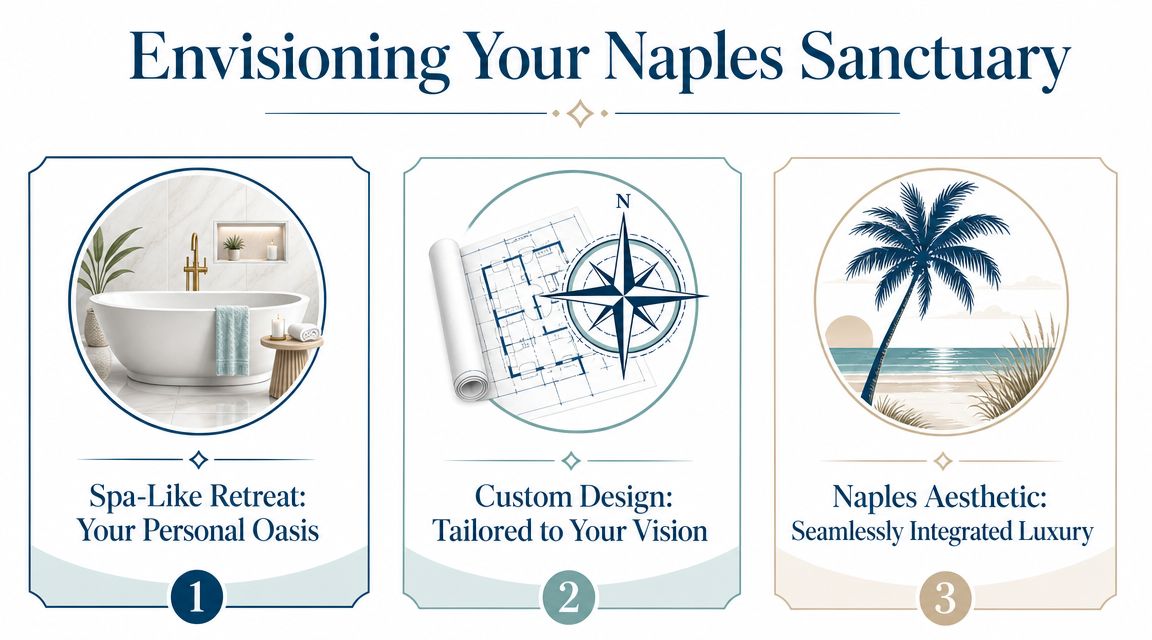
Envisioning Your Naples Sanctuary From Dream to Plan
Most homeowners begin with images. A warm stone palette. A larger shower. Better lighting. More storage. Those ideas matter, but the first real decision isn't style. It's scope.
If the room feels cramped, dark, or disconnected from the primary suite, cosmetic updates won't solve the problem. A successful luxury bathroom remodel Naples homeowners feel good about starts with asking what needs to change structurally, functionally, and architecturally. Sometimes that means reworking the shower and vanity wall. Sometimes it means taking square footage from an adjacent closet, changing door swings, or rebuilding the room around a stronger layout.
Start with function before finishes
The best planning conversations usually revolve around how the room is used at the beginning and end of the day.
Ask practical questions like:
Traffic flow: Do two people have enough clearance to move comfortably at the same time?
Storage habits: Are drawers, towers, and linen storage more valuable than a larger decorative vanity?
Shower use: Would a larger walk-in shower improve the room more than adding a tub you rarely use?
Privacy needs: Should the water closet be reworked for better separation?
Whole-home alignment: Does the bathroom match the home's broader design language, or does it feel like a one-room update?
These decisions affect plumbing locations, electrical planning, cabinetry design, slab selections, and permit drawings. That's why the planning stage should be handled with the same discipline used in luxury bathroom remodel ideas for broader custom-home thinking, not as a late shopping exercise.
Practical rule: If you choose tile and plumbing fixtures before confirming the layout, you're making expensive decisions in the wrong order.
Build a budget that reflects Naples reality
Naples is not an average remodeling market. One local cost guide notes that luxury master suite remodels commonly start at $30,000 and often exceed $70,000, while skilled labor can represent 40%–50% of total project cost. The same guide says even smaller Naples bathrooms commonly fall in the $8,000–$15,000 range, which still runs above many national expectations, and recommends a 10%–20% contingency reserve for hidden conditions discovered during renovation (Naples bathroom remodel cost guide).
That budget reality changes how you plan. A serious remodel isn't just tile, cabinetry, and fixtures. You also need room for demolition discoveries, code-related corrections, specialty labor, waterproofing systems, ventilation upgrades, and lead-time decisions that can affect the build schedule.
A workable planning framework
Before design drawings are finalized, lock down these items:
Non-negotiables first. Better showering, more storage, improved lighting, and a stronger layout should rank above decorative add-ons.
Material priorities next. Decide where you want permanence. Slab walls, custom cabinetry, premium plumbing trim, and glass are harder to swap later.
Contingency stays untouched. Don't spend reserve funds on upgrades before demolition begins.
Tie the remodel to the house. In Naples, a primary bath should feel like part of the residence's overall architecture, not a showroom insert.
When this stage is done well, the project feels calmer from the start. Fewer rushed changes. Fewer mismatched decisions. Better results.
Designing for the Coast With Materials That Endure and Inspire
A beautiful bathroom can still fail if it's specified like an inland project. In Naples, the room has to handle humidity, moisture, and in some homes the broader demands of coastal exposure. That's why material selection needs a tougher filter than simple color matching.
A local Naples remodeling source highlights a point many homeowners don't hear early enough. Finishes and systems need to be specified for humidity, salt air, and hurricane-zone requirements, because long-term durability matters more than style alone when corrosion and mold are on the line (Naples bathroom remodeling considerations for coastal durability).
What holds up and what needs more care
Some luxury materials are worth the upkeep. Others look impressive on sample boards but become maintenance-heavy once steam, cleaning routines, and daily use enter the picture.
Here's a practical comparison:
Material | Durability | Maintenance | Best For |
|---|---|---|---|
Large-format porcelain | Strong choice for wet conditions and consistent performance | Lower maintenance than many natural surfaces | Shower walls, floors, and contemporary designs |
Natural stone such as marble or travertine | Elegant, but performance depends on application and maintenance discipline | Higher maintenance, requires careful sealing and cleaning habits | Feature walls, vanities, and homeowners comfortable with upkeep |
Engineered surfaces | Stable and predictable in many bathroom applications | Generally easier to maintain than porous natural stone | Vanity tops, integrated sink designs, and cleaner-lined bathrooms |
Marine-grade metals | Better suited for coastal durability where corrosion is a concern | Maintenance depends on finish and cleaning products used | Plumbing trim, hardware, and exposed metal details |
Where homeowners make avoidable mistakes
The common misstep is choosing materials by appearance only. A polished marble floor may look exceptional, but if the bathroom has heavy daily traffic, frequent moisture, and limited natural drying, it may not be the smartest floor surface. The same goes for low-grade metal finishes that start showing wear in a high-humidity environment.
A better approach is to think in layers:
Use stable surfaces in the wettest zones. Shower walls, niches, and floors should prioritize reliable water performance.
Reserve delicate materials for lower-stress applications. Feature walls and vanity areas usually give you more freedom.
Choose cabinetry built for moisture. Painted wood can work, but only if fabrication and finishing are done for a bathroom environment.
Treat ventilation as a finish protector. Good air movement preserves paint, mirrors, cabinetry, and metal trim.
Coastal design works best when the room looks refined without depending on fragile choices to create that effect.
For homeowners who want a bathroom that feels rooted in place, it helps to study Florida-style home designs that suit coastal architecture. The strongest rooms don't chase trends. They use materials and detailing that belong in Southwest Florida and still look right years later.
The right trade-off is rarely the flashiest one
Large-format porcelain often wins on performance and visual control. Natural stone still has a place, especially when you want depth and variation that manufactured products can't fully replicate. But in most Naples bathrooms, the smartest specification mixes the two. Durable, low-maintenance surfaces in the highest-exposure zones. Richer materials where they can be appreciated without carrying the full burden of daily wear.
That balance is what keeps a high-end bathroom looking expensive long after install day.
Finding the Right Partner for Your Custom Home Vision
A luxury bath renovation isn't a one-room transaction. It touches design intent, structural judgment, permitting, scheduling, trade coordination, and finish execution. That's why choosing a builder should feel closer to selecting a long-term partner for your home than hiring a crew to replace tile.
The best relationships start with process, not promises. You want to know how the builder documents scope, handles revisions, sequences trades, communicates during construction, and protects the rest of the home while work is underway.
What to look for beyond a photo gallery
A polished portfolio matters, but it doesn't tell you how the project ran. Ask questions that reveal how the builder operates when decisions get complicated.
Look for evidence of these qualities:
Clear preconstruction work: Accurate field measurements, realistic drawings, and material review before ordering.
Local code familiarity: Naples and Collier County work requires someone who understands permitting and inspection expectations.
Trade coordination: Bathrooms involve tight sequencing between plumbing, electrical, tile, glass, paint, and finish carpentry.
Documentation habits: Change orders, allowances, product approvals, and schedule updates shouldn't be casual.
Whole-home perspective: The remodel should respect adjoining rooms, flooring transitions, trim details, and the home's overall architecture.
Why full-service capability matters
In high-end homes, bathroom work often reveals bigger opportunities or constraints. Once walls open, you may decide to improve adjacent closets, update suite lighting, or correct framing and mechanical issues that affect more than the bath itself.
That's where a full-service general contractor can be useful. For example, JVM Construction LLC handles custom homes, whole-home remodels, and high-end renovations in Naples, which is relevant when a bathroom project needs to align with a broader residential vision rather than stand alone as an isolated update.
A builder who can think past the room usually makes better decisions inside the room.
Questions worth asking in the first meeting
Don't focus only on finishes and start dates. Ask how the team approaches planning, quality control, and problem-solving.
A few worthwhile questions:
How do you verify dimensions before materials are ordered?
Who manages day-to-day communication during construction?
How do you handle discoveries behind walls?
What parts of the work are most sensitive to sequencing?
How do you protect the rest of the residence during demolition and installation?
The right partner won't rush through those answers. In this kind of renovation, calm, organized communication is usually a stronger sign than a dramatic sales pitch.
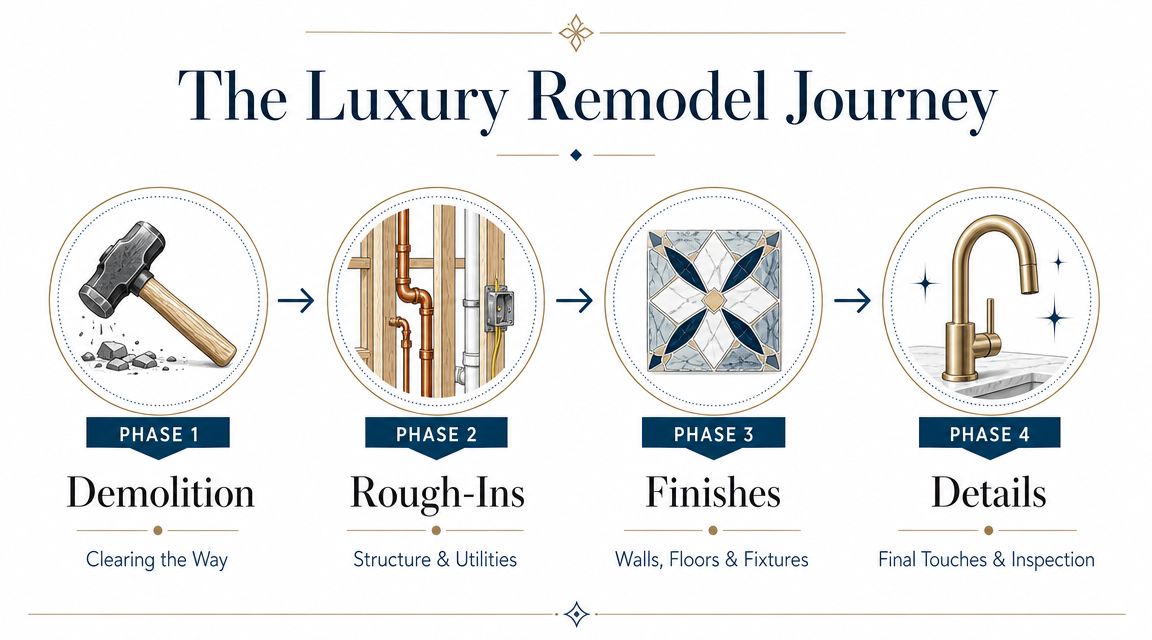
From Demolition to Details The Remodeling Journey
Once construction begins, most homeowners stop thinking about tile samples and start thinking about disruption. That's normal. Bathrooms are compact spaces with a lot happening inside the walls, and the sequence matters more than many people expect.
The remodel usually feels busiest at the beginning. Protection goes down in adjacent areas. Demo crews remove finishes. Trades inspect what's been exposed. Then the primary work begins, and at this stage, professional management makes a visible difference.
What the construction sequence usually feels like
Homeowners often expect steady visual progress every day. In reality, some of the most important steps are the least dramatic.
A typical journey looks like this:
Demolition and discovery: Existing finishes come out, and the team confirms field conditions against plan drawings.
Rough framing and utilities: Plumbing, electrical, blocking, framing corrections, and ventilation work get installed or adjusted.
Substrates and waterproofing: Backer systems, slope work, waterproofing membranes, and shower prep happen before finish materials appear.
Tile, cabinetry, glass, and trim: The room begins to look complete, but tolerances get tighter and coordination becomes more exact.
Punch and final review: Hardware alignment, fixture operation, sealant quality, lighting, paint touch-ups, and final corrections are addressed.
The phase that can't be treated casually
The most technically sensitive part of the project is waterproofing and moisture control. Industry guidance stresses the need for trained specialists, moisture-resistant substrates, and proper sealing, because small installation defects in bathrooms can become expensive long-term failures (bathroom remodel mistakes to avoid with emphasis on waterproofing).
That reality affects how pros build showers, niches, benches, and floor transitions. A bathroom can look flawless at completion and still be wrong underneath if the prep work wasn't done correctly. Homeowners rarely see that layer, but it's the one protecting the investment.
Field note: The prettiest tile in the room won't save a shower that was built on weak prep.
Keeping the project controlled while you live nearby
Some clients stay in the home during the work. Others prefer to step out for part of the process. Either way, disruption management matters. Dust control, material staging, delivery timing, daily cleanup, and access routes all need a plan.
For homeowners reviewing project risk during construction, it can also help to understand how builders risk insurance works for renovation projects. It's one of those topics often overlooked until a job is underway, but it belongs in early conversations when significant construction is happening inside a valuable home.
Details are where luxury either holds or falls apart
Late in the process, the room can look nearly done and still need real craftsmanship. Tile alignment at corners. Slab veining through returns. Mirror lighting placement. Hardware consistency. Glass fit. Caulk lines. Door reveals.
Those details separate a room that photographs well from a room that feels resolved in person. In Naples homes with a high design standard, that final layer matters as much as the bigger planning decisions.
Beyond the Budget Costs and Return on Your Investment
Homeowners usually ask two financial questions. What should this project cost, and will I get the money back? The honest answer is that both questions matter, but neither should be viewed too narrowly.
In Southwest Florida, mid-range bathroom remodels typically return 60%–75% of investment at resale, and the National Kitchen and Bath Association planning guideline cited by a Naples contractor suggests budgeting 5%–10% of the home's value for a bathroom remodel (Southwest Florida bathroom remodel budgeting and resale guidance). In the same Naples market discussion, one contractor also cites an average upscale bathroom remodel cost of about $67,000 with an average value increase of $37,000.
What those numbers mean in practice
Those benchmarks are useful, but they don't tell the whole story for a luxury property. In Naples, buyers often expect primary baths to match the caliber of the rest of the home. If the kitchen, flooring, windows, and exterior have been upgraded but the bathroom still feels dated, the room can pull down the perception of the whole residence.
That's why high-end bathroom work is often about more than direct payback. It helps the home present consistently. It reduces the visible gap between market expectations and current condition. It also makes daily use dramatically better if this is the home you plan to enjoy, not just sell.
A better way to evaluate value
Think about the investment in three buckets:
Personal use value: Better comfort, better storage, better lighting, and better flow every day.
Property alignment: The bathroom should support the home's price point, architecture, and finish level.
Risk reduction: Correcting aging waterproofing, weak ventilation, tired finishes, or poor layouts can prevent future headaches.
Luxury remodeling earns its keep in two ways. It improves how you live now, and it keeps the house from feeling behind the rest of the market.
Where owners overspend and where spending is justified
Overspending usually happens when decorative upgrades outpace the underlying plan. A room with expensive slab walls and premium fixtures can still disappoint if the lighting is flat, storage is insufficient, or the shower is undersized.
Spending tends to be justified when it improves one of the fundamentals:
Layout and circulation
Waterproofing and substrate quality
Ventilation and moisture control
Cabinetry design and storage function
Finish selections that suit long-term use in a coastal environment
That's the difference between a costly room and a valuable one.
Your Questions Answered A Naples Remodeling FAQ
Do I need a permit for a luxury bathroom remodel in Naples
If the work affects plumbing, electrical, framing, or other regulated building elements, permit requirements should be reviewed early. In practice, high-end bathroom renovations often involve more than finish replacement, so permit planning is usually part of responsible preconstruction. A local builder should guide that process and account for review timelines before materials are scheduled.
Can I live in the house during the remodel
Often, yes. It depends on the location of the bathroom, how much of the suite is affected, and whether you have another functional bath available. The key question isn't just whether you can stay. It's whether the builder has a plan for dust control, access paths, working hours, and day-to-day housekeeping that makes staying realistic.
What's the difference between a remodel and a renovation
Homeowners use the terms interchangeably, but they often describe different levels of work. A simple remodel may focus on finish replacement. A renovation usually goes deeper and can involve layout changes, utility relocation, framing corrections, ventilation upgrades, and a more complete rebuild of the space.
How early should I choose materials
Early enough to support planning, but not so early that you're making finish decisions before the layout is settled. The smartest order is layout first, then plumbing and electrical implications, then finish packages that fit the approved plan. That sequence reduces rushed substitutions and ordering mistakes.
What matters most in a high-end bathroom if I want lasting quality
Start below the surface. Waterproofing, moisture management, substrate preparation, and coastal-appropriate material selection matter more than decorative trends. Once those are correct, cabinetry, lighting, stone, tile, and glass can do their job without carrying the whole room.
Should I treat this as a stand-alone project or part of a larger home plan
If the bathroom sits inside a home that may see future renovations, think bigger from the beginning. Even if you only build the bathroom now, your design, finish, and construction decisions should align with the broader architecture of the house. That approach avoids one-off choices that feel disconnected later.
If you're considering a luxury bathroom remodel and want it planned as part of a coherent custom home vision, JVM Construction LLC is a Naples-based general contractor for custom homes, whole-home remodels, condo renovations, and high-end interior work. Reach out to discuss your property, your goals, and the level of construction planning the project will require.