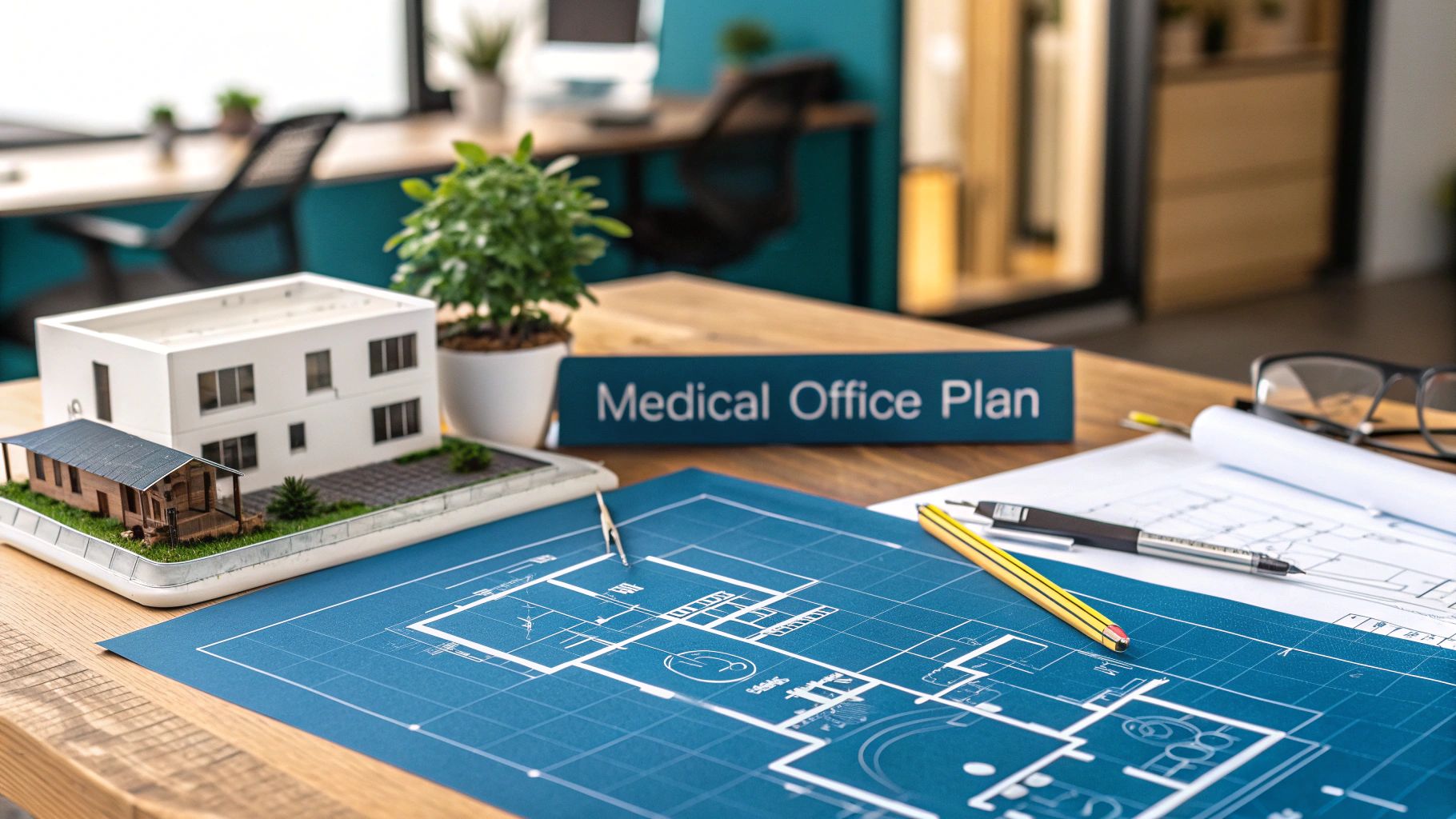
Medical office space planning is so much more than just figuring out where to put walls and furniture. It’s the art and science of designing a healthcare space to make everything run smoother—for your patients, your staff, and your practice's long-term health.
A well-designed office can genuinely reduce patient anxiety, cut down on staff burnout, and become a cornerstone of your practice's success. It’s the difference between a space that causes daily headaches and one that actively helps you deliver outstanding care.
Your Blueprint For A Successful Practice
Think of your office layout as a silent partner. It can either create daily frustrations—like a cramped waiting room or staff constantly bumping into each other—or it can promote a seamless, efficient workflow. That's why diving into medical office space planning isn't just another task on the to-do list; it’s one of the most critical investments you can make in the future of your practice.
A thoughtful layout can completely change the patient experience. Imagine a nervous new patient trying to navigate a confusing maze of hallways versus stepping into a space with a clear, intuitive path from reception to the exam room. The difference is huge, and it sets the tone for their entire visit, building trust from the very first step.
The Core Pillars of Effective Design
Getting this right means balancing several key pillars that all need to work in harmony. If you drop the ball on any one of them, you could end up with operational bottlenecks, compliance headaches, or a space that just feels wrong to patients and staff. Getting a handle on these elements is the first step toward building a facility that works for you, not against you.
Let's break down the core components you need to get right.
Pillar | Primary Goal | Practical Example |
|---|---|---|
Clinical Workflow & Adjacencies | Arrange rooms logically to minimize staff travel time and create an efficient "flow." | Placing a nurse's station at the center of a "pod" of 4-6 exam rooms. |
Patient Journey Mapping | Design the space from the patient's point of view to ensure a calm, private, and intuitive experience. | Ensuring the checkout desk is conveniently located near the exit, with a private area for payment discussions. |
Regulatory & Code Compliance | Meet all ADA, life-safety, and local health code requirements to ensure safety and avoid costly revisions. | Making sure all hallways are at least 36 inches wide and exam rooms have a 60-inch turning radius for wheelchairs. |
Future-Proofing | Design with flexibility in mind to accommodate future growth, new technologies, or additional services. | Building one or two "shelled" exam rooms that can be easily finished later as your practice grows. |
When you focus on these pillars, you’re not just drawing a floor plan—you’re crafting a true healthcare environment.
The goal is a space that feels calm and welcoming to patients while empowering your staff to deliver outstanding care.
This kind of comprehensive approach, where design and construction realities are considered together from day one, is at the heart of modern building practices. If you're curious about how this integrated method streamlines complex projects, you can learn more about the design-build construction process.
Ultimately, a well-planned medical office is a powerful tool. It boosts efficiency, elevates the patient experience, and builds a solid foundation for your practice's long-term success.
Designing For People And Patient Flow
A medical office isn't just a collection of rooms; it's a living, breathing space where your team works to heal and patients come to find comfort. The real secret to a successful practice lies in how people move through that space. Great medical office space planning always starts with the human experience, creating a layout that feels natural, calms nerves, and saves your staff from running marathons every day.
The idea is to walk in your patient's shoes, mapping out their entire visit from the moment they pull into the parking lot until they head home. It starts with a clear, welcoming entrance, flows into a peaceful waiting area, and continues through to private exam rooms and an easy-to-navigate checkout. A confusing layout can spike a patient's anxiety before they even meet their doctor.
Getting this right is more important than ever. The global market for medical office buildings was valued at a staggering USD 39.79 billion in 2023 and is expected to climb to USD 62.18 billion by 2030. This boom is fueled by an aging population and the trend of smaller practices merging into larger, more complex facilities. As a result, the demand for efficient, people-first designs is at an all-time high. You can discover more insights about the medical office buildings market and its growth drivers.
The Art of Adjacency Planning
At the core of a smooth-running office is adjacency planning—which is really just a technical term for putting things that belong together, together. Think of it like organizing a kitchen; you wouldn't put the silverware in the laundry room. It's about choreographing the daily movements of your practice so every step feels logical and effortless.
A classic example is designing a "pod" system where a nurse's station sits at the center of a small group of exam rooms. This simple move gives nurses a direct line of sight to their patients and lets them respond instantly without having to navigate a labyrinth of hallways.
Here’s how smart adjacency planning makes a real-world difference:
Minimizes Staff Movement: When supply closets are right next to clinical areas, your team isn't wasting precious minutes hiking back and forth for basics.
Enhances Patient Privacy: Thoughtful layouts can create separate hallways for patients and staff, so patients aren't walking past cluttered back-office areas.
Streamlines Clinical Tasks: Placing a small lab or blood draw station just steps from the exam rooms makes the entire process faster and far more convenient for everyone.
On-Stage vs. Off-Stage Design
One of the most powerful concepts we can borrow from the theater or hospitality world is the idea of "on-stage" and "off-stage" zones. This approach creates a clear distinction between patient-facing areas and the behind-the-scenes parts of your office.
On-Stage Areas: This is everything a patient sees and touches—the reception desk, waiting room, hallways, and exam rooms. The design here needs to project calm, cleanliness, and professionalism to build confidence and ease anxiety.
Off-Stage Areas: These are the staff-only zones, like break rooms, private offices, sterile processing, and storage closets. Keeping these spaces separate gives your team a place to collaborate, decompress, and handle the messy parts of medicine without disrupting the patient experience.
This isn't just about looking good; it's about function. For example, this separation ensures that a patient waiting for results doesn't overhear a loud staff conversation from the breakroom. It keeps the operational clutter out of sight and preserves a tranquil atmosphere.
A busy pediatric clinic might need a big, durable "off-stage" area for storing toys and equipment, while an orthopedic practice could prioritize a separate "off-stage" corridor for wheeling imaging machines between rooms. When you put people first, you create a space that feels serene for patients while giving your staff the tools they need to provide incredible care.
Essential Room Layouts And Dimensions
Alright, we’ve talked about the big picture of how people move through your office. Now, let's get into the nitty-gritty: the rooms themselves. Getting the layouts and dimensions right is where your medical office space planning really comes to life. This isn't just about aesthetics; it’s about crafting spaces that are functional, safe, and comfortable for everyone who walks through the door.
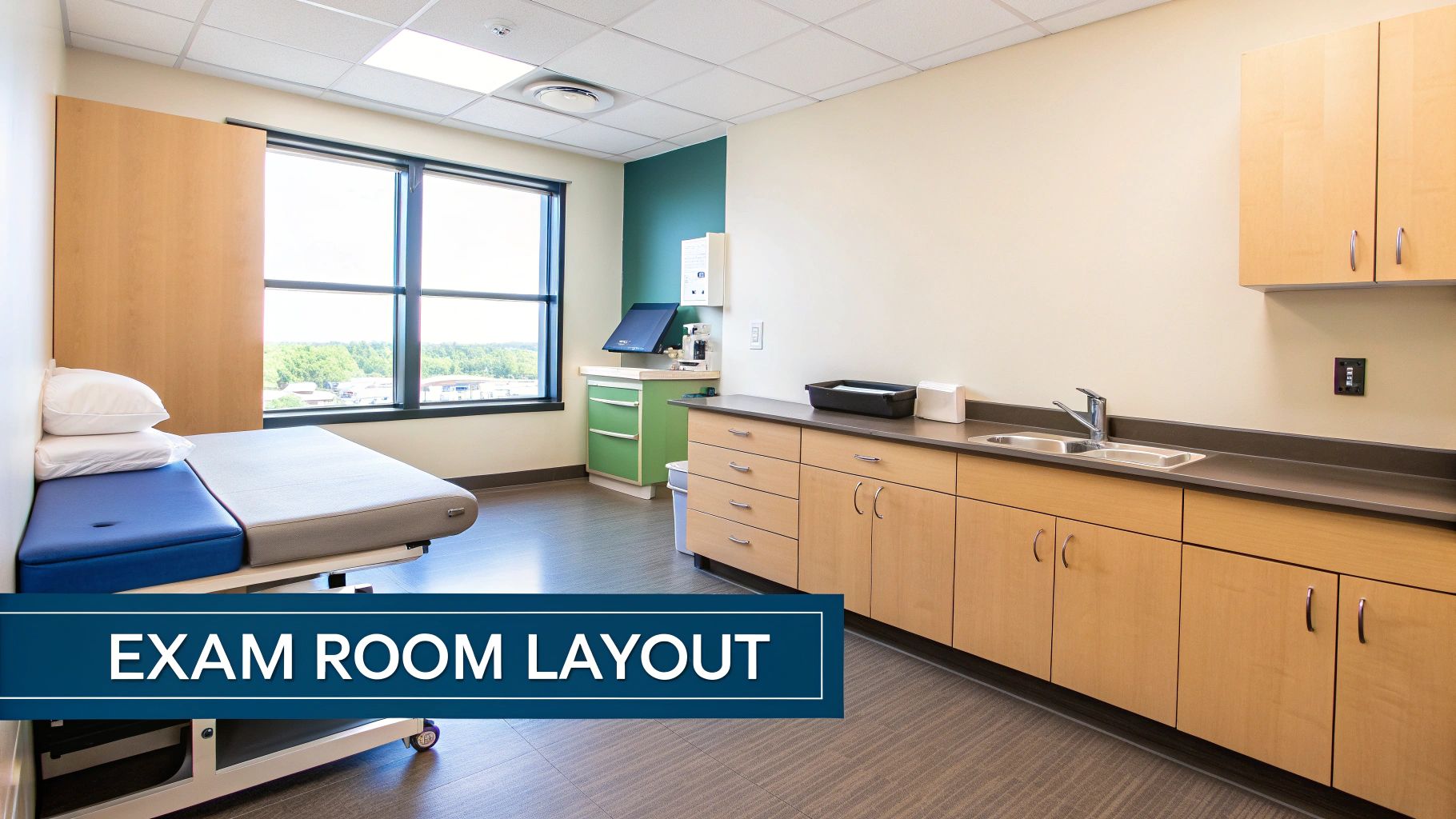
You'll often hear that a standard exam room should be about 10 feet by 10 feet, or somewhere in the 100-120 square foot range. But the why behind that number is what's truly important. That size gives you just enough room for the exam table, the provider, the patient, and maybe a family member without everyone feeling like they're on top of each other. It also ensures you have the clearance needed for walkers or wheelchairs.
Core Clinical Space Planning
Square footage is just the starting point. The real magic happens inside the room. A well-designed exam room, for instance, has a natural flow that makes the clinical workflow feel effortless. The goal is simple: minimize wasted steps and create a space that just makes sense for your team.
Think about how all the pieces of the puzzle fit together in a standard exam room:
Exam Table Placement: You want the provider to be able to get around the table easily, but you also don't want the patient facing the door, which can feel very exposed and vulnerable. A good layout often places the table diagonally or against a side wall.
Sink and Handwashing Station: This is a non-negotiable for infection control. It needs to be one of the first things you can access when walking in or out of the room.
Cabinetry and Storage: Smart, built-in storage for gloves, gowns, and basic supplies is a must. It keeps your counters clear and ensures everything is right where you need it, when you need it.
Provider Workspace: A small counter or desk for a computer is crucial for charting. The key is placing it so you can interact with electronic health records (EHR) without turning your back on the patient for long stretches.
When these elements don't work together, you feel it immediately. A sink in the wrong spot can create a traffic jam by the door, and clunky cabinets can become a safety hazard.
Sizing Specialty and Support Areas
Of course, exam rooms are just one part of your practice. Your other spaces have their own unique needs, and a one-size-fits-all approach just won't cut it. A dermatology procedure room is going to have totally different requirements than a pediatrician's friendly consultation office.
Here are a few other common spaces to consider:
Consultation Offices: These are for talking, not examining. A comfortable space is usually around 120 to 150 square feet, which is plenty of room for a desk, a few chairs, and maybe some shelving without feeling cramped.
Procedure Rooms: The size here is all about the equipment. A room for minor procedures might need 150 to 200 square feet—or even more—to safely accommodate specialized gear, extra staff, and sterile supply carts.
Medical Labs: If you're building an in-house lab, the layout has to be laser-focused on safety and a logical workflow. You'll need distinct zones for specimen collection, processing, and storage, all with proper ventilation and plenty of counter space.
The real takeaway here is that every single square foot has to earn its keep. When you truly understand what's going to happen in each room, you can design a space that actively helps your practice run smoothly instead of getting in the way.
As you plan these essential layouts, don't forget how much the right furniture matters. Thoughtful choices in seating, storage, and clinical equipment can make or break a room's functionality. It's worth learning more about choosing healthcare furniture for modern facilities, which gets into important details like durable materials, infection control, and ergonomics.
In the end, great room design goes way beyond a tape measure. It's about making sure every doorway is wide enough for ADA compliance, integrating storage that feels seamless, and creating a layout that feels professional for your staff and reassuring for your patients.
Navigating Codes And Accessibility Requirements
A medical office isn’t just another commercial building. It's a place of healing, which means it’s held to a much higher standard of safety and accessibility. Trying to untangle the complex web of building codes and regulations can feel like a full-time job, but it's an absolutely non-negotiable part of medical office space planning. These rules aren’t just red tape—they are the blueprint for creating a space that’s fundamentally safe and welcoming for every single patient.
Think of these codes as the essential safety features in a car. You wouldn't even consider driving a car without airbags or seatbelts, and you can't operate a medical facility without rock-solid life-safety and accessibility measures. Getting this right from day one saves you from the headache of costly revisions, failed inspections, and potential legal troubles down the road.
Understanding ADA and Universal Design
The Americans with Disabilities Act (ADA) is the bedrock of accessible design. It’s the law that ensures your space is usable by everyone, regardless of their physical ability. But this goes so much further than just sticking a ramp at the entrance.
True accessibility is woven right into the fabric of your floor plan:
Doorways and Corridors: Hallways need to be at least 36 inches wide to allow for easy passage, and doorways must have a clear opening of at least 32 inches so a wheelchair can get through without a struggle.
Accessible Restrooms: This is a big one. It involves specific clearances around toilets, proper grab bar installations, and sink heights that work for someone in a seated position. A 60-inch clear turning radius is a key number to remember.
Exam Room Maneuverability: Your exam rooms have to provide enough clear floor space for a wheelchair to make a full turn. This ensures patients can move around and position themselves without difficulty.
Compliance is the floor, not the ceiling. The real goal is universal design—creating a space that is inherently intuitive and comfortable for everyone, from an elderly patient with a walker to a parent wrangling a stroller.
Life-Safety and Health Code Essentials
Beyond the ADA, your office has to meet strict life-safety and health codes. These are designed to protect people during an emergency and, just as importantly, to prevent the spread of infection. These regulations dictate very specific details that will directly impact your layout and material choices.
For instance, fire safety codes determine how far someone might have to travel to reach an emergency exit, which is often no more than 75 feet in smaller practices. These codes also mandate the precise placement of fire extinguishers and require fire-rated materials for certain walls and doors.
Health codes are just as critical in a clinical setting. They govern things like:
Handwashing Stations: You'll find there are specific rules for the number and location of sinks to ensure proper infection control is always within reach.
Clean vs. Soiled Utility Rooms: Your design must include separate, clearly designated areas for clean supplies and soiled materials to eliminate any chance of cross-contamination.
Material Finishes: Surfaces in clinical areas, from the flooring underfoot to the countertops, have to be non-porous and easy to sanitize thoroughly.
When you're dealing with this complex regulatory landscape, you have to understand all of your obligations. For healthcare facilities, this also means performing a thorough risk assessment to protect patient data. You can find a helpful HIPAA risk assessment template to help you navigate that critical process.
Making sure your plans meet these standards from the very beginning is everything. For a deeper dive into how to maintain these high standards throughout your build, our construction quality control checklist offers some valuable insights. At the end of the day, following these codes isn't just about passing an inspection; it’s about proving your commitment to your patients' safety and well-being.
The Unseen Systems That Shape the Patient Experience
Some of the most critical parts of your medical office are the ones your patients will never see—but they will absolutely feel. We're talking about the mechanical, electrical, and plumbing (MEP) systems hiding behind the walls. These are the silent workhorses of your facility, and smart medical office space planning gives them the serious attention they deserve.
Why? Because they directly impact everything from patient comfort to critical infection control. This is where a clinical space stops feeling cold and sterile and starts feeling calm and healing. A patient might not consciously notice the brand of your air filter, but they'll remember if the air felt stuffy, the lights were harsh, or the exam room was freezing.
Specialized HVAC for Health and Comfort
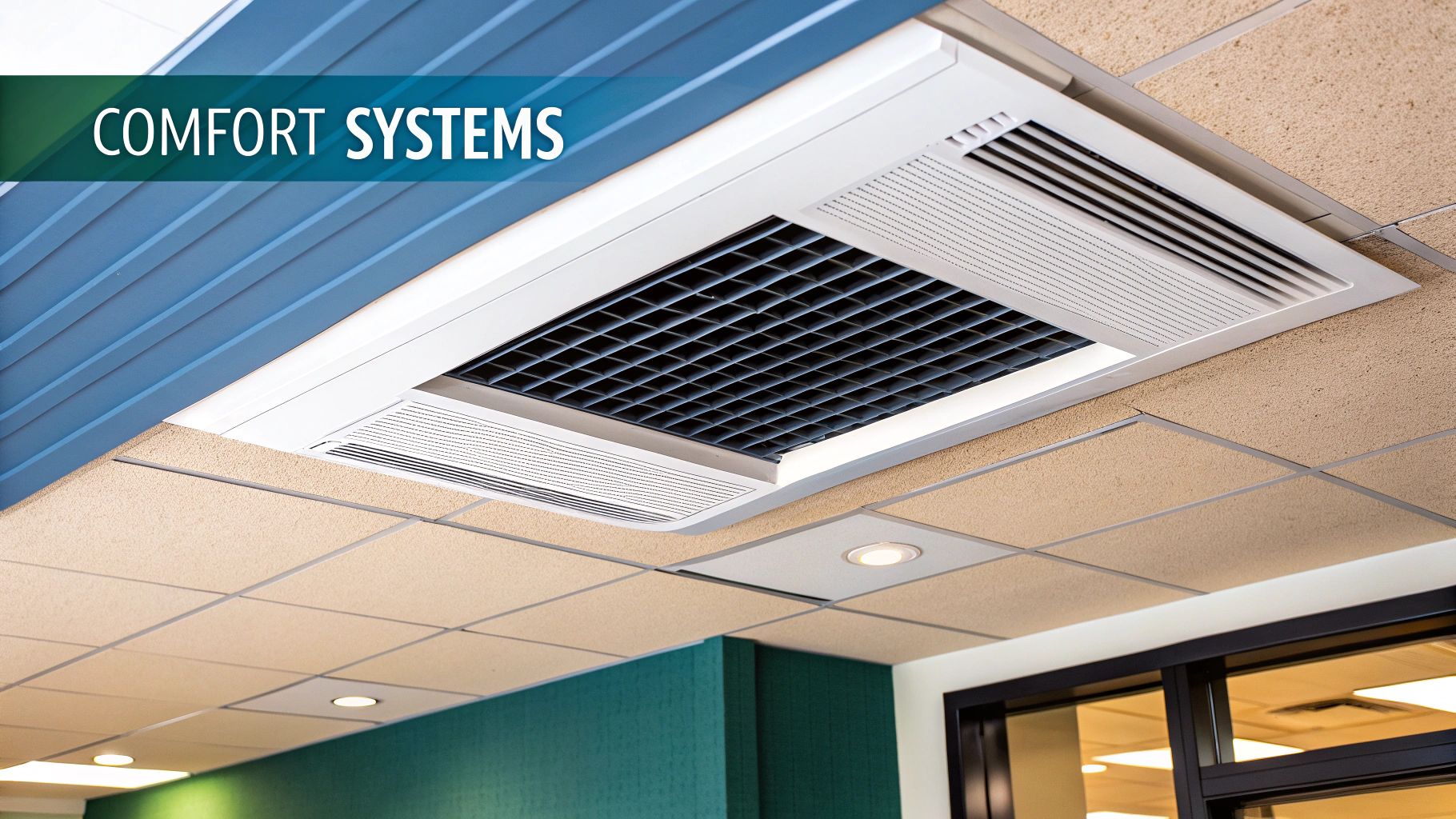
In a medical practice, your heating, ventilation, and air conditioning (HVAC) system does a lot more than just manage the temperature. It’s one of your most important tools for infection control. The standard HVAC system you'd find in a typical office building just isn't built to handle the demands of a healthcare environment.
A specialized medical HVAC system is designed to manage several key factors that keep everyone safe:
Advanced Air Filtration: Think beyond basic dust filters. Medical-grade systems use high-efficiency particulate air (HEPA) filters that are designed to capture microscopic airborne pathogens, including viruses and bacteria. This is non-negotiable for protecting vulnerable patients.
Proper Ventilation: The system needs to perform a high number of air changes per hour (ACH). This means it’s constantly pulling stale indoor air out and bringing fresh, filtered outdoor air in, effectively diluting any contaminants.
Air Pressure Differentials: This is a bit more technical but incredibly important. Some rooms, like isolation areas, need negative pressure to pull air in and keep contaminants from escaping. Others, like clean procedure rooms, need positive pressure to push air out and protect immunocompromised patients from germs.
Getting this right is a major investment, but it pays for itself in patient safety and trust. Honestly, this level of quality is becoming a major differentiator in today's competitive market.
Powering Your Practice with Smart Electrical Design
The electrical grid in a medical office is far more complex than in a typical retail or office space. You're running everything from power-hungry imaging equipment to highly sensitive diagnostic tools. Your electrical infrastructure has to be robust, reliable, and planned with foresight.
A big piece of this is ensuring you have enough dedicated circuits. Equipment like an X-ray machine or a medical laser draws a huge amount of power and needs its own circuit. If you don't plan for this, you risk overloading the system, causing outages, or even damaging other expensive electronics.
But it's not all about raw power. Lighting design, for instance, has a massive impact on how patients feel.
The secret to great lighting is layering. You need bright, clear task lighting for clinical work, but you pair it with softer, warmer ambient light in waiting areas and consultation rooms. It’s a simple change that makes the entire space feel less institutional and more welcoming.
This one strategy can do wonders for reducing patient anxiety. When you combine thoughtful lighting with quiet-running systems and comfortable temperature control, you create a genuinely stress-free environment.
The Naples Market Demands Excellence
In a hot healthcare market like Naples, creating a top-tier patient experience isn’t just a nice-to-have; it's essential. Compared to traditional office space, medical office vacancy rates are incredibly low. In fact, since 2010, the national absorption of medical office buildings has outpaced new construction every single year, pushing occupancy to an impressive 92.7%.
Here in South Florida, that demand is even more intense. The state welcomed over 300,000 new residents in 2023 alone, many of whom are affluent and seeking high-quality outpatient care. You can get a deeper dive into these market drivers on mmcginvest.com.
What does this mean for you as a practice owner? It means every detail counts. Investing in high-quality, quiet, and dependable MEP systems isn’t just a construction decision—it’s a business strategy. It directly elevates the patient experience, protects your reputation, and helps your practice stand out. When patients feel safe and comfortable, they come back, and they tell their friends.
Bringing Your Vision to Life with the Right Partner
This is where the rubber meets the road. All the planning, blueprints, and late-night decisions start to become a physical, functioning medical office. It's easily the most exciting part of the process, but it hinges on a solid partnership between you, your architect, and your builder. The best projects are built on a foundation of clear communication and shared goals—everyone needs to be pulling in the same direction.
The right partner gets that medical office space planning is more than just framing walls and hanging drywall. It’s about building a high-performance environment for healthcare. They're the ones who translate those complex drawings into a real-world space that actually supports your workflow, makes patients feel comfortable, and ticks every last regulatory box.
Understanding the Construction Journey
Knowing the path from groundbreaking to grand opening helps you keep your finger on the pulse of the project. It lets you manage expectations and avoid those frustrating surprises that can pop up. Generally, your project will move through a few key stages, each one demanding close collaboration with your construction crew.
Pre-Construction and Permitting: This is ground zero. Your builder finalizes the designs, locks in a realistic budget, and tackles the often-tricky permitting process with local Naples and Collier County authorities.
Site Work and Foundation: Now the real work begins. The crew starts by prepping the land, laying all the crucial underground plumbing and electrical conduits, and pouring the foundation that will support everything.
Framing and Systems Rough-In: Suddenly, your office has a skeleton. As the walls go up, the "bones" of your HVAC, electrical, and plumbing systems are installed before anything gets closed up.
Interior Finishes and Final Details: This is the fun part, where the space truly comes alive. Drywall, flooring, paint, and custom cabinetry go in, along with the installation of all your specialized medical equipment.
Building a premier medical facility is the ultimate investment in your patients, staff, and future success. Your construction partner acts as your guide, ensuring every detail aligns with your vision and budget from start to finish.
Local Considerations for a Lasting Build
Let's be honest: building in Southwest Florida brings its own set of challenges. A builder with deep local roots will know how to get ahead of these issues, making sure your facility isn't just beautiful on day one, but also durable and efficient for years to come.
For instance, you have to choose materials that can stand up to our humidity and intense sun. That’s non-negotiable if you want to avoid problems like mold and premature fading or wear. This means thinking carefully about everything from exterior finishes and high-impact windows to the right roofing materials. And navigating the specific county codes for building in coastal high-wind zones? That’s where a local expert really proves their worth.
Your job is to be an informed, confident leader throughout the build. When you team up with people who value transparency and collaboration, the whole construction process can actually be a rewarding experience.
If you’re ready to build a facility that truly reflects the quality of your care, take a look at our approach to high-end commercial construction services. Let's start the conversation about bringing your vision to life.
Frequently Asked Questions
Planning a new medical office brings up a lot of questions. It's a big investment, and you want to get it right. Here are some of the most common things practice owners ask us, along with some straightforward answers from our experience.
How Much Space Do I Really Need?
That's the million-dollar question, isn't it? The honest answer is it truly depends on your practice. A family doctor might be perfectly fine with 1,200 to 1,500 square feet per physician, but an orthopedic specialist with in-house X-rays and physical therapy is going to need a much larger footprint.
The best way to figure this out is to stop thinking in square feet for a moment and start with what you actually do every day:
How many providers will be seeing patients at the same time?
What's your realistic daily patient volume?
How many support staff—nurses, admin, techs—are on your team?
What specialty equipment do you need space for, like an X-ray or ultrasound machine?
Once you've got a handle on your current needs, a smart rule of thumb is to add a 15-20% cushion for future growth. This simple step can save you the headache and expense of moving again in just a few years.
What Is the Most Common Planning Mistake?
It's almost always neglecting the "backstage" areas. It's easy to get laser-focused on patient-facing spaces like exam rooms and the waiting area, but your staff needs functional spaces to do their jobs well and decompress.
A tiny break room squished next to a noisy lab or a supply closet that's always in the way creates little daily frustrations that add up. These things impact morale and efficiency more than you'd think. The best designs give your team their own dedicated, quiet zones for admin work and breaks, keeping the operational chaos out of sight and maintaining a calm environment for patients.
How Long Does the Planning and Build Process Take?
For a standard medical office build-out here in Naples, you should probably budget for a timeline of 8 to 12 months. That's from the first napkin sketch to the day you welcome your first patient. Of course, this can shift depending on how complex the project is and how quickly local permits move.
Here’s a rough breakdown of that timeline:
Design & Planning: 2–3 months
Permitting & Approvals: 2–4 months
Construction & Finishing: 4–6 months
The secret to keeping things on track is to start talking to your builder early. Getting them involved from the get-go helps create a realistic schedule and avoids a lot of nasty surprises down the road.
Ready to create a medical space that reflects the quality of your care? JVM Construction LLC specializes in building and renovating premier commercial properties in Naples, ensuring every detail aligns with your vision. Visit us online to start planning your project.