Imagine you've decided to create your dream home. In the old way of doing things, you'd hire an architect to draw up beautiful plans, and then, with those plans in hand, you'd hire a completely separate builder and hope they could bring that vision to life within your budget. It often feels like you're the one stuck in the middle, managing two different teams.
Now, imagine a different way. Instead of juggling separate contracts, one dedicated team handles both the creative design and the physical construction under a single agreement. That, in a nutshell, is the answer to the question, what is design-build construction? It's a simpler, more collaborative path to the home you've always wanted.
A Simpler Path to Your Dream Home
Building a custom home should be one of the most exciting journeys of your life. But the traditional way of doing things—pitting the architect against the builder—often turns it into a headache. That old-school route almost guarantees a divide, where beautiful design concepts clash with the practical realities and costs of construction.
For example, an architect might design a stunning cantilevered balcony without fully considering the complex engineering and high cost, leaving you to deal with the budget shock when the builder prices it out. This friction is a recipe for miscommunication, delays, and surprise expenses. The design-build model was created to eliminate that conflict entirely.
It works by bringing designers, architects, and builders together as one team right from the start. Think of it as a true partnership, where everyone shares the same goal and is equally responsible for the outcome. This approach has become incredibly popular for one simple reason: it just works better for the homeowner.
Why Homeowners Are Choosing This Model
The numbers don't lie. By 2020, design-build was used in 41% of non-residential construction projects, a huge jump from just 28% back in 2010. That 46% leap in adoption shows that property owners are tired of the blame game and want the clarity that comes from having a single point of contact. You can dig deeper into this construction trend over at Glass Magazine.
The whole idea behind design-build is powerful in its simplicity: one team, one contract, one unified vision from the first sketch to the final nail. It fosters a collaborative spirit focused on creating your dream home, not pointing fingers when challenges pop up.
For someone looking to build their perfect family home, this means you get a single, trusted partner who is fully invested in your vision. Your project benefits from constant, open communication and forward-thinking problem-solving, making sure every detail fits your goals, your style, and your budget.
Ready to see how this simpler approach can make your dream home a reality? Contact JVM Construction to Discuss Your Vision
How The Design-Build Process Unfolds
Your journey from a simple idea to a finished luxury home should feel inspiring, not overwhelming. The design-build process is structured to bring clarity and purpose to every step, turning what could be a complex undertaking into a seamless, collaborative experience. And it all starts with your vision.
Instead of having separate conversations with an architect and then a builder, the process kicks off with a unified team. From day one, architects, designers, and construction experts are all at the same table with you. This initial phase is all about creative exploration—really digging into your lifestyle, your aesthetic, and what "home" truly means to you.
Having the builder involved from the very beginning is a game-changer. It means every design idea is instantly weighed against practical construction methods and real-world costs. This simple step prevents the common heartbreak of falling in love with a design that later turns out to be unbuildable or wildly over budget.
From Blueprint to Budget
Once we’ve captured your creative vision, the team gets down to detailed design development. This is where rough sketches evolve into precise architectural plans and we start selecting materials. The key difference here is the constant feedback loop between the design and construction sides of our team.
This collaborative approach ensures that the home's beauty and its buildability grow hand-in-hand. We can solve potential construction headaches on paper, long before they could ever cause costly delays on-site.
The design-build process is fundamentally about proactive problem-solving. By integrating design, budgeting, and construction planning from the start, we transform potential risks into opportunities for innovation, ensuring a smoother journey for the homeowner.
From there, we move into the pre-construction phase. This is where all the critical behind-the-scenes work gets done, including:
Finalizing Budgets: With a complete design and a clear construction plan, we can provide a transparent, detailed budget you can trust.
Securing Permits: Our team handles the often-complex permitting process with local authorities, so you don't have to.
Scheduling Timelines: We map out a realistic project schedule, coordinating every subcontractor and material delivery down to the day.
This infographic shows a simplified flow of the design-build model, from your initial vision right through to your finished home.
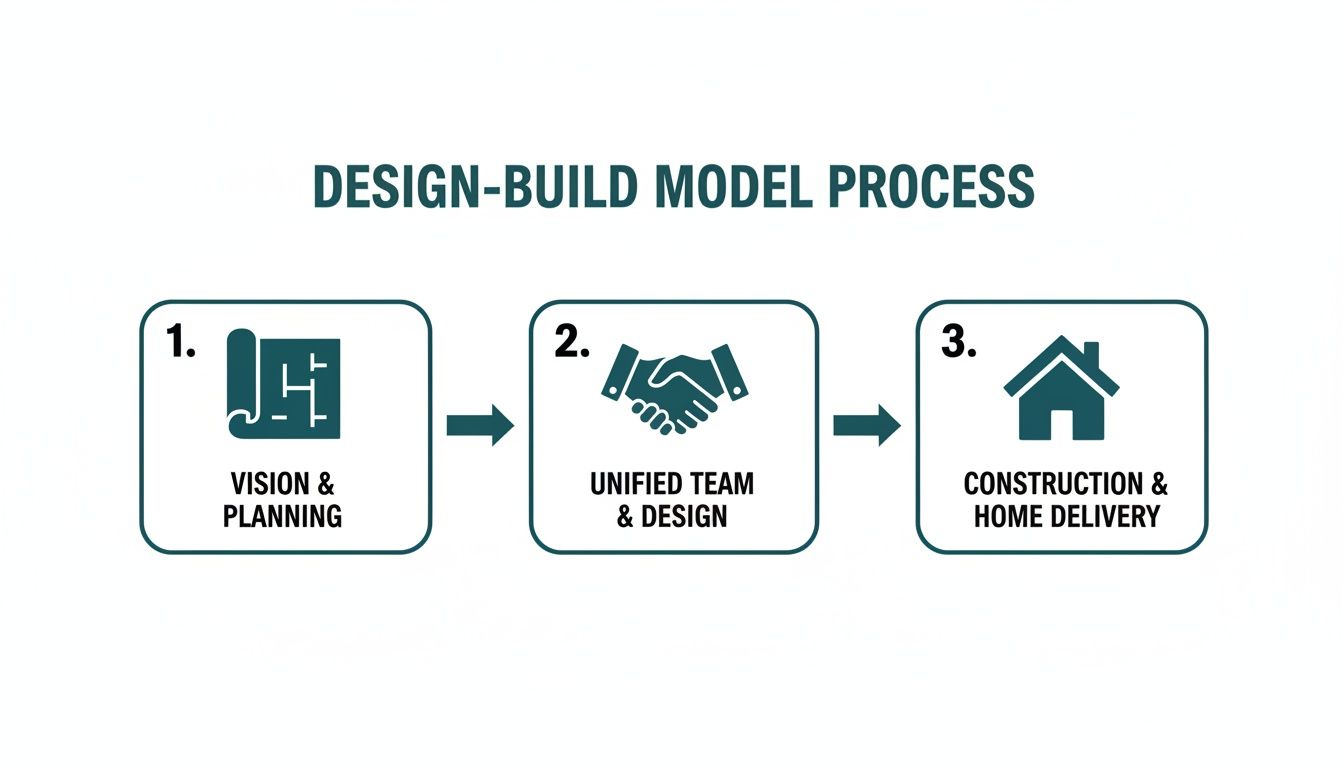
As you can see, the unified team acts as the central engine, converting your ideas directly into a tangible home without the communication gaps that plague traditional methods.
Construction and Completion
Once construction begins, the benefits of having a single, accountable team become even more obvious. Communication is direct, decisions are made quickly, and the project keeps its momentum. If an unforeseen issue pops up—say, a supply chain delay on your chosen flooring—the entire team swarms the problem together to find the best alternative solution, no finger-pointing, just results.
Through regular updates, you’ll feel informed and confident every step of the way. As the project nears its end, we conduct meticulous quality checks and walkthroughs. This all leads to the final review, where we address any minor adjustments on the punch list. To get a better feel for this last stage, you can explore our guide on what is a punch list in construction. This transparent, organized approach ensures your new home is delivered exactly as you envisioned.
Design Build Versus Traditional Construction
Deciding how to build your dream home is just as important as deciding what to build. You’ll generally find yourself choosing between two main paths: the modern design-build approach and the more traditional method, known as design-bid-build. Knowing the difference isn't just about process—it can be the key to avoiding months of frustration and unexpected expenses.
The old-school route involves hiring an architect first. They create a full set of plans, and then you take those finished plans and shop them around to various general contractors to get bids. It’s a disconnected process where you end up with two separate contracts and two separate teams. You become the go-between, trying to bridge the gap between the creative vision and the practical construction.
Design-build flips that model on its head by bringing everyone to the same table from the very beginning. The architect, designers, and builders are all part of one cohesive team, working under a single contract. This isn't just a small tweak in paperwork; it fundamentally changes the entire experience of building a home.
Accountability and The Blame Game
In the traditional setup, when a problem pops up—and they always do—it can quickly devolve into a frustrating blame game. Maybe a design feature is proving too expensive or complex to actually build. The builder points their finger at the architect's plans, and the architect points right back at the builder's execution. And where does that leave you? Stuck in the middle, trying to mediate a dispute while your project stalls.
This is where the design-build model truly proves its worth. With a single team responsible for everything from the first sketch to the final nail, there’s no one else to blame. Accountability is baked right into the process because everyone is united by the same goal.
With design-build, the question is never "Whose fault is it?" It’s always, "How do we, as a team, solve this?" This shared ownership keeps the project moving forward, focused on creating your perfect home.
Comparing The Two Models
The contrast between the two approaches becomes crystal clear when you break them down side-by-side. From who carries the risk to how the budget is managed, the homeowner’s experience couldn't be more different.
We've put together a simple table to show you exactly what we mean.
Design Build vs Traditional Design Bid Build
Factor | Design Build (One Team) | Design Bid Build (Separate Teams) |
|---|---|---|
Accountability | Single-point responsibility. One team owns the entire project outcome from start to finish. | Divided responsibility. Can easily lead to conflicts and finger-pointing between the architect and builder. |
Communication | Direct and clear. You have one contact for all your questions and updates. Simple. | Fragmented. You’re the one managing communication between two separate design and build teams. |
Project Risk | Held by the design-build firm. The team is responsible for managing risks and solving problems. | Primarily held by the homeowner. You bear the financial risk of design errors or misinterpretations. |
Budget Issues | Addressed collaboratively. The team works together to find creative, in-budget solutions. | Often leads to costly change orders. The builder simply prices the plans they were given, with surprises costing you more. |
What this table really shows is a massive shift in risk. One of the biggest advantages of design-build is that it takes a huge burden off your shoulders. For a family planning a major home addition, this is a game-changer. In fact, studies show the design-build method can reduce a homeowner's risk exposure by 62% compared to traditional methods. It also helps slash expensive change orders by 25-35%, a huge relief when construction costs are unpredictable. You can dig deeper into these trends in this detailed construction outlook from Deloitte.
Ultimately, the choice comes down to the kind of journey you want to have. If you’re looking for a true partnership with a single, dedicated team that has your back, design-build offers a much smoother and less stressful path. To get a better handle on the builder's specific duties, take a look at our guide on what is a general contractor.
What This Actually Means For Your Custom Home
Let's move past the theory and talk about what design-build really does for you. When you’re building a custom home, the process itself should feel as good as the final result. That's where design-build shines—it's designed to give you peace of mind and turn a potentially stressful project into an exciting one.
Think about it: one team, one vision, one point of contact. If you have a question, a brilliant new idea, or a concern, you know exactly who to call. This is what we mean by single-point accountability. You’ll never be stuck in the middle of a blame game between your architect and your builder. It’s just one unified team working together, for you.
Getting You Into Your Home Faster
One of the biggest wins here is time. The old-school way of building involves designing the entire home first, then spending months getting bids from different builders. You're waiting and waiting before a single shovel hits the dirt.
Design-build throws that outdated model out the window. We can overlap the design and construction phases, which is a game-changer.
In fact, studies show a design-build project can be completed up to 102% faster than a project using the traditional design-bid-build approach. You get to start enjoying your new home months, or even a year, sooner.
How does this work in practice? We can order long-lead materials, like custom windows that have a long manufacturing time, while we're still finalizing the tile selections for the master bath. This means the construction can start sooner. It’s just a smarter, more efficient way to build.
Keeping Your Budget On Solid Ground
Let's talk about money, because it's one of the most stressful parts of any build. With the traditional method, you often don't know the true cost until the design is 100% finished and the bids come in. That's when "sticker shock" happens, forcing you back to the drawing board for painful redesigns.
Design-build makes budget a central part of the conversation from day one. As the design takes shape, our construction experts are providing real-time cost feedback. This means the design evolves in lockstep with your budget, not in a vacuum. We can guide you on where to spend for maximum impact—like on high-end kitchen appliances—and where you can save without sacrificing quality.
This approach gives you incredible financial clarity. Projects built this way average only 3.8% in cost growth, a tiny fraction of the overruns and expensive change orders that are so common otherwise.
Better Ideas, Better Quality
At the end of the day, it's about the quality of your home. When architects and builders are on the same team, you get the best of both worlds. Creative vision is grounded by practical, hands-on construction knowledge from the very beginning.
This synergy prevents those "it looked good on paper" problems and ensures the architect's vision can be built beautifully and durably. For your home, that means every detail—from the engineering of your foundation to the flawless execution of the trim—is a product of true collaboration.
It’s not just about building a house. It’s about creating a better building experience and a home that is a perfect reflection of you.
Ready to see how a smoother process can build a better home? Schedule a consultation with JVM Construction today.
So, Is Design-Build the Right Fit for You?
The design-build method is a fantastic way to approach a custom home or renovation, but how do you know if it's right for you? Its real magic shines when it aligns with a homeowner’s personality and the unique demands of their project. To figure out if it’s the right path for your family, let's look at where this model really excels.
For complex, high-stakes projects, design-build is often the clear winner. Think about building a ground-up custom home on a challenging sloped lot, a major remodel that completely reimagines your home's layout, or a kitchen renovation where every single detail has to be flawless. In these kinds of projects, a single, cohesive vision isn't just nice to have—it's essential.
This approach is perfect for homeowners who want a true partnership, not the headache of juggling multiple contracts and playing mediator. If the thought of coordinating between a separate architect and a construction crew sounds utterly exhausting, you'll find design-build to be a breath of fresh air.
A Few Questions to Ask Yourself
To get a clearer picture, take a moment to think about your own preferences. Answering these questions honestly can reveal whether the collaborative, integrated nature of design-build fits with how you envision bringing your dream home to life.
Do I want one go-to partner, or am I okay managing multiple contracts? With design-build, you get a single point of contact. The traditional route often puts you in the middle, acting as the manager between your designer and your builder.
How much do I value collaboration? This model is teamwork in its purest form. If you want to be part of a unified team all pulling in the same direction, it’s a perfect fit.
Am I comfortable with a process where the design and budget evolve together? Design-build bakes cost control into the process from day one, which helps avoid nasty surprises. This is a world away from falling in love with a design, only to discover later that it’s wildly over budget.
Choosing a construction method is really about choosing your experience. If you value clarity, shared accountability, and a process built on trust and open communication, then the design-build model is almost certainly the right path for you.
At the end of the day, this model is for the homeowner who wants to focus on their vision, not on refereeing disputes. It's for those who see their builder as a long-term partner, someone dedicated to bringing their dream to life with precision, creativity, and care. If that sounds like you, then this method is practically made for you.
Ready to explore a partnership for your dream home? Let's start the conversation.
Choosing The Right Design-Build Firm
Picking your design-build partner is arguably the most critical choice you'll make when creating your custom home. This isn't just about hiring a builder; it's about finding a genuine partner you can trust to navigate this entire process with you. To get it right, you need to dig deeper than the glossy photos and ask some pointed questions.
Start by really studying their portfolio. Don't just look at the pretty pictures—look for consistency in quality. Zoom in on the details, the craftsmanship. Do they handle projects with the complexity you envision? Does their style actually connect with what you want? A strong portfolio does more than just show off nice houses; it shows a firm’s skill in turning a client's vision into a beautifully built reality.
Key Questions To Ask Any Firm
Before you even think about signing a contract, you need to have a real conversation. How a firm answers the following questions will tell you everything you need to know about their process, how they communicate, and whether they’re the right fit for you.
How do you make sure the design actually sticks to my budget? A good answer will involve constant budget checks and value engineering. The design and the budget should be intertwined from day one, not treated as separate things.
Who is my go-to person for this entire project? You need a single point of contact. This is the secret sauce that makes the design-build delivery method work so well—no confusion, no finger-pointing.
Can you show me some of your work that’s similar to my project? They should be able to point to specific homes that had similar site challenges, architectural styles, or were built under the same HOA guidelines you'll face.
Finding The Right Partner For Your Vision
At the end of the day, you're looking for a team you can implicitly trust. They should listen more than they talk, showing a real desire to understand what you're trying to achieve. The right design-build firm makes the whole experience feel like a creative collaboration, not just another business deal.
The right partner doesn’t just build a house; they build a relationship. They should feel like a trusted advisor, someone who’s as invested in protecting your budget and executing your vision as you are.
Building a custom home is a massive investment, both financially and emotionally. The right firm respects that. They'll offer total transparency, expert guidance, and a relentless focus on quality. Don't rush this decision. Do your homework, and choose a partner who will make the journey as remarkable as the final result.
If you’re curious about our approach, you can explore the details of our custom home building services. When you're ready, we can start with a simple, no-pressure conversation about your ideas.
Common Questions About Design-Build Construction
Starting a custom home project is exciting, but it’s natural to have questions. Getting a handle on how design-build construction actually works can give you the confidence you need to take that next step.
Let's clear up some of the most common questions we hear from homeowners.
Is The Design-Build Method More Expensive?
This is a big one, but the answer is no—in fact, it usually saves you money. Think of it this way: the budget is part of the conversation from the very first sketch. We’re not designing a dream home in a vacuum only to find out later that it costs a fortune to actually build.
This approach sidesteps the expensive redesigns and surprise budget blow-ups that can plague the traditional process. You get a much clearer picture of the final cost, right from the beginning.
Do I Lose Control Over The Design?
It's a common misconception, but you actually have more meaningful control, not less. You're the key player on a unified team.
The design-build model puts you in the same room (often literally) with the design and construction experts at the same time. Your vision and feedback are woven into the plan from day one. You always have the final say, but now you have a team of experts making sure your brilliant ideas are also buildable and practical.
The point of design-build isn't to take control away—it's to give you a clearer, more direct path from your vision to the finished home. It’s about empowering you with a single team focused on your goals.
What Happens If The Project Goes Over Budget?
Since one team is responsible for the entire project, from the blueprints to the final nail, we all share responsibility for the budget. If an unexpected challenge pops up, there's no finger-pointing. We simply work together to find a smart solution that respects your budget and protects the integrity of the project.
This built-in collaboration is one of the biggest strengths of the design-build process. It shields you from the financial blame games that can happen when your designer and builder are on separate teams.
Ready to build your home with a process built on clarity and partnership? The team at JVM Construction LLC is here to answer any other questions you have and help bring your vision to life. Learn more about our client-first approach today.