You’ve pictured this moment for months, maybe even years: finally getting the keys to your new Naples dream home. It’s an incredible feeling. But before you can officially pop the champagne and start arranging furniture, there's one last, critical milestone: securing the Certificate of Occupancy, or CO.
Think of the CO as your home's official diploma. It's the document from your local government that says your home isn't just a construction project anymore—it's a safe, legal, and livable residence, ready for you to start making memories.
Your Home's Final Green Light for Move-In Day

A Certificate of Occupancy is much more than a simple piece of paper. It’s a formal declaration from your local building department—in our area, that’s usually the City of Naples or Collier County—certifying that your property has passed all required inspections and meets every building code.
This isn’t just a formality. It’s the final legal step that proves your home is structurally sound, the utilities are safe, and it’s fit for human habitation. For you, the homeowner, it’s the ultimate peace of mind.
To give you a clearer picture, this table breaks down the essentials of what a CO means for your project.
Certificate of Occupancy at a Glance
Key Aspect | What It Means for Your Naples Home |
|---|---|
Purpose | Legally confirms the property is safe and ready for you and your family to live in. |
Issuing Authority | Issued by the City of Naples or Collier County building department. |
Trigger | Required for all new construction, major renovations, and changes in how a room is used. |
Implication | You cannot legally occupy the property, get permanent utilities, or often finalize your mortgage without it. |
This final approval is what officially turns a blueprint and a pile of materials into a home you can cherish for years.
What the CO Confirms
So, what are inspectors actually looking at when they give that final sign-off? The CO is proof that your home has passed a whole series of tough inspections, confirming everything is up to snuff. It’s their way of making sure your home is built for lasting safety and comfort.
It verifies several critical components, including:
Structural Integrity: The foundation, framing, and roof are built to code and can handle everything Florida weather throws at them. For example, inspectors check that the roof trusses are properly secured to withstand hurricane-force winds.
Safety Systems: Your electrical wiring, plumbing, and HVAC systems are installed correctly and pose no hazards. This means ensuring smoke detectors are in all the right places and that there are no hidden water leaks behind the walls.
Egress and Accessibility: All doors, windows, and hallways meet the specific size and placement requirements for a safe exit during an emergency.
Zoning Compliance: The property’s use matches local zoning laws, confirming it's a single-family home as intended.
A Certificate of Occupancy is the official seal of approval from your local government. It’s the final word that says, "Welcome home, this space is safe and legally yours to enjoy."
This last step is what finally transforms a construction site into your dream home. To get a better sense of all the details, this is a great resource explaining what a Certificate of Occupancy entails. A good builder will manage this entire process for you, ensuring a smooth and stress-free transition from final inspection to move-in day.
Of all the paperwork involved in building your dream home, the Certificate of Occupancy is the one you absolutely cannot ignore. It might feel like just one last hurdle before you can finally relax and enjoy your new space, but it’s so much more than that.
Think of it as the final, official stamp of approval from the city. It’s the inspector's way of saying, "We've checked the work, and this building is safe for you and your family." Trying to move in without one isn't just cutting a corner; it's a massive gamble with serious legal and financial consequences.
Trying to move in without a valid CO means you're living there illegally. That’s not an exaggeration. Local authorities, including here in Collier County, have every right to show up and order you to leave until the property is officially certified.
The Real-World Consequences
So, what happens if you decide to just move in and hope for the best? Trust me, it's a headache you don't want. The risks go way beyond a simple slap on the wrist.
Here’s what you’re really up against:
Hefty Fines: Cities and counties don't take illegal occupancy lightly. They can hit you with daily fines that add up frighteningly fast, turning your dream home into a financial nightmare.
Insurance Roadblocks: You won't be able to get homeowners insurance. Carriers will not cover a property that hasn't been legally cleared for occupancy. Without insurance, your mortgage lender won't release the final funds, and your entire home is left vulnerable to fire, storms, or any other disaster.
A Nightmare to Sell: Imagine years down the road when you're ready to sell your beautiful home. A missing CO is a giant red flag that will stop a sale dead in its tracks. No buyer, and certainly no bank, will move forward without proof that the home is legal and safe.
A missing Certificate of Occupancy isn't just a bureaucratic snag—it puts the legal status and safety of your home in question. In the eyes of the law, it renders your property uninsurable, unsellable, and uninhabitable.
Protecting Your Peace of Mind
For anyone building or remodeling in Naples, the CO is your ultimate assurance. It's the official document that proves your home is solid, secure, and built to today's demanding codes.
It’s the peace of mind knowing that your gorgeous high-rise condo remodel has met every last fire safety standard. It's the confidence that the complex electrical and HVAC systems in your new custom home were installed perfectly and pose zero risk to your family.
This final certificate is the proof that every single person who worked on your project did their job correctly. It’s the capstone of a well-run project, showing a commitment to quality from the first shovel in the ground to the final coat of paint. At the end of the day, the CO is what makes a house a home. It confirms that your beautiful new space isn't just stunning to look at, but is also structurally sound, legally compliant, and ready for you to enjoy for years to come.
Your Path to Securing a Certificate of Occupancy
Think of your Certificate of Occupancy not as a single piece of paper, but as the grand prize at the end of a long construction race. It's the final, official sign-off that your home is safe and ready for you. For most homeowners, this whole process hums along in the background, managed by their builder. Still, knowing the major milestones gives you a real appreciation for the quality and safety being built into your new home.
So, how does this all come together? Let's trace the path from a bare plot of land in Naples to a home you're ready to love. Each step is punctuated by a critical inspection where a city or county official ensures the work meets Florida’s tough building codes.
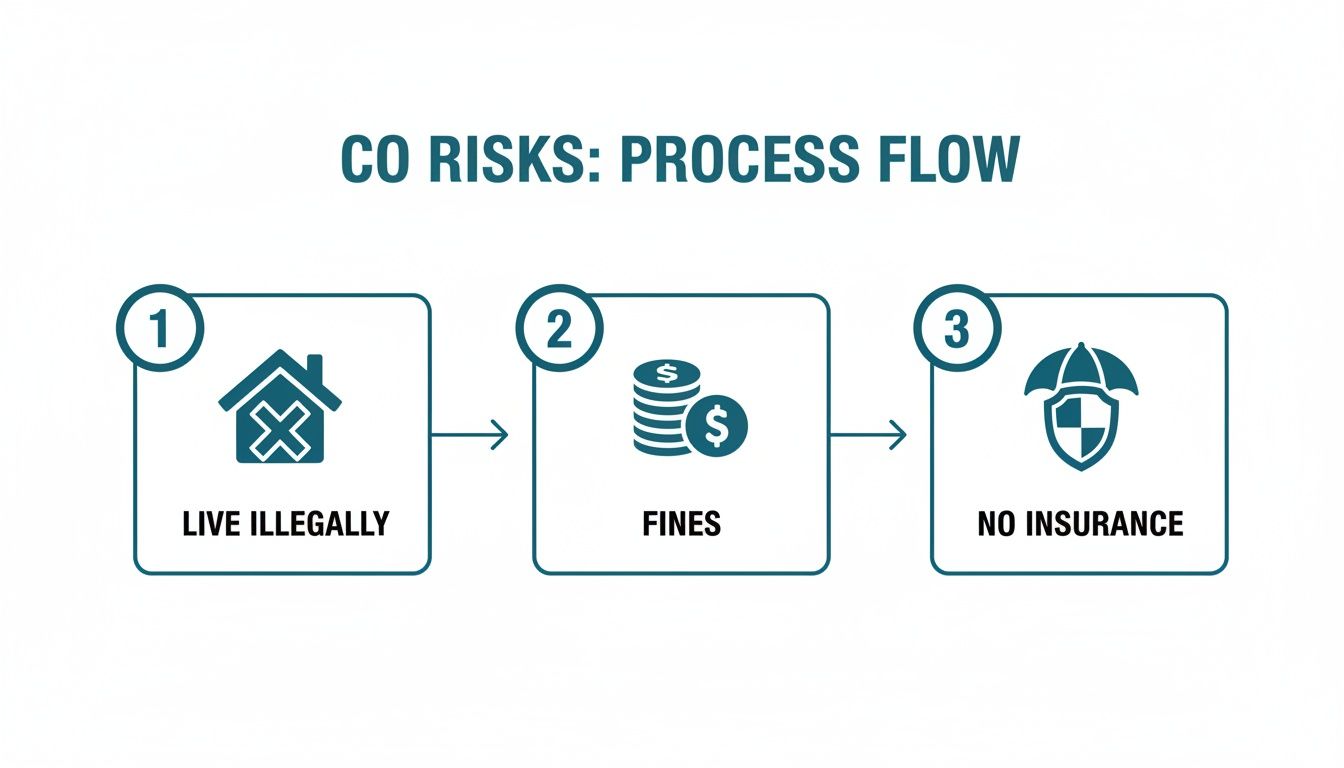
The bottom line is crystal clear: moving in without that official CO can lead to hefty fines and, even worse, leaves your biggest investment completely uninsured.
The First Hurdle: Initial Permit and Plan Approval
Before a single shovel hits the dirt, the journey starts at a desk. Your builder submits a massive set of architectural and engineering plans to the local building department, whether that's the City of Naples or Collier County. These blueprints are the complete instruction manual for your home.
Plan reviewers then comb through every single page, checking the design against the Florida Building Code. They're looking for things like:
Structural Soundness: Will the design hold up to hurricane-force winds and our unique local soil?
Zoning Compliance: Does the home’s size, height, and position on the lot follow all local rules?
Safety and Egress: Are the windows, doors, and hallways properly sized and placed for a quick escape in an emergency?
Once they’re satisfied, the initial building permit is issued. This is the green light to start building, confirming your home's design is safe on paper. Now comes the hard part: bringing that plan to life.
The 'Behind the Walls' Rough-In Inspections
This next phase is one of the most important, yet it’s the part of your home you’ll never see once the drywall goes up. After the foundation is poured and the home's skeleton—the framing—is built, a whole series of "rough-in" inspections begin.
An inspector visits the site multiple times to check the core systems of the house before they get covered up. This is their one and only chance to see the "guts" of the home.
These crucial checks include:
Framing Inspection: The inspector makes sure all the wood and structural pieces are the right size, in the right place, and connected just like the plans say.
Plumbing Rough-In: They confirm all the drain and water lines are installed correctly, sloped properly for drainage, and pressure-tested to ensure there are no hidden leaks.
Electrical Rough-In: Here, they verify all the wiring is run safely, junction boxes are accessible, and the right size wire is used for every single circuit.
HVAC Rough-In: This check ensures the ductwork is sealed tight and sized right to heat and cool your home efficiently.
Passing these inspections is a huge milestone. It’s the official confirmation that the fundamental systems keeping your home safe and comfortable are installed perfectly. A seasoned builder knows that juggling these inspections requires serious coordination to avoid delays. If you're curious about how that complex dance is managed, you can learn more about what construction scheduling involves in our guide.
Ensuring Comfort and Safety: Insulation and Drywall Checks
With all the rough-in approvals in hand, it’s time to install insulation. This inspection is all about your home's future energy bills and its fire safety.
An inspector will physically check that the insulation’s R-value (its ability to resist heat) is high enough for our hot Florida climate and that it’s installed snuggly without any gaps. They also look for fire-blocking materials inside the walls, which are designed to slow the spread of a potential fire.
Once the insulation gets a thumbs-up, the drywall can finally be hung. This is always an exciting moment because it’s when "the space" finally starts to look like "a room." Even at this stage, an inspector might pop in to check that the right type of drywall is used, especially in fire-rated areas like the wall between your house and the garage.
The Grand Finale: The Final Inspections
The finish line is in sight! This last phase involves a flurry of final inspections covering every visible and functional part of your new home. This isn’t a single visit but a series of specialized checks.
These final inspections are incredibly thorough. An inspector will walk the entire property to make sure every last detail is safe, complete, and up to code—from the height of your stair handrails to the placement of every smoke detector.
For example, in a Naples home, an inspector will meticulously check that your hurricane-rated windows not only have the right certification sticker but were installed with the exact number and type of screws the manufacturer requires. A single missing screw can cause a failed inspection and delay your move-in. This is where a builder's obsessive attention to detail really pays off.
After every last light fixture is installed and the builder has done their own final quality walkthrough, the final building inspection is scheduled. If the inspector gives the all-clear on every single item, they will "final" the permit. That approval is the last step needed for the building department to officially issue your hard-earned Certificate of Occupancy.
When You Need a Certificate of Occupancy in Naples
When most people hear “Certificate of Occupancy,” they picture a brand-new home rising from an empty lot. And they’re not wrong—that’s the classic case. But here in Naples, where building standards are justifiably high, a CO is required for a much broader range of projects than you might think.
Think of it as the city’s official stamp of approval. It’s the final word that says your property—whether it's brand new or freshly renovated—is safe and ready for people. This isn't about creating hoops to jump through; it's about protecting you and your family.
So, what’s the tipping point? When does a simple weekend project become a full-blown renovation that needs permits and a final CO? Let's walk through a few real-world scenarios we see every day in the Naples area.
Building Your Dream Custom Home
This one’s the most straightforward. If you're building a new home from the ground up, getting that Certificate of Occupancy is the grand finale. It’s the non-negotiable step that officially turns a construction site into a place you can call home.
It doesn’t matter if it’s a stunning beachfront estate in Olde Naples, a sleek modern design in The Moorings, or a beautiful family home overlooking a fairway. The journey ends the same way. That CO is only handed over after your home passes every single inspection, from the concrete in the foundation to the last light switch on the wall.
A Certificate of Occupancy for a new build is more than just a piece of paper. It’s documented proof that your builder has followed the plans and met Florida's tough building codes down to the letter.
Without it, you can't legally move in, get your permanent power and water turned on, or even finalize your homeowner's insurance. It's the green light you’ve been working toward from day one.
A Major Condominium Renovation
Life in a luxury high-rise is fantastic, but renovating in one has its own set of rules. Simple cosmetic changes like fresh paint, new flooring, or updated countertops usually don't need a new CO. But when you start a major overhaul, the game changes.
So, when does your condo remodel trigger the need for a CO?
Moving or Removing Walls: The moment you alter the unit's layout, you're changing its fundamental structure. For example, if you want to take down a wall between the kitchen and living room for that open-concept feel, inspectors need to ensure it's not a load-bearing wall and the new design is safe.
Altering Electrical Systems: Rewiring the unit, adding circuits for a home theater, or even just moving a bunch of outlets means a full electrical inspection is necessary to rule out fire hazards.
Changing Plumbing Layouts: Rerouting pipes for a spa-like master bath or a gourmet kitchen is a big deal. The work has to be inspected to prevent leaks and ensure everything drains as it should.
For these larger projects, the city essentially treats your unit as a new construction. Your remodeled space has to pass all the final inspections to prove it’s up to today’s building, fire, and safety codes before a new Certificate of Occupancy is issued.
Changing a Room's Intended Purpose
This is the one that often catches homeowners by surprise. A CO isn't just about what you build; it’s about how you plan to use the space. Every room in your home was given a specific "use" on the original blueprints, and changing that use often requires a whole new permitting and inspection cycle.
The classic Naples example? Converting a garage into living space. You might envision a perfect home gym, a private guest suite, or a fun media room. But you can't just lay down some carpet and call it a day.
To do it right and legally, you must:
Bring it Up to Code: Garages aren't built to the same standards as living areas. The conversion means adding proper insulation, HVAC, windows that allow for emergency escape (egress), and specific electrical wiring.
Pass Inspections: An inspector will need to sign off on all these new systems to verify the room is safe, habitable, and energy-efficient.
Obtain a New CO: Once everything is approved, you'll get a new Certificate of Occupancy that reflects the change in use from "garage" to "habitable space."
This process ensures the new room is every bit as safe as the rest of your house. It also protects your investment by making the addition fully legal, insurable, and valuable. If you're dreaming up a project like this, we're here to help you navigate the process. Contact JVM Construction today to discuss your vision.
How to Avoid Common Delays and Hidden Costs

You can practically see the finish line. Your custom home or major renovation is almost complete, and the last thing you want is an unexpected delay stealing your thunder. While the direct government fee for a Certificate of Occupancy is small, the real cost comes from hidden pitfalls that can stall your project for weeks, draining your budget and your patience.
Understanding these common roadblocks is the key to sidestepping them. Most delays aren’t caused by one big disaster but by a series of small, avoidable mistakes that snowball. A proactive builder doesn't just react to problems; they build a process designed to stop them from ever happening in the first place.
This foresight is what separates a stressful project conclusion from a smooth, celebratory one. It’s all about anticipating challenges and having systems in place to ensure every single detail is nailed the first time.
Why Do Final Inspections Fail?
Failed inspections are, without a doubt, the number one cause of CO delays. An inspector's job is to be meticulous, and even a tiny oversight can bring your entire project to a screeching halt. Just imagine the frustration of being told you can’t move in because a subcontractor made a minor but critical error weeks ago.
Here are a few all-too-common reasons a project might fail its final inspection:
Contractor or Subcontractor Error: This is a huge category, but it’s a frequent culprit. For example, a final electrical inspection might fail simply because a GFCI outlet—required by code near any water source—was forgotten in a powder room. A small fix, but one that requires rescheduling and causes delays.
Deviation from Approved Plans: Your home has to be built exactly as shown on the plans stamped by the city. If the plans call for a specific type of exterior sheathing and the builder substitutes it for something else—even if it seems equivalent—it can trigger an immediate failure.
Incomplete or Missing Paperwork: The final inspection isn't just a physical walkthrough. It requires a whole package of supporting documents, from engineer letters and energy calculations to specific product approvals. A missing form can be just as big a problem as a construction flaw.
These seemingly small issues create a massive ripple effect, pushing back your move-in date and costing more to fix under pressure. The only way to avoid them is through obsessive oversight and a deep knowledge of local codes.
The path to your Certificate of Occupancy is paved with details. A delay isn't just an inconvenience; it's a sign that a critical detail was missed somewhere along the way, turning your move-in excitement into unnecessary stress.
The Power of Proactive Quality Control
An experienced builder doesn’t wait around for the city inspector to find mistakes. They should be running their own quality control checks at every stage, all leading up to a detailed pre-inspection walkthrough. This internal "punch list" process is designed to catch and correct every issue before the official inspector ever sets foot on your property. For more on this, you can explore what is a punch list in construction and why it’s so important.
This preventative strategy is built on a few key actions:
Rigorous Subcontractor Vetting: We work only with trusted, proven tradespeople who know the high standards required in Naples and Collier County. There’s no room for guesswork.
Constant On-Site Supervision: A project manager needs to be present and actively overseeing the work, ensuring it aligns with the plans and meets our quality benchmarks every single day.
Pre-Inspection Walkthroughs: Before we even think about scheduling the final city inspection, our team conducts its own exhaustive review, checking off every item on the inspector's likely list.
Local Expertise Is Your Best Asset
Navigating the building departments of the City of Naples and Collier County requires more than just knowing the codebook—it requires familiarity. Every jurisdiction has its own quirks, unwritten rules, and even specific inspectors who are known to focus on particular details.
A builder with deep local roots understands this landscape inside and out. They know the submission procedures by heart, have established relationships with department staff, and stay on top of the latest code interpretations. This insider knowledge is invaluable for anticipating requirements and resolving potential red flags before they become problems.
Ultimately, this expertise transforms a complex bureaucratic process into a predictable experience for you. It saves you from frustration, sidesteps costly delays, and ensures the path to your Certificate of Occupancy is as smooth as possible, letting you focus on the real prize: moving into your beautiful new home.
Your Partner for a Stress-Free Project Finish
Getting to the finish line of a major construction project should be exciting, not a scramble of last-minute paperwork and anxiety. That final Certificate of Occupancy isn't just a piece of paper; it’s the official green light that says, "Welcome home." A great builder knows that getting you to that moment seamlessly is the final, most important part of their job.
For homeowners in Naples, the building experience should be just as thoughtful and well-crafted as the home itself. That’s where a true partner—someone who sweats the small stuff so you don’t have to—makes all the difference.
A Smooth Path to Move-In Day
Imagine heading into the final weeks of your project feeling calm and confident. Instead of worrying about inspections and approvals, you’re planning your move-in party. That’s our goal for you.
Your builder should be your advocate, lining up every inspection and ensuring every T is crossed on the paperwork. This turns what can be a bureaucratic headache into a smooth, predictable final step. No frustrating delays, no last-minute surprises—just the keys and your CO in hand.
A builder’s job isn’t just to put up walls and a roof. It's to deliver a complete, legally sound home that’s ready for you to live in. That Certificate of Occupancy is the ultimate proof of a promise kept.
This last stage really shows the quality and care that went into your project from day one.
If you’re thinking about a custom home or a significant renovation, working with a team that can expertly manage the entire process is key. You can see how we guide our clients every step of the way by exploring our custom home building services in Naples. We’re here to handle everything, right up to the moment you can finally put your feet up and enjoy your beautiful new space.
Answering Your Top CO Questions
Even after you wrap your head around the basics, a few specific questions always seem to pop up. Let's tackle some of the most common ones we hear from homeowners right here in the Naples area.
Can I Get a Temporary Certificate of Occupancy in Naples?
Yes, sometimes that's an option. A Temporary Certificate of Occupancy (TCO) is something an inspector might grant if the home is perfectly safe to live in, but a few minor, non-safety items aren't quite finished.
Think of it this way: if your home is ready but a stretch of bad weather has delayed the final landscaping or sod installation, the inspector has the discretion to issue a TCO. It allows you to move in while those last few boxes are checked. It’s decided on a case-by-case basis by the Collier County or City of Naples official.
Do I Need a New CO for Small Updates?
For purely cosmetic changes, the answer is almost always no. If a project doesn’t touch the home's structure, electrical, or plumbing systems, you won't need a new CO. This includes projects like:
Painting your walls
Putting in new floors
Replacing kitchen cabinets and countertops in the same layout
But the moment you start moving walls, relocating a sink, or changing the electrical for new appliances, you're back in permit territory. That means you’ll need a new CO once the work is done. When in doubt, it's always smart to ask your builder first.
A Certificate of Occupancy is valid for the life of the building as long as its use doesn't change. It does not expire.
A new CO is only triggered by major renovations requiring a permit or an official change in how you use the space—like turning a garage into a living area. It's the system's way of ensuring your home stays safe and up to code through every chapter of its life.
Navigating the world of permits, inspections, and certificates can feel overwhelming, but it doesn't have to be. JVM Construction LLC manages this entire process for our clients, ensuring a smooth and predictable journey from the first shovel in the ground to the day you get your keys. If you're ready to build or renovate with a team you can trust, start a conversation with us today.