You've probably already done the fun part in your head.
You know the street you want to live on. You know how the morning light should hit the kitchen. You know whether this will be a ground-up custom home, a full-property transformation, or a major condo rework that needs to feel calm, current, and built to last in a coastal setting.
Then the first serious question lands. Who should design it?
That's where many homeowners get stuck with architect Naples FL searches that all start to look the same. Beautiful renderings. Strong language about luxury. Plenty of finished photos. Much less clarity on how to choose the right architect, when to bring in a builder, and how to avoid a project that looks impressive on paper but gets harder once budgets, permits, and field conditions enter the picture.
Your Naples Custom Home Journey Begins
In Naples, quality matters because the homes do, too. Naples is a high-income coastal city with a median household income of $153,182, and the city's median age is about 67.3, according to the Naples demographic profile. That combination shapes a market where homeowners expect thoughtful design, refined execution, and long-term value from every decision.
A typical Naples client isn't just looking for a pretty façade. They want a home that fits how they live now and how they'll live years from now. They want a layout that feels effortless, materials that hold up in a coastal environment, and a process that doesn't become a full-time job.
That's why the architect decision matters so much at the beginning. A good architect helps shape vision. A great one shapes vision while respecting site realities, code constraints, maintenance demands, and the way the home will be built.
What homeowners usually need most
Most clients don't need more inspiration. They need better filters.
They need to know how to tell the difference between:
A strong portfolio and a relevant portfolio
A talented designer and a practical project leader
A beautiful concept and a buildable custom home plan
An architect-led path and a design-build path
If you're early in planning, it also helps to review the custom home building process in Naples before interviewing design professionals. It gives you a better sense of when design decisions start affecting permitting, pricing, lead times, and construction sequencing.
Practical rule: The best architect for your Naples project isn't always the one with the most dramatic photos. It's the one whose process protects your investment.
There's also a practical side many owners overlook until late in the process. As you evaluate construction costs, resilience choices, and flood-related considerations, it's smart to compare affordable home and auto insurance quotes early so coverage discussions don't start after design is already locked in.
Locating Naples Architects Who Match Your Vision
Finding the right shortlist takes more than typing architect Naples FL into a search bar and clicking the first few websites. Good discovery is part style research, part local knowledge, and part pattern recognition.
Start with style, then narrow by project type
Begin by collecting examples of homes you respond to. Save elevations, interiors, exterior details, stair designs, window compositions, and outdoor living spaces. Don't worry yet about whether the projects all come from the same architect. Look for consistency in what you're drawn to.
Then separate preference from project type.
A firm may be excellent at:
New waterfront custom homes
Whole-home transformations in established neighborhoods
Luxury condo redesigns with complex building coordination
Historically sensitive updates in older Naples areas
Those are not interchangeable specialties. A firm that shines in one category may be less effective in another.
Use real-world local discovery
Naples is one of those markets where driving neighborhoods still teaches you a lot. If you spend time in Old Naples, Port Royal, Aqualane Shores, or The Moorings, you'll start noticing recurring design signatures. You'll also see which homes feel timeless and which ones feel overly tied to a trend.
Local architecture galleries, design publications, neighborhood signage, and trusted referrals often produce a much better candidate list than broad search results.
One useful way to sharpen your eye is to spend time reviewing examples of Naples Florida architecture styles and home design trends. That helps you name what you like, which makes architect interviews far more productive.
Ask builders who works well in the field
Homeowners often ask friends for architect recommendations. That's reasonable, but it only tells part of the story.
Builders see things owners usually don't:
How complete the drawing sets are
How quickly questions get answered
Whether details resolve cleanly in the field
Whether revisions arrive on time
Whether the architect protects design intent without ignoring budget reality
That last point matters. Some architects are excellent collaborators. Others produce attractive plans that require repeated field interpretation because key conditions weren't fully thought through.
The architect who communicates best during construction is often more valuable than the architect who interviews best at the start.
Build a shortlist with range, not volume
A long list usually creates confusion. A focused shortlist creates better conversations.
Aim for a few firms that each meet different criteria:
One whose design style aligns strongly with your taste
One known for strong technical documentation
One with a reputation for clean collaboration on complex homes
That gives you meaningful comparison. You'll hear differences in process, not just differences in marketing language.
Evaluating Firms and Asking the Right Questions
Once you have a shortlist, the work changes. At this point, you're not just looking for inspiration. You're testing competence, fit, and process discipline.
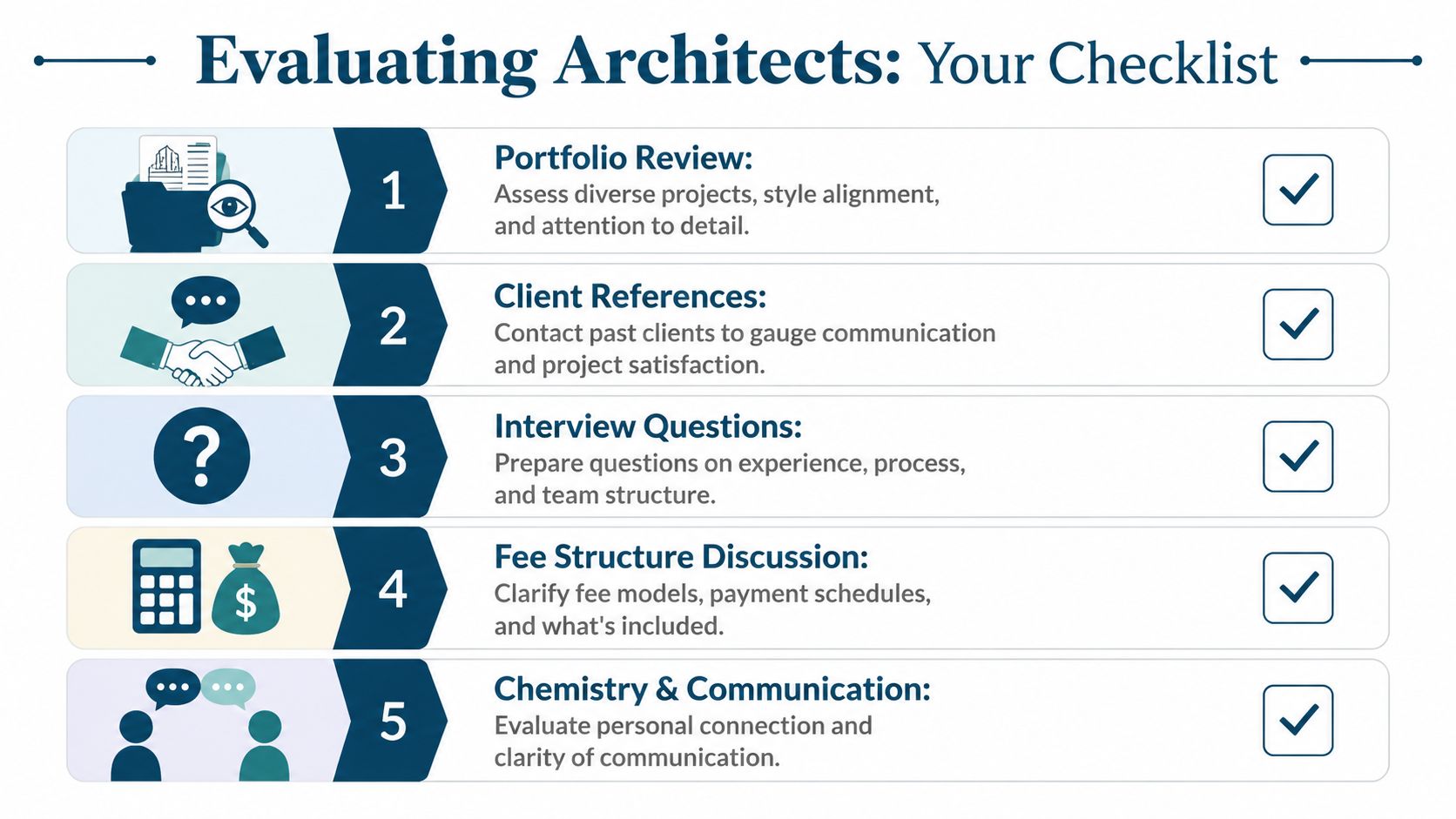
In Naples luxury residential work, due diligence isn't optional. Elite architects and builders prioritize thorough due diligence, with feasibility studies serving as the foundational document that prevents costly downstream revisions, as noted in this discussion of residential development mistakes and feasibility planning. When teams skip that work, projects tend to drift, and drift is expensive.
Review the portfolio like an owner, not a fan
Beautiful photography can hide weak problem-solving. Look beyond mood and study the work for signs of discipline.
Ask yourself:
Does the firm show multiple homes with consistent quality?
Do exterior proportions feel resolved from all angles?
Are windows, rooflines, and material transitions clean?
Do interiors look livable, or only staged?
Is there evidence they understand your project category?
If you're planning a custom home, a portfolio filled mainly with condo interiors won't tell you enough. If you're renovating a high-end residence in an established Naples neighborhood, a firm focused only on speculative-style new construction may not be the right fit.
Ask questions that reveal process
Initial meetings should sound less like a sales presentation and more like a working session. Good architects ask about your daily routines, priorities, timing, and tolerance for complexity. Good clients ask how the firm runs a job.
Use questions like these:
Who leads the project day to day? Some firms sell with a principal and deliver with a junior team.
How do you handle feasibility before design advances? This reveals whether they address zoning, review boards, site restrictions, and practical build concerns early.
What do you need from us before schematic design starts? Strong firms are specific.
How do you coordinate with consultants and builders during design? Coordination quality often predicts project smoothness.
How do you manage revisions? You want a disciplined process, not endless redrawing.
What happens when field conditions differ from the plan? Their answer tells you how they behave under pressure.
A polished concept meeting doesn't prove much. The real test is whether the firm has a repeatable way to make decisions before those decisions become expensive.
Architect-led versus design-build
This is the trade-off many homeowners don't understand until late. In a traditional architect-led model, the architect develops the design first, then a builder prices and executes it. That can work very well when the owner wants a highly design-driven process and is comfortable managing separation between design and construction.
An integrated model works differently. Design, interior planning, and construction coordination begin earlier and stay more connected. The main advantage is practical alignment. Budget, detailing, sequencing, and constructability get discussed while ideas are still flexible.
Here's a simple comparison:
Model | Works best when | Main risk |
|---|---|---|
Architect-led | You want maximum design independence and are prepared for more owner coordination | Budget and construction realities may enter later than they should |
Integrated design-build | You want tighter coordination between design intent and execution | You need to be sure the team still protects architectural quality |
Neither model is automatically right. The better choice depends on your priorities.
Signs the fit is wrong
Some red flags appear quickly:
Vague answers on permitting or pre-construction research
No clear explanation of who does what
Heavy focus on style, little focus on delivery
Resistance to builder input during design
A portfolio that feels broad but not deep
When the right fit is there, meetings feel clear. You leave with more confidence, not more fog.
Understanding Architectural Fees and Contracts
Fees feel opaque to many homeowners because architects don't all structure services the same way. That doesn't mean the pricing is arbitrary. It means you need to understand what is being included, what is being excluded, and when additional services begin.

There's also a reason Naples architectural fees can feel premium. A leading workplace-review platform reports an average architect salary in Naples of about $130,593 per year, as shown on Indeed's Naples architect salary page. That figure likely reflects senior and specialized roles in a market shaped by complex coastal work and high expectations.
Common fee structures
You'll usually encounter one of three models.
Fee model | How it works | Best use |
|---|---|---|
Percentage of construction cost | Fee scales with project size | Common on custom homes with evolving scope |
Fixed fee | Defined amount for defined services | Useful when scope is well established |
Hourly billing | Time-based charges for work performed | Often used for early studies, limited scopes, or added services |
None of these is automatically better. The issue is fit.
A percentage model can align with a full custom design effort, but it needs a clear definition of what construction cost means. A fixed fee can feel cleaner, but only if the scope is clearly defined. Hourly billing can be fair during feasibility or exploratory work, but it requires close tracking and written approval habits.
Read the agreement with a sharp pencil
The architectural agreement matters as much as the fee number. Owners get into trouble when they compare proposals by price alone and ignore scope language.
Review these items carefully:
Basic services. Schematic design, design development, construction documents, and construction-phase support should be clearly described.
Additional services. Revisions after approvals, extra meetings, consultant coordination, or permit resubmissions may fall outside the base fee.
Reimbursables. Printing, travel, application expenses, and outside consultant costs should be stated.
Construction administration role. Some architects remain actively involved during construction. Others play a lighter review role.
Payment timing. Milestones should match actual progress.
Owner's note: A lower proposal with thin scope language often becomes the more expensive choice once the project starts moving.
If you want help interpreting contract language before signing, a tool like an AI agent for scanning contracts can be useful for spotting unclear clauses or missing definitions. It won't replace legal advice, but it can help you prepare better questions before you commit.
What works in practice
The cleanest agreements usually share three qualities. They define the phases clearly, identify what triggers additional fees, and explain the architect's role once the builder is in the field.
That clarity reduces friction later. It also helps everyone make faster decisions because responsibility is already mapped out.
Designing for Coastal Resilience and Permitting
In Naples, good design has to survive contact with weather, salt air, humidity, code requirements, review comments, and long-term upkeep. A house can look refined on move-in day and still become frustrating if resilience wasn't designed into the bones of the project.
That's why the best architect Naples FL conversations go beyond elevations and finish palettes.
Permitting is not paperwork at the end
Permitting affects design choices early, especially on coastal and high-value properties. Site conditions, local requirements, flood considerations, review processes, and product approvals all influence what can be built and how long approvals may take.
Homeowners often treat permitting as an administrative handoff. In reality, it's part of design strategy. A team that understands this will ask tougher questions sooner and save you from redesigning after avoidable comments.
For owners who want a plain-language overview of common local issues, this Collier County permit guide is a useful starting point. It's not a substitute for project-specific advice, but it helps frame the kinds of approval details that can affect scheduling.
Resilience is more than code compliance
One of the biggest gaps in the market is explanation. Few architects clearly explain how decisions such as material selection and fenestration detailing translate into durability and lower maintenance costs over 20 to 30 years, and rising insurance premiums plus recent Florida Building Code updates have made resilience a key concern for Naples homeowners, as discussed in this overview of Naples residential architecture and resilience concerns.
That matters because code is the minimum. Long-term performance comes from decisions above that minimum.
Examples of resilience-minded design include:
Exterior material selection that handles salt exposure better over time
Window and door detailing that supports water management, not just appearance
Roof and drainage planning that reduces vulnerability at transitions and edges
Mechanical layout decisions that improve service access and protect equipment
Finish choices that are easier to maintain in a humid coastal environment
A well-designed home should age gracefully, not require constant correction.
Ask how the house will live ten years from now
A revealing interview question is simple: how will this design perform over time?
Strong answers usually address daily ownership, not just visual impact.
Look for discussion around:
maintenance access
replacement cycles
cleaning demands
exposure on specific elevations
coordination between envelope details and field execution
If you want a broader sense of storm-conscious planning, review these hurricane-resistant home plan considerations in Naples. It helps connect architectural intent with what has to happen in construction.
Homes in Southwest Florida don't fail only because of major storms. They also fail slowly when small detailing decisions ignore moisture, salt, heat, and maintenance reality.
What does not work
What fails most often is a style-first process that treats resilience as a late-stage specification exercise. By then, key decisions are already baked into the form, openings, assemblies, and budget.
A stronger approach starts with performance and lets aesthetics grow from that foundation. In coastal luxury construction, that usually produces better homes, not more compromised ones.
The Architect and Builder Partnership for Seamless Results
The handoff from design to construction is where many promising projects lose momentum. Not because the architect lacked talent or the builder lacked skill, but because the project was set up as a relay race instead of a partnership.

In high-end residential work, early collaboration usually produces smoother results. Expert architectural firms in Naples employ an integrated design-build methodology that centralizes architecture, interior design, and construction, reducing delays and costly change orders by bringing construction expertise into the project from the start, according to this explanation of integrated architectural design services.
What a healthy partnership looks like
The architect and builder do different jobs. The architect protects design intent, spatial quality, detailing logic, and documentation. The builder manages means and methods, trade coordination, scheduling, pricing feedback, site conditions, and execution quality.
The strongest projects create a working rhythm between those roles.
That usually includes:
Pre-construction coordination before drawings are fully locked
Regular site meetings where issues are addressed while solutions are still efficient
Submittal and shop drawing review so products match design intent
Prompt response paths when field conditions require decisions
Clear change management instead of reactive improvisation
Why owners benefit from integration
Owners often think they're preserving control by separating everyone until late. Sometimes that works. Often it creates blind spots.
When the builder joins the conversation early, the team can test:
whether details are practical to build
whether product selections fit schedule realities
whether structural and architectural ideas are aligned
whether budget priorities reflect the owner's goals
That kind of feedback doesn't diminish architecture. It strengthens it.
The best builder input doesn't water down design. It helps preserve the parts of the design that matter most by resolving problems before they become expensive.
What to watch for during construction
You want to see a project team that communicates without drama. Questions should move quickly. Decisions should be documented. Field conditions should trigger collaboration, not finger-pointing.
A few simple signs tell you the relationship is working:
The architect's details are being respected
The builder is raising issues early, not after installation
Selections are coordinated before lead-time problems hit
Changes are explained with cost and schedule implications
Everyone is working from the same current information
That's the difference between a project that feels managed and one that always feels one step behind.
If you're planning a custom home, luxury renovation, or coastal rebuild in Naples, JVM Construction LLC offers the kind of architect-builder coordination that helps great design hold up in practice. From early planning and permitting strategy to construction execution and finish quality, the team brings practical experience, clear communication, and deep local knowledge to every phase. Reach out to discuss your vision and build a home that looks exceptional, performs well, and feels right from the first sketch to final completion.