You're probably in one of two places right now. Either you've toured enough polished model homes to realize they all feel like someone else's idea of Florida living, or you've found a location in Bonita Springs and you don't want to waste it on a house that looks interchangeable with the one next door.
That's the right instinct.
Bonita Springs FL new construction offers plenty of options, but most buyers who want a luxury result eventually hit the same wall. Community inventory is convenient. A true custom home is personal. Those are not the same product, and treating them like they are is how people end up disappointed after spending a lot of money.
A custom build in Bonita Springs can be exceptional. It can also get complicated fast if you choose the wrong lot, underestimate permitting, or hire a builder who is good at finishes but weak on preconstruction discipline. The clients who have the smoothest experience usually make one decision early. They stop shopping only for aesthetics and start evaluating process, site constraints, and builder judgment with the same seriousness.
Your Guide to Building a Dream Home in Bonita Springs
A couple comes to Bonita Springs after years of visiting the area. They know how they want to live. Morning light in the primary suite, a proper outdoor living area that isn't an afterthought, a kitchen that works for entertaining, a study that doesn't feel tucked into leftover square footage, and materials that still look right years from now.
They start in new communities because that seems easier. It usually is easier, right up until they realize the floor plans solve the builder's production needs, not their own. The lot is good enough, the finishes are upgraded enough, and the layout is close enough. “Close enough” is expensive when you're building or buying at the luxury level.
That's where a custom approach changes the conversation. You stop asking, “Which model works best?” and start asking, “What should this home be for the way we live?” That's a far better question.
A disciplined custom process starts with the site, the rules attached to it, and the lifestyle priorities that won't change in five years. Then the design team and builder shape the house around those fixed realities. If you're looking at custom home building services in Southwest Florida, that early planning phase matters more than any showroom visit.
Practical rule: If the lot, permitting path, and budget structure aren't clear, the design isn't ready no matter how beautiful the renderings look.
Bonita Springs rewards buyers who are decisive, but luxury clients shouldn't be rushed into a production template just because it's available. If your goal is a home that fits your habits, your standards, and the property itself, custom construction is often the smarter route.
The Current State of New Construction in Bonita Springs
The local market is active, competitive, and segmented. That matters because custom buyers often assume they're operating outside the broader market. You're not. Land pricing, builder availability, trade schedules, and buyer expectations all move with the market around you.
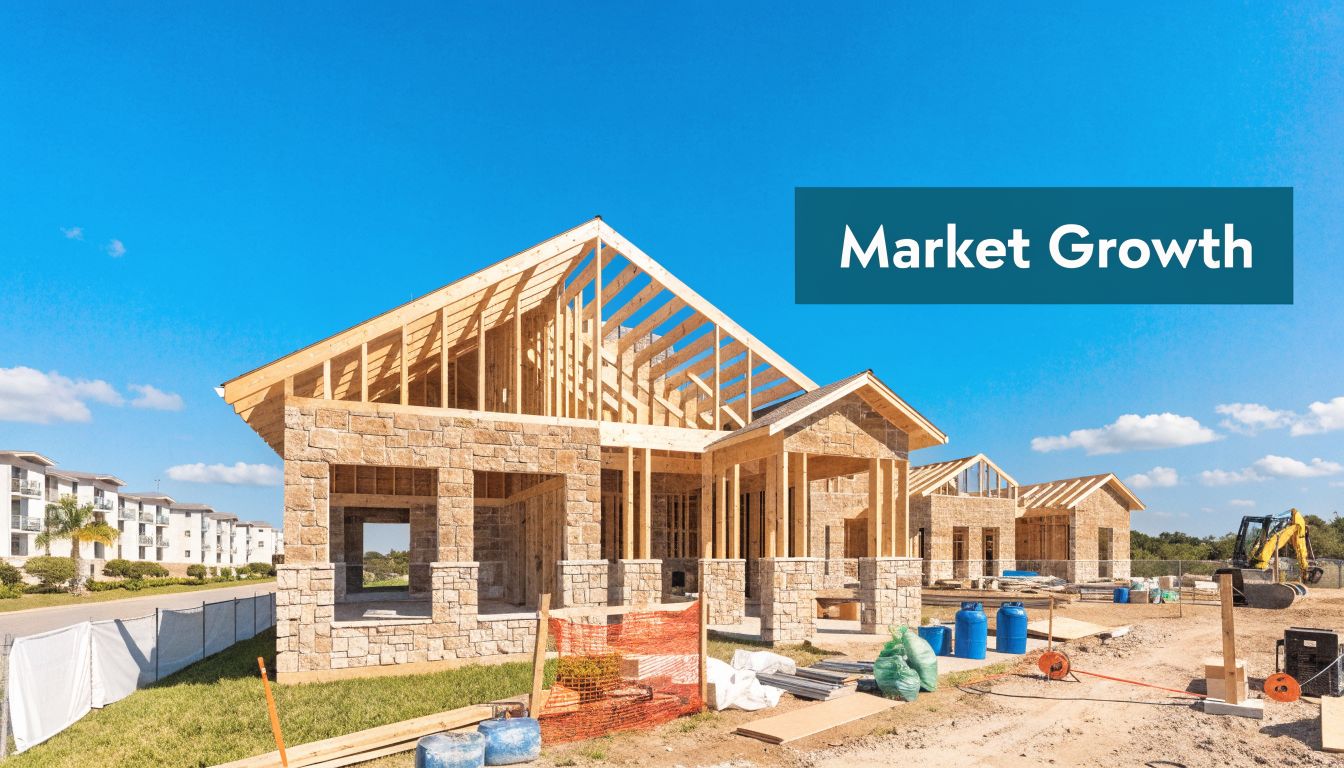
Bonita Springs has 98 active new construction communities with pricing from $389,990 to over $2.6M, according to Bonita Springs new construction community data. That range tells you something important. This isn't one uniform market. It includes entry-level production product, mid-market homes, and luxury offerings aimed at buyers who expect design, space, and location to work together.
What the numbers mean for a luxury buyer
A busy market doesn't just mean more homes for sale. It changes how quickly good opportunities disappear and how carefully you need to evaluate them.
Bonita Springs resale activity reinforces that pace. The same market snapshot notes 223 closed sales in April 2026, up 6.7% year over year, which supports ongoing demand for housing in the area. On the broader market side, median days on market fell from 62 days in April 2025 to 55 days in April 2026, while pending sales reached 189 new contracts in April 2026, up 28.6% from a year earlier, based on Bonita Springs housing market reporting.
That matters because fast movement narrows your margin for indecision. It also raises the value of doing real due diligence before you fall in love with a parcel, a floor plan, or a builder promise.
Why inventory conditions push buyers toward custom
The same housing report shows a 2.4 competitive months of supply versus 5.1 overall, and new listings dropped 21.7% in April 2026 compared with April 2025. That's a practical signal, not just a statistic. Desirable inventory is tighter, and buyers who want a very specific outcome often won't find it ready-made.
Here's the more telling detail. First-attempt listings closed in a 56-day median, versus 258 days for relisted homes. Quality and positioning matter. Homes that are well conceived, well presented, and correctly priced move. Homes that miss the mark linger.
Buyers don't reward compromise at the upper end of the market. They notice awkward layouts, weak finishes, and houses that ignore the lot.
My read on the market
If you want a standard home in a standard package, Bonita Springs gives you options. If you want a house with a clear point of view, built around your routines and your parcel, custom construction is often the cleaner answer.
A production builder can offer speed and predictability. A custom builder should offer better alignment between house, site, and client. In this market, that alignment is where the value is.
Finding Your Perfect Spot Premier Communities and Custom Lots
Location decisions in Bonita Springs usually come down to a fork in the road. You either buy into a community with an established product, or you secure a private homesite and build around it. Both approaches can work. Only one gives you full control.
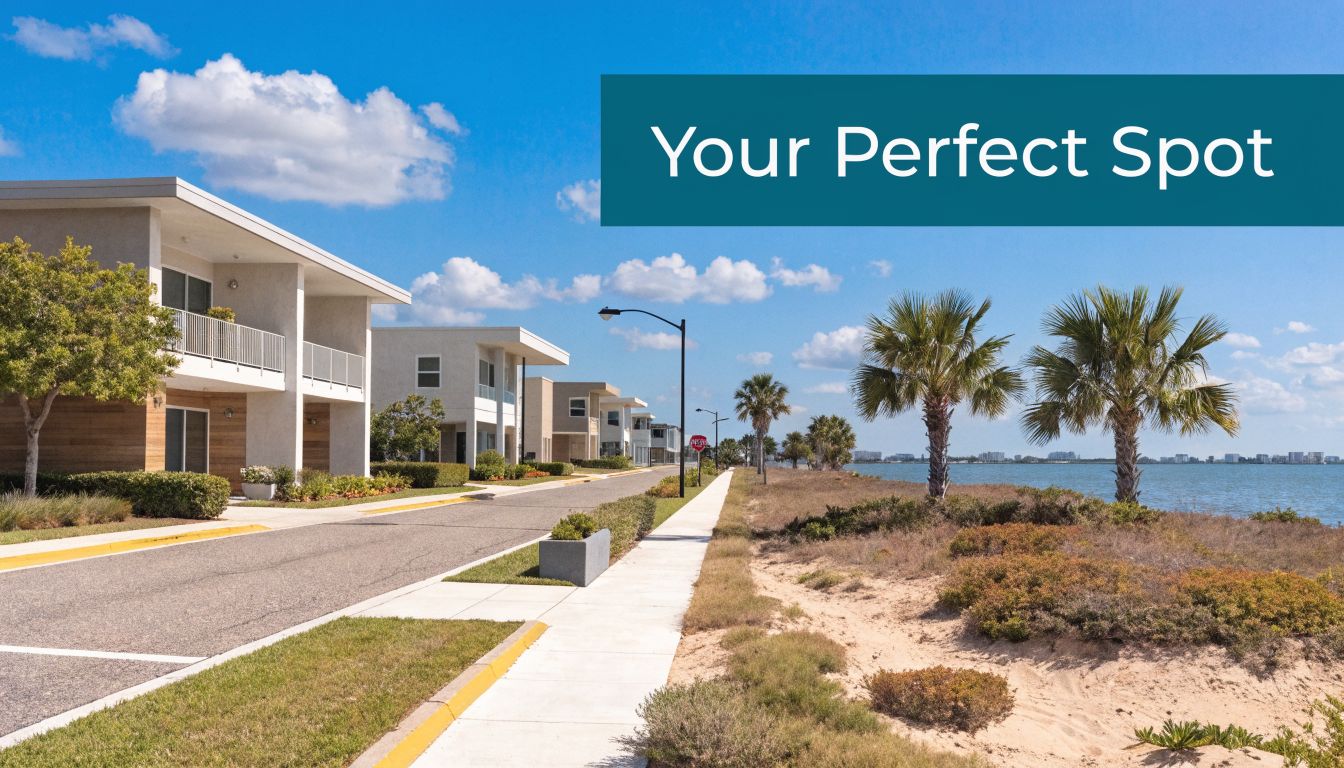
Community living versus building on your own lot
Here's the straight comparison.
Path | What works well | Where it falls short |
|---|---|---|
Master-planned community | Amenity access, simpler selection process, clearer baseline pricing | Limited design freedom, repeated plans, tighter architectural controls |
Private custom lot | Full design flexibility, stronger response to views and orientation, more privacy | More due diligence, more entitlement risk, more site-specific complexity |
Communities appeal to buyers who want convenience. That's fair. If you're happy choosing from a menu of plans and structural options, it can be a sensible path.
But luxury clients usually care about things communities struggle to deliver. Arrival sequence. View framing. Privacy from neighboring homes. Garage placement that doesn't dominate the front elevation. A floor plan that responds to sunrise, outdoor living, and how the family uses space.
If you're considering the second route, it helps to understand what's involved in building on your land in Southwest Florida. A beautiful parcel can still be a poor building site if the setbacks, access, drainage, or review requirements don't match your vision.
The custom lot advantage
A private lot lets you solve the house correctly from the beginning. You can place the pool where it belongs, shape the outdoor room around wind and light, and design circulation that feels composed instead of squeezed into a developer template.
That freedom is valuable, but it comes with responsibility. You need someone to evaluate:
Orientation: How sun, shade, and prevailing weather affect comfort
Site conditions: Grading, drainage, vegetation, access, and buildable area
Neighborhood context: Adjacent structures, privacy lines, and future nearby activity
Regulatory exposure: What approvals may shape design, timing, or feasibility
Why future supply is more political than many buyers realize
Not all new supply in Bonita Springs comes from easy greenfield development. Increasingly, future inventory depends on infill, redevelopment, approvals, and local politics.
That's why the recent Revana Lakes proposal for a 299-home community on a 204-acre property split between Bonita Springs and unincorporated Lee County matters. As reported in coverage of the Revana Lakes development proposal, the project moved forward only after a contentious city council vote. For buyers, the lesson is simple. Land availability is not the same as buildability.
A lot isn't valuable because it's empty. It's valuable because you can build the right house on it without ugly surprises halfway through approvals.
If you want a one-of-one home, treat lot selection like the foundation of the whole project, because it is.
Decoding the Costs of a Custom Luxury Home
Clients often ask the wrong first question. They ask for price per square foot. I understand why, but that number rarely tells the truth on a custom luxury project.
The better question is this. What are the actual cost drivers on this specific home and this specific site?
Bonita Springs gives you a useful baseline. Pulte's Bonita Del Sol pricing and related market context show entry pricing at $525,990 for that community, with homes ranging from 1,889 to 4,194 square feet. The same source notes a median listing price around $588,230 for new-construction homes in Bonita Springs, while emphasizing that final pricing shifts with square footage, lot premiums, and upgrades.
That baseline is helpful. It is not a custom-home budget.
What actually drives cost on a custom build
A bespoke home budget usually breaks into layers:
Land cost
This is the obvious one, but buyers often underestimate what the lot itself forces them to spend later. A premium site can justify the number. A problematic site can wreck the budget.Site preparation
Clearing, grading, drainage work, access conditions, and utility coordination all matter. On some lots, the house is the easy part.Design and preconstruction
Architectural plans, engineering, surveys, and the builder's preconstruction coordination are not overhead fluff. They are what prevent expensive mistakes.Core construction
Foundation, framing, roofing, openings, mechanical systems, insulation, drywall, and the rest of the structure.Selections and customization
Cabinetry, flooring, stone, lighting, millwork, specialty finishes, integrated technology, and exterior features create most of the visible difference between average and excellent.
The costs people forget
Budgets usually drift. Not because the client is careless, but because someone made the early budget look cleaner than reality.
A serious budget should account for:
Lot-specific work: Driveway length, fill needs, drainage strategy, retaining conditions
Architectural complexity: Roof lines, structural spans, large openings, custom detailing
Exterior living: Pools, outdoor kitchens, covered lanais, screens, grounds features
Revision risk: Changes after engineering or permitting cost more than changes on paper
Budget rule: Spend more time on preconstruction than feels necessary. That's where expensive surprises still cost paperwork instead of demolition.
How to use pricing information correctly
Don't use community pricing as proof that a custom luxury home should land near the same level. Use it as a market reference point. Production homes spread cost across repeated plans, fixed vendor relationships, and standardized details. Custom homes do the opposite. They concentrate effort on your lot, your plan, your finish schedule, and your priorities.
If you want a precise number early, ask for a line-item preconstruction budget with allowances that are explained in plain language. Then test it. Ask what is fixed, what is estimated, and what tends to move.
For a deeper look at budgeting logic, this guide on the cost to build a luxury home in Florida is a useful starting point. The point isn't to chase a magic square-foot number. It's to understand where the money goes and decide which parts of the home deserve it most.
Navigating Local Permitting and Coastal Building Codes
Bonita Springs is beautiful because it's coastal, and coastal building comes with rules. Some buyers treat permitting like annoying paperwork that happens in the background. That's a mistake. In this market, permitting influences design, schedule, and cost from the first serious conversation.
The City of Bonita Springs Community Development Department states that any construction seaward of the 1978 Coastal Construction Control Line requires a City Beach and Dune Permit, and that permit fees for hurricane-related repairs are no longer waived after January 31, 2025. The city also notes that plans must comply with applicable Land Development Code, state, and federal requirements, as outlined by the Bonita Springs Community Development Department.
What that means in plain English
If your property is coastal or near coastal conditions that trigger extra review, this affects more than the main structure. Decks, landscaping, site work, dune-related improvements, and exterior changes can all become part of the permitting conversation.
That has three practical consequences.
Design decisions must be code-aware early. Don't wait until finished plans are complete to ask whether the site can support what you drew.
Permit sequencing matters. Some approvals affect others, and a disorganized sequence can create delay.
Site features deserve the same scrutiny as the house. A client may focus on architecture while the actual permitting challenge sits outside the footprint.
Why good builders don't “figure it out later”
A strong builder doesn't promise an easy path before reviewing the parcel and the rules. They ask sharper questions first.
Questions worth asking before design gets too far
Is the lot affected by coastal review layers that change site planning?
Will exterior improvements need separate or additional approval?
Are there code or land development constraints that shape massing, setbacks, or placement?
Has the permit path been mapped in a realistic order?
If the answers are vague, the preconstruction work is not mature enough.
Coastal compliance isn't an obstacle to good design. It's part of good design.
How to protect your timeline
The best move is to front-load coordination. Get the site reviewed. Align architect, builder, engineer, and consultants early. Resolve likely friction points before they become formal comments or redesign cycles.
Luxury clients usually care about finish quality and architectural intent, which they should. But the project only moves smoothly when those ambitions are matched by permitting discipline. In Bonita Springs, that discipline is not optional. It's part of building responsibly and protecting your schedule.
From Vision to Reality The Custom Home Building Process
A custom home should feel deliberate from the first sketch to final handover. When the process is loose, clients feel it. Decisions pile up, schedules wobble, and small issues become expensive ones.
The cleanest projects follow a predictable progression, even though every house is different.
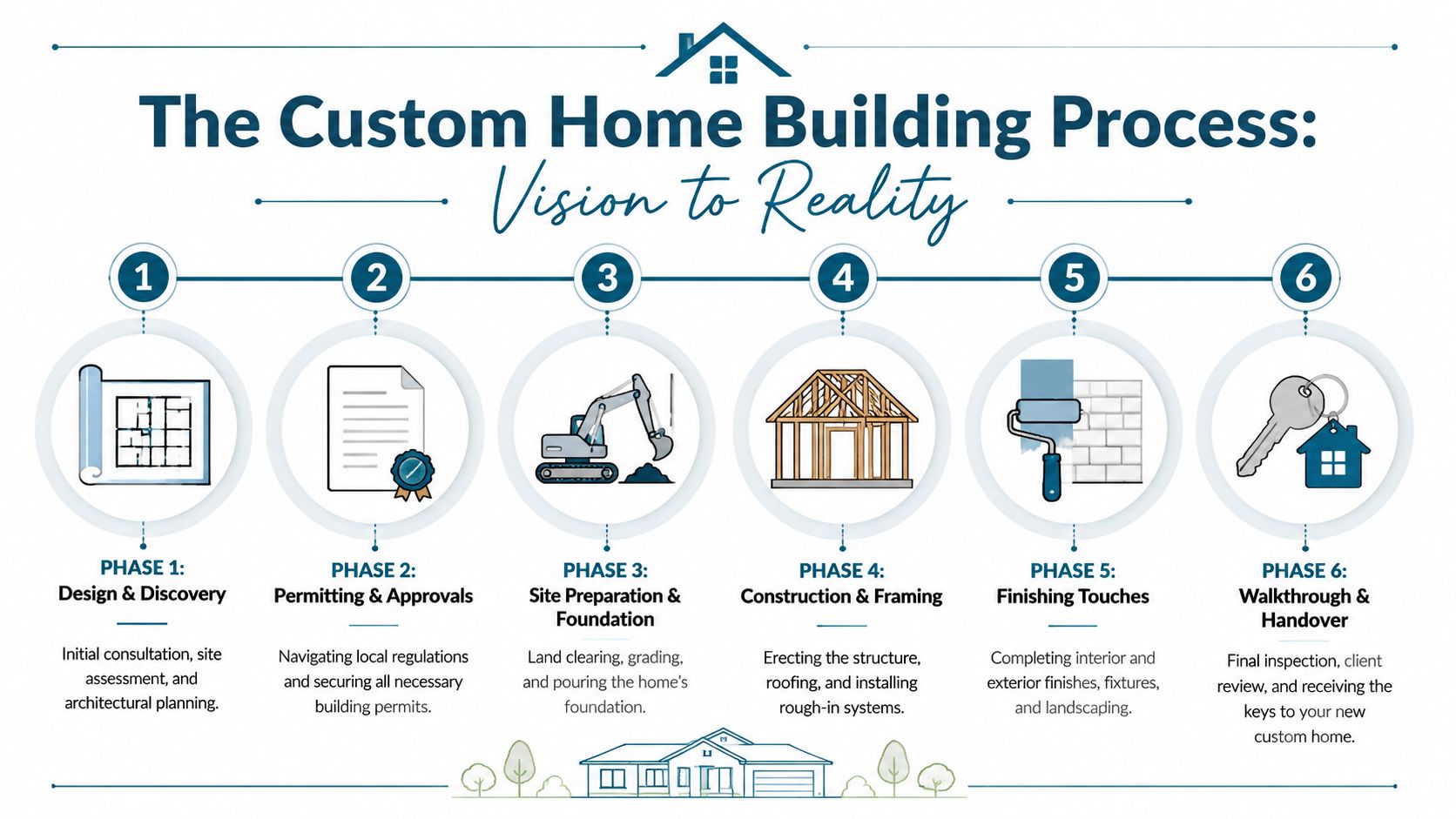
The six phases that matter
1. Design and discovery
This phase is where the home gets smarter or sloppier. Site assessment, architectural planning, room relationships, structural thinking, and lifestyle priorities all need to align.
Don't rush this stage. If the garage, entry, outdoor space, and primary suite orientation aren't solved now, they won't magically improve later.
2. Permitting and approvals
Once the plans are sufficiently developed, the project moves into formal review and permitting. This stage is administrative, but it still needs active management.
A builder who tracks comments, revisions, and dependencies carefully will save weeks of frustration. One who doesn't will start blaming the jurisdiction for problems created in-house.
3. Site preparation and foundation
The paper project transitions into a physical one. The lot is prepared, grades are addressed, and the foundation work begins.
Good site management matters here because the property sets the tone for every trade that follows. Sloppy prep usually creates downstream issues.
What construction should look like when it's organized
Once the structure starts rising, clients often think the hardest part is over. It isn't. Framing, roofing, rough mechanical systems, and coordination between trades require constant supervision.
A disciplined builder keeps the site safe, clean, and sequenced correctly. If you want an outside perspective on why jobsite discipline matters, the Growth 4 Trades builder safety guide gives a practical overview of the standards serious construction teams should take seriously.
4. Construction and framing
This phase includes structural framing, dry-in, and rough-in systems. It's also where mistakes become expensive if coordination is weak.
5. Finishing touches
Now the home starts to look like the renderings. Millwork, cabinetry, flooring, tile, fixtures, paint, exterior details, and landscaping come together.
Clients need clear selection schedules and lead-time awareness. High-end materials don't help if they arrive late or weren't specified completely.
6. Walkthrough and handover
Final walkthroughs shouldn't feel ceremonial. They should feel thorough. Punch list items need to be documented, addressed, and verified before handover.
The handover should be the calmest day of the project, not the day everyone scrambles to explain what's still unfinished.
How to Select Your Bonita Springs Custom Home Builder
If you choose the wrong builder, the rest of the project gets harder no matter how good the lot or architect is. That's the blunt truth.
Luxury clients often start with portfolio photos. That's understandable, but it's not enough. A builder can photograph well and still be weak on budgeting, scheduling, documentation, or communication. Those weaknesses won't show up in a finished kitchen shot. They show up when allowances are vague, calls aren't returned, and field decisions get made without discipline.
What to evaluate beyond aesthetics
Look for proof of process, not just proof of taste.
Preconstruction discipline: Ask how they budget, review plans, flag risk, and manage permit sequencing.
Communication style: You want direct answers, not charm. If someone is slippery before the contract, they won't become transparent later.
Relevant experience: Coastal and luxury work require judgment. Not every builder who can finish a nice home can manage site complexity well.
Trade network: Strong subcontractor relationships matter because quality execution depends on the people on site every day.
One useful screening tool is to ask how the builder helps clients visualize decisions before construction begins. If you're comparing teams, these examples of 3D house renders by Roomstage AI show the level of visual clarity that can help clients catch proportion, massing, and exterior character issues early.
Questions I'd ask every builder
Use these in your interviews and listen for specifics.
Question | What a good answer sounds like |
|---|---|
How do you handle budget updates during design? | Clear explanation of allowances, scope changes, and decision timing |
How do you manage lot due diligence? | Mentions site review, consultants, permitting path, and buildability |
Who communicates with me weekly? | A defined point of contact and a real reporting rhythm |
How do you handle issues in the field? | Direct process, documented decisions, no hand-waving |
If you want one factual example of a firm operating in this space, JVM Construction LLC provides custom home building, whole-home remodeling, permitting coordination, subcontractor management, and scheduling for luxury residential projects in Southwest Florida. That's the kind of scope you should expect from any builder you seriously consider.
Choose the team that gives you the clearest process, the clearest numbers, and the least drama in how they answer hard questions.
If you're planning a custom home in Bonita Springs and want a builder who can help evaluate your lot, clarify the permitting path, and manage the project from design through completion, contact JVM Construction LLC to start the conversation.