You're probably in one of two places right now. You've either found a lot in Naples that feels too good to waste on a generic house, or you've bought an older property in a prime location and you're trying to decide whether to tear it down, rework it, or walk away. That's the moment when most owners realize mansions in Naples Florida are not just about square footage, views, or finishes. They're about making the right decisions early, before the drawings, before permits, and definitely before construction starts.
Naples rewards people who plan well. It also punishes shortcuts. A beautiful elevation means very little if the house sits too low, the wrong materials get specified for salt exposure, or the team treats a waterfront build like a suburban project. This market is too expensive, too regulated, and too exposed to coastal conditions for guesswork.
That's why the right way to think about a Naples mansion is not “What home should I buy?” It's “What kind of life do I want here, and what path gets me there with the fewest compromises?” Sometimes that means building from scratch. Sometimes it means buying a structurally solid home and transforming it. Sometimes it means staying away from a “deal” that will become a construction headache.
Your Guide to Creating a Luxury Home in Naples
Naples attracts people who want more than a winter address. They want a house that lives well every day. Morning light in the main suite. Outdoor spaces that actually get used. A floor plan that works when grandchildren visit, when friends come in for a weekend, and when the owners want the place to feel calm instead of oversized.
That's why the conversation around mansions in Naples Florida should start with lifestyle, not listings. Important questions are practical. Do you want to walk to dinner in Old Naples, keep a boat behind the house in Aqualane Shores, or create a quiet compound with more flexibility outside the usual gated pattern? Do you want a clean-sheet custom home, or do you want to preserve a location that would be hard to replace?
Naples is also a market where quality matters more than flash. Buyers and homeowners here notice proportions, detailing, millwork, sightlines, and structural confidence. They also notice when a house was designed without respect for the coast.
Practical rule: In Naples, the expensive mistakes usually happen before finishes are selected. They happen in site choice, design coordination, code planning, and builder selection.
A well-executed luxury home here comes from a disciplined sequence:
Choose the right setting: The lot, street, and water exposure shape everything that follows.
Decide on the right path: Buy, build, or renovate based on location, structure, and how much personalization you want.
Build for coastal reality: Elevation, piles, glazing, roofing, drainage, and corrosion resistance are not optional.
Use a team that can coordinate: High-end homes fail when the architect, builder, engineer, and interior designer operate in silos.
If you get those four calls right, the rest becomes much more manageable. If you get them wrong, even a large budget won't save the project.
Mapping Your Dream Naples' Most Exclusive Mansion Enclaves
Naples doesn't have one luxury market. It has several distinct lifestyles, each with its own rhythm, architecture, and construction challenges. You shouldn't choose a neighborhood because it sounds prestigious. You should choose it because it matches how you want to live.
Port Royal
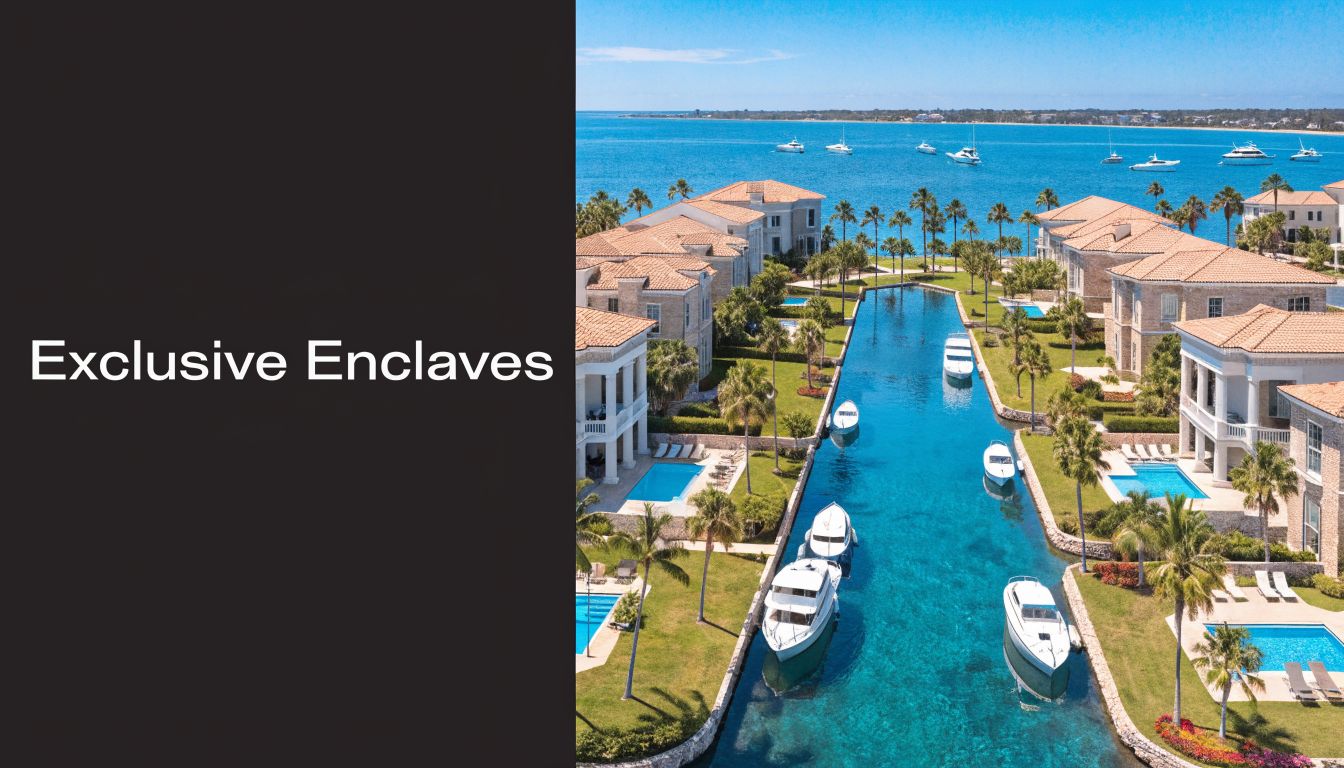
Port Royal is for owners who want waterfront presence and direct boating access woven into daily life. The houses are large, the expectations are higher, and the site planning is unforgiving. If your vision includes a serious dock program, broad outdoor entertaining areas, and a home that reads as an estate the moment you arrive, this is the benchmark.
The best Port Royal projects don't just look impressive from the street. They solve circulation well. They separate service access from guest arrival. They make the water the focal point without turning the floor plan into a long corridor of glass.
Old Naples and Aqualane Shores
Old Naples has a different energy. It's more walkable, more layered, and often more personal. You're balancing charm, location, and lifestyle access. If you want to move between the beach, dining, and shopping without feeling removed from the life of town, it's hard to beat.
Aqualane Shores sits in a sweet spot for many luxury buyers because it blends canal-front living with close access to downtown. It can give you the waterfront component without forcing you into a more isolated setting. That mix is hard to replicate.
If you're comparing streets and micro-locations around these areas, it helps to understand how the larger luxury corridor fits together. This overview of Millionaire's Row in Naples Florida is useful context when you're sorting prestige from actual livability.
A great Naples address doesn't automatically mean a great homesite. The lot's elevation history, water relationship, access, and design constraints matter more than the name on the listing.
The Moorings
The Moorings appeals to buyers who want refinement without the same level of intensity that surrounds the most publicized enclaves. Bay views, established streets, and a mature residential feel give it staying power. It's a strong fit for owners who want a polished home and a coastal lifestyle without feeling like they have to perform luxury.
From a builder's perspective, The Moorings often opens the door to thoughtful whole-home transformation. Many properties have strong location value and need a sharper plan, better structure, and cleaner detailing.
Non-gated privacy is underrated
A lot of buyers start by asking about gated communities because they assume that's where privacy lives. That's too narrow. Naples offers 346 non-gated homes and 142 secluded properties at a median of $1.4M, and areas like Rural Estates or non-gated waterfront pockets in Aqualane Shores can provide 20-30% better appreciation for homeowners who want flexibility and discretion without strict HOA rules, according to Zillow's Naples non-gated community listings.
That matters if you want room to shape the property around your family instead of fitting your plans into community restrictions. Non-gated doesn't mean less luxury. In many cases, it means more freedom.
For clients who split time between Naples and other cities, travel logistics often matter more than people admit at first. If private air access is part of your routine, this guide to Naples Florida jet charter routes is worth reviewing while you narrow neighborhoods and arrival patterns.
The Naples Luxury Market Prices Trends and Value
Naples earns premium pricing because buyers are paying for a combination that's hard to duplicate. Coastal setting, established luxury neighborhoods, long-term desirability, and a buyer base that values quality all support the market. That doesn't mean every property is worth the ask. It means the top end of this market has real depth when the home and location align.
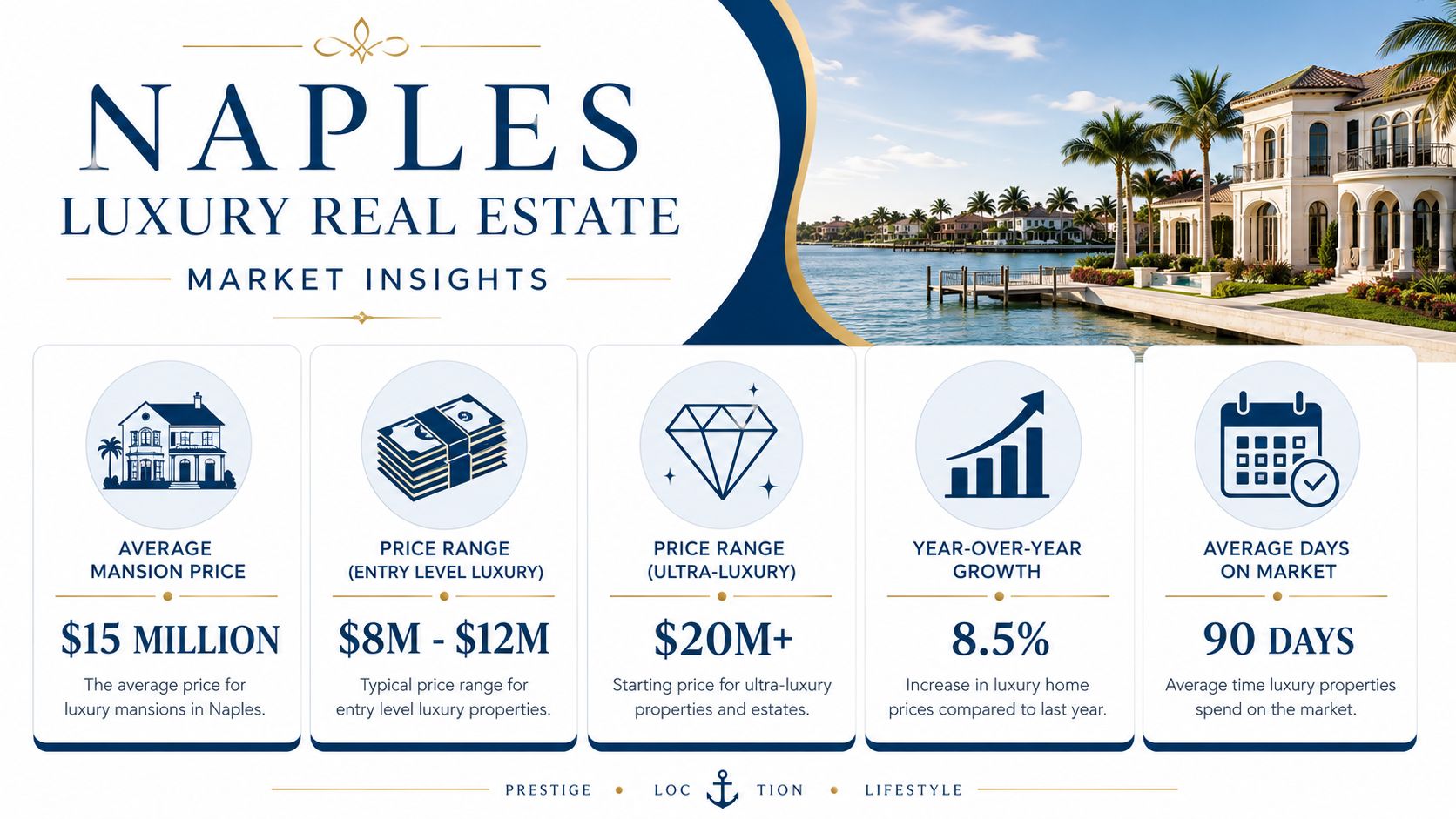
The headline number tells you how different Naples is from most markets. Median property values in Naples reached $1.53 million in 2024, which is over 4.5 times the national average, and the city's municipal tax millage rate is 1.1700, among the lowest in Florida, according to Data USA's Naples profile. That combination matters if you're planning a custom home and thinking beyond the initial build cost.
Why value holds here
Naples has something many luxury markets struggle to maintain. Buyers keep showing up for lifestyle, not just momentum. That creates a stronger floor under well-located homes. In practical terms, that means owners who build carefully, choose enduring materials, and avoid trendy mistakes usually preserve value better than owners who chase visual drama without discipline.
There's also a difference between expensive and durable value. Durable value comes from things that won't age out quickly:
Walkability or water access: Those advantages stay relevant.
A flexible floor plan: Families change. A rigid layout becomes obsolete.
Coastal-ready construction: Buyers pay attention to resilience.
Architectural restraint: Clean, timeless work ages better than novelty.
Don't confuse asking price with real worth
Many buyers are distracted by listing language. That is a mistake. Real value stems from site quality, structural soundness, replacement difficulty, and the cost to bring the property up to the standard you want. If you want a clearer framework for that side of the conversation, this guide helps demystify real estate valuation in plain terms.
Here's the blunt truth. In Naples, the home that looks cheaper up front can become the most expensive option if it needs major structural correction, flood-related redesign, or a complete systems overhaul. The smarter buyer studies the property as a building project, not just a purchase.
Bottom line: In this market, value follows location, build quality, and how hard the property would be to recreate today.
Blueprint for Your Vision Buying Building or Renovating
Most clients start with an assumption. They think one path is clearly better. Then they look closer and realize each option comes with tradeoffs. Buying is faster but usually means compromise. Building gives you control but demands patience and discipline. Renovating can preserve a prized location, but only if the underlying structure and layout make sense.
In Naples' luxury market, new custom home construction typically ranges from $500 to $1,500 per square foot, while high-end remodels average $250 to $500 per square foot, according to this Naples custom construction cost overview. That same source notes that many pre-2000 estates are now being updated so owners can meet modern hurricane-related expectations while keeping a prime address.
Buy existing when location wins
Buying an existing mansion makes sense when the property already nails the things you can't change. Street, orientation, water relationship, and neighborhood feel come first. If those are right, cosmetic or selective layout changes are manageable.
This path works best for clients who:
Want to move faster: You'll still renovate, furnish, and personalize, but you skip the full ground-up cycle.
Find an irreplaceable lot: Some addresses justify working with an existing structure.
Can tolerate compromise: No resale home fits perfectly. The question is whether the compromises are minor or fundamental.
The risk is simple. Buyers underestimate what it takes to make an older luxury home feel coherent. Patchwork improvements are common. You'll often uncover dated systems, awkward transitions, and details that don't match the level of the neighborhood.
Build custom when your standards are specific
If you know exactly how you want to live, building is often the cleanest path. You control the floor plan, the structure, the materials, the view corridors, the storage, the wellness spaces, the garage strategy, and the outdoor program. You also avoid inheriting someone else's decisions.
New construction is the right move if you care about:
Precision: You want the house to fit your routines, not the other way around.
Coastal performance: It's easier to engineer resilience correctly from day one.
Consistency: The whole home can be designed as one integrated vision.
Where people get in trouble is assuming the process is only about design taste. It isn't. A strong custom home depends on early collaboration between architect, engineer, builder, and interior team. If those voices arrive late or fight each other, the result looks expensive but feels unresolved.
Renovate when the address is too good to lose
Whole-home renovation is often the smartest move in Naples, especially in mature neighborhoods with excellent sites and aging housing stock. A lot of owners don't want to give up their location. They want the same lot, the same street, and a much better house.
A serious remodel can work beautifully when the project includes:
Structural evaluation first
A realistic plan for code-driven upgrades
A layout rethink, not just finish replacement
A builder who can manage sequencing in an occupied or constrained setting
That last point matters. Renovation is not “easier building.” It's more surgical. You're solving for old framing, hidden conditions, delivery limits, and the need to merge new work with existing character.
Factor | Buy Existing | Build Custom | Renovate Whole-Home |
|---|---|---|---|
Decision speed | Faster path to ownership | Slower, more deliberate | Moderate, depends on scope |
Customization | Limited by existing layout and structure | Highest level of control | Strong, but shaped by what stays |
Budget clarity | Can shift after inspections and post-close discoveries | More predictable when documents are coordinated | Depends heavily on hidden conditions |
Best use case | Great lot and mostly workable home | Exact lifestyle goals and long-term ownership | Prime location with salvageable structure |
Main risk | Paying luxury pricing for someone else's compromises | Team misalignment early in design | Underestimating scope behind walls and under floors |
A practical benchmark helps. If the lot is outstanding and the home is structurally promising, renovation deserves a hard look. If the floor plan fights the site, the elevation is wrong, and core systems need replacement, a new build is often the cleaner answer.
Building for the Coast Resiliency Style and Materials
Luxury homes in Naples live in a beautiful environment, but they also live in a demanding one. Salt air, wind exposure, flood requirements, and water intrusion risk don't care how much you spent on the chandelier package. The house has to be engineered for the coast first and styled second.
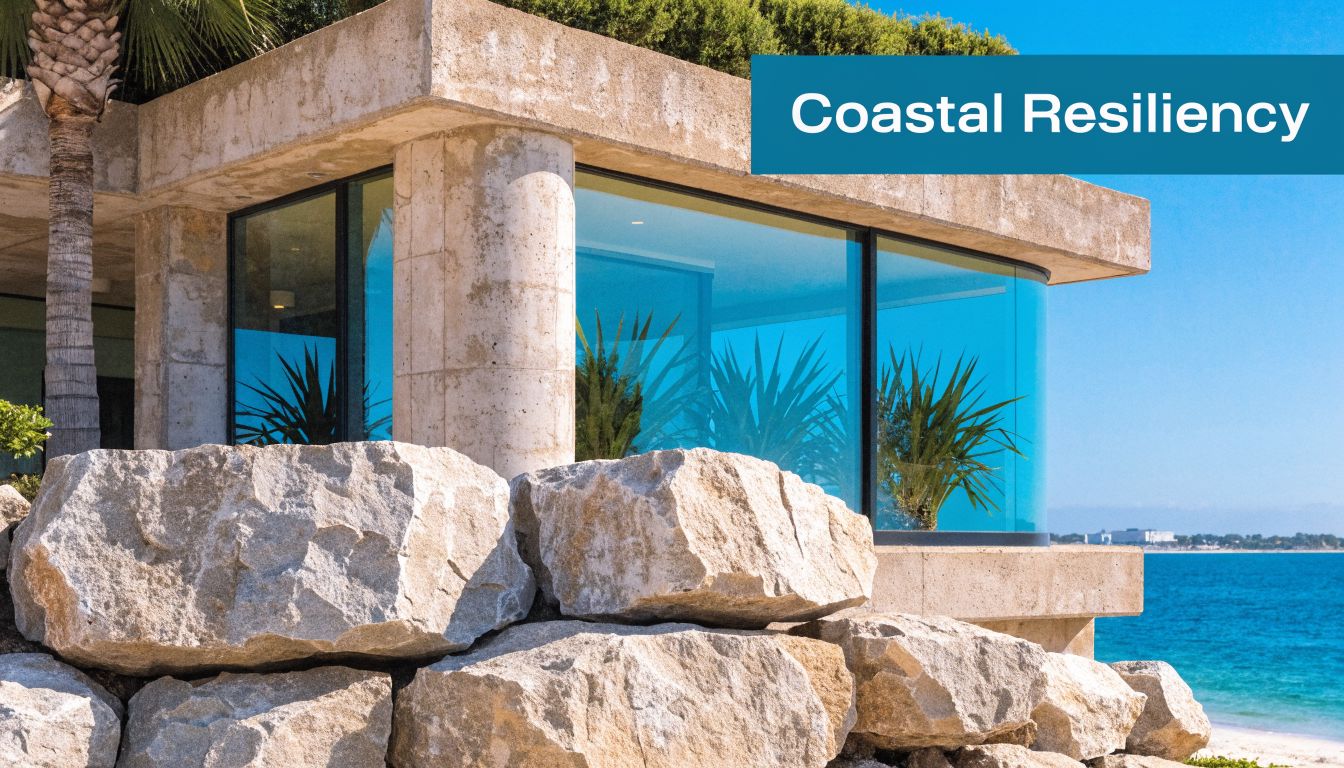
According to the City of Naples coastal construction reference, luxury mansions in Naples commonly require concrete pile foundations driven 20-40 feet deep and raised first floors set 12-18 feet above sea level to comply with FEMA flood maps. That same source notes that homes built to Fortified standards by the IBHS can see insurance premiums reduced by 20-35%, which can translate to $50k+ annual savings on a $10M home.
Start below grade, not at the front elevation
The most important parts of a Naples mansion are the parts guests rarely notice. Foundation design, slab strategy, drainage planning, and structural connectors make the home durable. If those are weak, the house becomes an expensive maintenance project.
For waterfront and coastal lots, I'd insist on clarity in these areas:
Pile foundation design: The structure needs competent support, not assumptions.
Finished floor elevation: You want confidence here from day one, not regret after a storm.
Water management: Grade, hardscape runoff, and drainage need to work together.
Structural continuity: Roof, walls, openings, and connectors should perform as one system.
If you're still early in planning, this resource on hurricane-resistant home plans is worth reviewing before the design gets too far along.
Build the shell like you expect the coast to test it. Because it will.
Materials that belong in Naples
Not every premium material is the right material. Some products look impressive in a showroom and age poorly near the Gulf. Others cost more up front but save years of aggravation.
I'd prioritize the following without hesitation:
Impact-rated glazing: This is not a luxury add-on. It's part of responsible coastal construction.
Corrosion-resistant hardware: Salt exposure attacks cheap metal fast.
Durable roofing assemblies: The roof system needs to be specified for local uplift conditions and long-term weathering.
Concrete and reinforcement protection: Coastal environments are hard on exposed and embedded components.
Exterior finishes with real staying power: Select systems that can handle sun, moisture, and maintenance cycles without constant repair.
Style still matters, but restraint ages better
Resiliency doesn't mean the home has to feel defensive. The best coastal houses in Naples feel calm, open, and composed. They use large glass carefully, shade outdoor areas well, and create strong indoor-outdoor transitions without making the envelope vulnerable.
You can still get the look clients want. Clean contemporary. Warm transitional. West Indies influence. Refined Mediterranean. But the style needs to sit on top of a disciplined building strategy.
One practical recommendation. Don't let the design team treat structural requirements as something to disguise at the last minute. When elevation, roof form, opening protection, and material durability are integrated early, the house looks better and performs better.
Assembling Your Dream Team Selecting a Builder and Architect
The team you choose will shape your project more than any finish, appliance package, or outdoor design concept. Owners spend a lot of time debating stone, millwork, and pool features. They don't spend enough time asking whether the architect and builder can deliver a coordinated luxury home in Naples.
That's backwards.
What to look for first
Portfolio matters, but not in the way many would assume. Don't just look for pretty photos. Look for evidence that the team understands coastal construction, proportion, detailing, and project control. A builder should be able to walk you through how a house came together, not just show you the finished kitchen.
Ask direct questions like these:
What kinds of Naples projects have you completed? New custom homes and whole-home remodels are different animals.
How do you handle preconstruction? Good teams solve problems on paper before they become change orders.
Who manages communication? You need a clear point person.
How do you coordinate architect, engineer, designer, and trades? Luxury homes break down when nobody owns coordination.
How do you document allowances, selections, and scope changes? Vague paperwork creates expensive misunderstandings.
For a sharper interview list, this guide on what to ask a general contractor gives homeowners a solid starting point.
The real red flags
Some warning signs are obvious. Others are subtle.
A team is risky when they:
Talk only about aesthetics: If they don't bring up structure, code, sequencing, and site conditions, they're selling a fantasy.
Promise easy timelines without seeing the property: Serious builders don't guess casually.
Avoid hard conversations about cost alignment: Luxury projects need budget realism early.
Can't explain their process: If the process sounds loose, the project will be loose.
The right team won't try to impress you with buzzwords. They'll make you feel that the project is organized, understood, and under control.
Choose collaborators, not order takers
The best architect-builder relationships are candid. They challenge weak ideas early. They protect the homeowner from avoidable mistakes. They know that luxury construction is not about saying yes to everything. It's about saying yes to the right things and no to the expensive distractions.
One practical option in this market is working with firms that already handle custom homes, whole-home remodels, high-end condo renovations, permitting coordination, and subcontractor scheduling, such as JVM Construction LLC, because that kind of scope familiarity can reduce handoff friction during a complex Naples project.
I'd also recommend speaking with prior clients. Ask how the team handled tension, not just how the house looked at the end. Every project hits stress points. The measure of a team is how they respond when something changes, gets delayed, or needs to be redesigned.
From Permits to Perfection Navigating Timelines and Condo Remodels
Luxury homeowners don't need fairy tales about construction timelines. They need realism. In Naples, the schedule depends on design complexity, approvals, product lead times, and how well the team coordinates the process. A clean project doesn't happen because someone “pushes hard.” It happens because the work is properly sequenced from the beginning.
Permitting deserves more respect than most owners give it. A permit set has to do more than look complete. It has to answer the questions reviewers, engineers, and inspectors will ask. Weak permit documents slow everything down and force costly revisions later.
What owners should expect from the process
A well-managed project usually moves through these stages:
Preconstruction and document alignment Scope, budget direction, site conditions, and consultant coordination need to tighten up during this phase.
Permitting and approvals
The quality of the drawings and specifications drives this phase more than optimism does.Procurement and scheduling
Critical materials, windows, doors, specialty finishes, and mechanical components should be planned early.Construction and inspections
Field execution only goes smoothly when the decisions upstream were disciplined.Final approvals and closeout
Owners should understand the importance of the building's official permission slip, because final occupancy is more than a bureaucratic step. It confirms the home can legally and safely be used as intended.
Condo remodels are their own category
High-end condo renovation in Naples requires a different mindset from a single-family remodel. You're not only working with design and structure. You're also working with building rules, elevator logistics, delivery windows, noise constraints, protection requirements, and board approval procedures.
That means a condo renovation team should know how to handle:
Board submittals and approvals
Work-hour restrictions
Material delivery and staging in occupied buildings
Protection of common areas
Coordination with building management and neighboring units
Superior condo renovations seem seamless to the property owner because the team manages every restriction with professional discretion. The most difficult projects prove draining because the planners failed to prepare for the challenges of working within a shared high-rise setting.
If you're planning mansions in Naples Florida, whether that means a waterfront estate, a major whole-home remodel, or a luxury condo transformation, the smartest move is to get the planning right before the excitement takes over. That's where good projects separate from expensive disappointments.
If you're ready to talk through a new custom home, a whole-home renovation, or a high-end condo remodel in Naples, reach out to JVM Construction LLC. A clear early conversation can save months of frustration and help you choose the right path for your property, your timeline, and the way you want to live.