You’re probably in one of two places right now. You’ve either found the lot and started collecting screenshots, sketches, and inspiration photos, or you’ve been touring homes across Naples and keep saying the same thing: “Nice house, but it’s not us.”
That’s the moment when custom starts to make sense.
A luxury home in Florida isn’t just a set of finishes. It’s how the house sits on the lot, how it handles weather, how it captures light, how it supports your routines, and how smoothly the entire building experience runs while you’re making hundreds of decisions. The home matters, of course. But the relationship with the builder matters just as much.
Your Florida Dream Home Awaits So Where Do You Begin
A lot of homeowners start with the fun part. They talk about wide-plank floors, a floating staircase, a club room, maybe a guest suite that feels like a boutique hotel. Then they start calling builders and run into a wall of polished websites, glossy portfolios, and vague promises.
That’s where the process gets confusing.
Florida is not a small, simple building market. The state’s home builders industry reached a projected market size of $18.2 billion in 2026 and supports over 33,000 businesses, while Southwest Florida had nearly 340 active builders competing in December 2025, according to IBISWorld’s Florida home builders industry data. That tells you something important. Finding a builder isn’t hard. Finding the right one is.
Start with fit, not flash
If you’re searching for luxury home builders florida, don’t start by asking who has the prettiest photos. Start by asking who can guide a high-stakes, detail-heavy, emotionally demanding project without turning it into a second full-time job for you.
A serious luxury build in Naples involves more than design taste. It involves flood considerations, engineering, permitting, trade coordination, scheduling discipline, and clean communication. One builder might show you a beautiful waterfront home. Another might show you how they handled approvals, site challenges, and finish coordination without chaos. The second conversation is usually the one that matters more.
The wrong builder can make a beautiful design feel stressful. The right builder makes a complex project feel organized.
What most homeowners need at the beginning
Before you compare portfolios, get clear on these points:
Your lifestyle priorities. Do you entertain often, host extended family, or need lock-and-leave simplicity?
Your decision style. Some clients want deep involvement in every finish. Others want strong guidance and fewer moving parts.
Your site realities. A waterfront lot in Naples isn’t built the same way as an inland lot.
Your tolerance for uncertainty. Custom work always requires decisions. Good process reduces surprises, but it never eliminates the need for active collaboration.
The best place to begin is a candid conversation with a builder who can talk plainly about your lot, your goals, and your process. Not a sales pitch. A working conversation.
What Truly Defines a Luxury Home Builder
“Luxury” gets thrown around too casually. In this market, it can mean imported stone, oversized appliances, or a dramatic foyer. That’s not how I define it.
A true luxury builder gives you a better building experience. The materials matter. The craftsmanship matters. But the true difference is in how the project is managed, how decisions are documented, how problems are handled, and whether you feel informed or blindsided.
Scale and standardization versus custom partnership
National builders serve a purpose. They’re built for scale, repeatability, and systematized delivery. Lennar generated $32.5 billion in homebuilding revenue in 2023, according to Statista’s revenue ranking of leading U.S. homebuilders. Companies at that scale rely on standardized models and a repeatable operating structure.
That’s a completely different business from a custom luxury builder.
If you want a one-of-a-kind home on a valuable Naples lot, standardized thinking becomes a problem fast. A custom builder’s value is not volume. It’s judgment. It’s the ability to coordinate architects, engineers, trades, interior selections, site conditions, and your personal priorities into one coherent process.
What I’d look for first
When homeowners meet with builders, they often focus too hard on style. I’d focus on process first.
Here’s what separates one builder from another:
Communication discipline. Do they answer clearly, or do they dodge specifics?
Job load. A builder who takes on too many projects usually gives each one less attention.
Decision management. Selections, approvals, and change documentation need structure.
Local fluency. Coastal building in Southwest Florida requires practical knowledge, not generic experience.
Subcontractor standards. A luxury home is only as good as the trades executing it.
Luxury means fewer unpleasant surprises
The biggest misconception in custom building is that luxury means unlimited choices. It does, but that’s only half the story. Luxury also means someone is controlling the complexity those choices create.
For example, homeowners often want whole-house automation, climate control, lighting scenes, security, and motorized shading integrated early, not bolted on late. That only works when the builder coordinates rough-in decisions with the rest of the house. If you’re evaluating systems, this guide to integrated smart home technology is useful because it shows how HVAC and automation planning connect in a real home.
Practical rule: If a builder talks more about countertops than coordination, keep looking.
The human side matters more than people admit
You’ll be in regular contact with your builder for a long stretch of time. This isn’t a retail purchase. It’s a working relationship during a project that affects your budget, your schedule, and your peace of mind.
That means trust isn’t a soft issue. It’s a project issue.
A luxury builder should be able to tell you:
who your main point of contact will be
how often you’ll get updates
how change orders are priced and approved
what happens when lead times shift
how they handle quality control before a walkthrough
If they can’t explain that cleanly in the interview stage, don’t expect clarity once construction starts.
What luxury feels like in practice
It feels calm. It feels organized. It feels like someone is protecting your time and your investment.
That’s why I tell clients to stop chasing the word “luxury” and start looking for evidence of partnership. The builder should make you feel heard, not managed. They should give you straight answers, not polished ambiguity. They should care about the relationship, not just the contract.
That’s the standard.
Mapping Your Journey From Concept to Completion
Custom home building gets easier when you can see the road ahead. Most frustration comes from not knowing what happens next, who’s responsible, or why one decision suddenly affects three others.
This process works best when you think of it as a sequence of handoffs. Design informs permitting. Permitting shapes scheduling. Scheduling affects selections. Selections affect rough-ins. The earlier the builder helps coordinate those handoffs, the fewer expensive detours you’ll face.
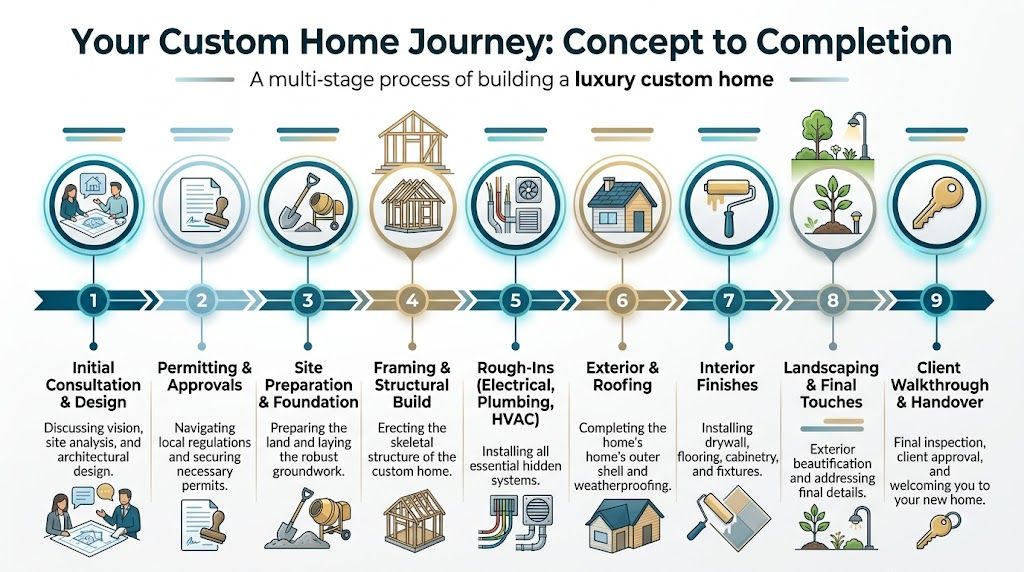
For a deeper look at how these stages connect, this overview of the custom home building process is a helpful reference.
The early stage where good projects are won or lost
The first phase is not demolition or concrete. It’s alignment.
You, your architect, your designer, and your builder need to get on the same page about the lot, your priorities, your must-haves, and your absolute requirements. In Naples, that often includes outdoor living, storm resilience, storage, privacy, guest circulation, and how the house will function when you’re entertaining.
This is also when practical technology decisions should show up. If energy storage matters to you, or if you want stronger backup planning for weather events, reviewing something like Tesla Powerwall 2 installation early is smarter than trying to squeeze it in after key electrical decisions are already made.
The nine major stages
Initial consultation and design
In this phase, the vision gets tested against the lot. A good builder asks about setbacks, elevation, circulation, and buildability, not just style.Permitting and approvals
This part takes patience. Local approvals, documentation, and revisions can slow a project if the plans aren’t coordinated well.Site preparation and foundation
The site gets prepared, the building pad is established, and the foundational work begins. This stage sets the tone for everything structural that follows.Framing and structural build
The home becomes real here. Room sizes feel tangible, ceiling heights make sense, and sightlines can finally be evaluated on-site.Rough-ins for electrical, plumbing, and HVAC
This phase is hidden work, but it drives comfort and functionality. It’s also where delayed decisions can create costly rework.Exterior and roofing
Once the shell tightens up, the project becomes less vulnerable to weather interruptions.Interior finishes Drywall, flooring, cabinetry, trim, tile, fixtures, paint, and specialty details all converge here. Here, quality control must be relentless.
Landscaping and final touches
Exterior finishes, lighting, plantings, hardscape, and punch-list coordination round out the property.Client walkthrough and handover
The final walkthrough shouldn’t feel rushed. It should feel thorough, documented, and respectful of the investment you just made.
Your role during construction
Clients sometimes think they need to be involved in everything. You don’t. But you do need to stay engaged at the right moments.
Your most important jobs are:
Make timely decisions so materials and trades stay on track.
Review updates carefully instead of skimming and assuming.
Ask questions early when something doesn’t look or sound right.
Keep your priorities visible so tradeoffs don’t drift away from your original goals.
A smooth project doesn’t happen because nothing changes. It happens because the team deals with change quickly and clearly.
Where delays usually come from
Most schedule pressure comes from a small set of issues. Plan revisions that come late. Selections that aren’t finalized. Materials with extended lead times. Inspections that require follow-up. Weather that disrupts sequencing.
None of that means a project is failing. It means the builder needs to manage the sequence actively and keep you informed instead of going quiet.
What a healthy process feels like
You should know where the project stands. You should know what decisions are coming. You should know what’s waiting on approvals, what’s ordered, and what could affect timing.
That’s what good luxury home builders florida provide. Not perfection. Visibility.
The Real Costs of Building a Luxury Coastal Home
The question everyone asks first is cost per square foot. I understand why. It sounds simple, measurable, and easy to compare.
It’s also one of the least reliable ways to understand a luxury coastal build.
Two homes can have the same square footage and carry very different budgets based on lot conditions, engineering requirements, finish level, structural demands, mechanical complexity, and how much custom detailing is involved. In Naples, site and code realities often matter as much as the visible design choices.
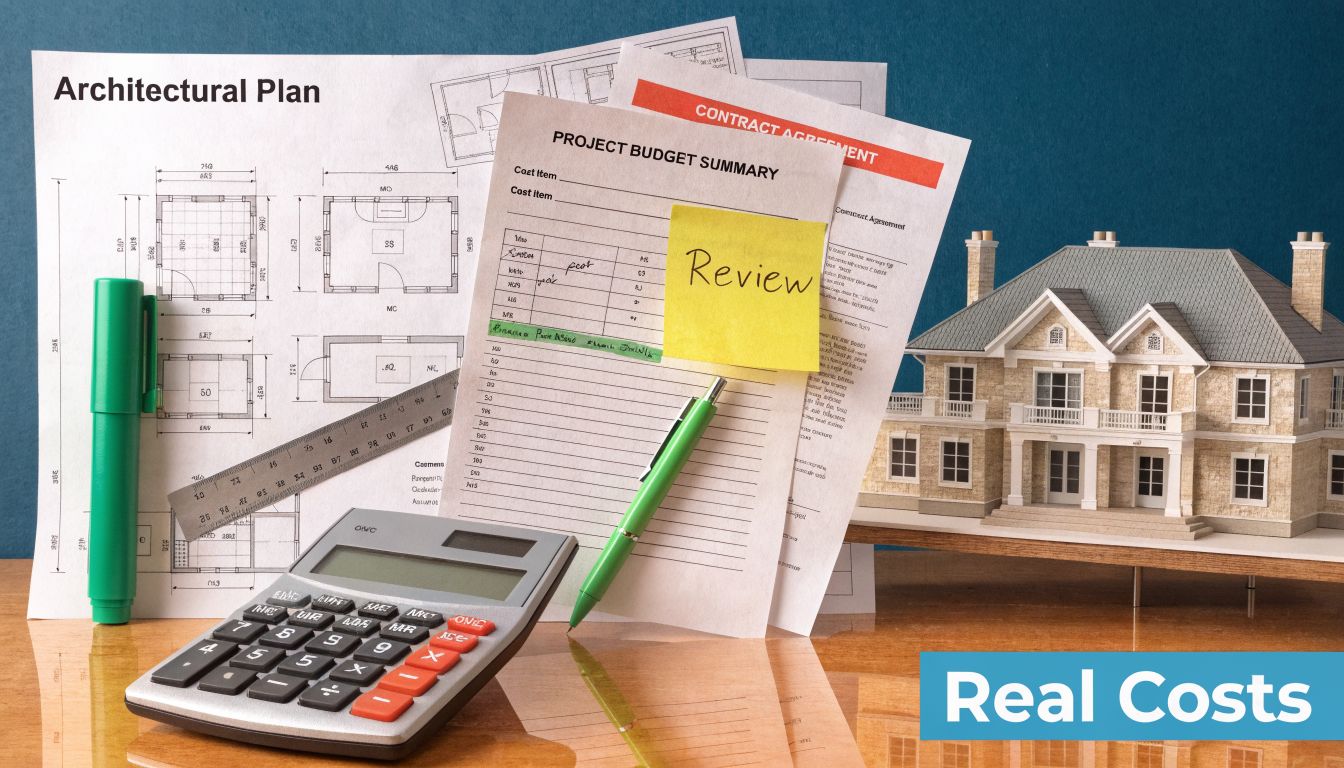
If you want a broader planning reference before meetings with builders, review this guide on the cost to build a luxury home.
Coastal construction changes the budget immediately
On a Florida coastal lot, the ground itself can drive major decisions. High water tables, corrosive salt exposure, flood risk, and wind exposure mean engineering is not a paperwork exercise. It’s the backbone of the project.
According to Ronin Development’s overview of luxury home construction in South Florida, site-specific geotechnical and structural engineering is critical in coastal conditions, often requiring customized foundation systems such as deep pilings or raised slabs. That source also notes practical benchmarks such as geotechnical boring to determine coastal soil bearing capacity, commonly 2,000 to 4,000 psf, and pile-driven foundations using minimum 12-inch diameter prestressed concrete piles embedded 20 to 40 feet.
Those aren’t cosmetic upgrades. They’re structural decisions that protect the house.
Foundation and elevation are not optional upgrades
A lot of clients walk in thinking foundation work is hidden cost. I’d frame it differently. It’s hidden value.
The same South Florida construction reference states that these foundation strategies can add 10 to 15% to base costs in homes with base construction costs around $50 to $100 per square foot, but they help support insurability and long-term durability. The source also notes that flood-compliant elevations are often built 1 to 3 feet above base flood levels and that structural design under the Florida Building Code can require foundations capable of resisting 150 to 180 mph wind loads.
Here’s the practical takeaway. If a builder downplays engineering and site prep to make the budget feel easier, you should be concerned.
Budget truth: The most expensive structural decision is the one you avoided early and paid for later.
Hurricane code affects far more than windows
Luxury coastal homes need a strong shell. That includes impact-rated openings, reinforced roofing, and thoughtful structural detailing. It also affects electrical planning, HVAC design, and exterior assemblies.
According to LHS’s summary of Florida luxury home features and code-driven systems, hurricane-resistant requirements and luxury specifications can move construction from $150 to $280 per square foot for base construction to $400 to $800+ per square foot with luxury finishes, while ultra-custom builds can exceed $1,000 per square foot. The same source highlights impact-rated windows and doors, raised foundations, reinforced roofing, 400 to 600A electrical service for high-demand homes, and SEER 20+ HVAC units with dehumidification.
This is why apples-to-apples pricing is hard. One builder’s budget may include a strong shell, raised structure, high-capacity systems, and integrated planning. Another may show a lower number because important scope is thin, undefined, or delayed.
The invisible systems add up quickly
Homeowners naturally focus on what they can see. Cabinets. Slabs. Flooring. Lighting fixtures. That’s fine, but the invisible systems are often where luxury homes separate themselves.
A high-end coastal home often needs:
Electrical capacity for modern living including EV charging, pool equipment, automation, and backup power planning
HVAC zoning and humidity control because comfort in Southwest Florida depends on more than temperature
Plumbing coordination for large-format showers, secondary laundry areas, outdoor kitchens, and guest suites
Automation infrastructure so lighting, audio, security, access control, and shading work together cleanly
The same LHS reference notes that integrating advanced MEP systems during rough-in can add $50 to $100 per square foot. That’s exactly why system planning should happen early, not after framing when options narrow and changes get expensive.
Finish level drives cost, but not all finishes are equal
Luxury pricing rises with finish quality, but what matters most is the combination of materials and labor. Imported stone isn’t just a material decision. It affects fabrication, installation, sequencing, and risk. Custom millwork isn’t just cabinetry. It’s shop drawings, field dimensions, finish matching, hardware coordination, and punch-list standards.
This is also where some builders lose control of the budget. They price for “nice” but not for exact. Then the client starts choosing custom materials and the gap widens.
A disciplined builder doesn’t pretend all finish packages behave the same. They guide you toward realistic allowances, identify long-lead selections early, and tell you where money buys real value versus where it just buys noise.
What I recommend clients do before signing
Bring these questions to the table:
What site assumptions are included in the budget?
What structural and code-related items are fully carried?
What level of MEP complexity is assumed?
Which finish allowances are realistic, and which are placeholders?
How are changes documented and approved?
That conversation will tell you more than any single price metric ever will.
How to Select the Right Builder for Your Naples Home
This decision deserves more rigor than most homeowners give it. You’re not hiring a vendor. You’re choosing the person and team who will control communication, money flow, schedule movement, subcontractor coordination, and the quality of the final result.
If you’re serious about building in Naples, treat builder selection like a major interview process. Friendly chemistry matters, but chemistry without discipline will cost you.
What to evaluate before price
Start with how the builder thinks, not just what they charge.
A strong candidate should be able to walk your lot, discuss design implications, explain how they manage documentation, and speak clearly about permits, trade sequencing, and finish coordination. If they stay vague until after contract, that’s not sophistication. That’s a warning sign.
Here’s the shortlist of what I’d review first:
Relevant local experience. Have they worked on homes similar in complexity, location, and level of finish?
Communication habits. Do they respond directly and on time during the courtship phase?
Project management method. How are updates, approvals, selections, and changes tracked?
Trade relationships. Do they have steady, high-quality subcontractors, or do they piece crews together job by job?
Financial clarity. Can they explain billing, allowances, lien releases, and change order procedure in plain language?
Essential Questions for Vetting a Luxury Home Builder
Category | Question to Ask | Why It Matters |
|---|---|---|
Experience | Have you built homes in Naples or similar coastal conditions? | Local code and site experience reduce avoidable mistakes. |
Process | Who will be my main point of contact during the project? | You need clarity on communication from day one. |
Scheduling | How do you handle delays, resequencing, and long-lead materials? | Problems aren’t the issue. Silence is. |
Budgeting | What assumptions are built into your estimate? | Hidden gaps create ugly surprises later. |
Changes | How are change orders priced, approved, and documented? | You need a controlled process before changes happen. |
Quality control | When do you inspect work before client walkthroughs? | Good builders catch issues before you do. |
Trades | How long have you worked with your core subcontractors? | Stable trade relationships usually mean better consistency. |
Insurance and licensing | Can you provide proof of insurance and licensing details? | Verification is basic due diligence, not distrust. |
References | Can I speak with recent clients and, if possible, key trade partners? | Former clients tell you how the process felt. Trades tell you how the builder operates. |
Closeout | What does handover include, and how do you handle punch-list items? | The final phase often reveals how disciplined the builder really is. |
Watch how they answer, not just what they answer
A polished answer can still be a weak answer.
If you ask about change orders and hear “we’ll work that out as we go,” that’s not flexibility. It’s a setup for confusion. If you ask about communication and hear “you can call anytime,” that’s not a system. It’s a nice sentiment.
The builder who explains hard parts clearly is usually safer than the one who makes everything sound effortless.
Red flags I wouldn’t ignore
Some warning signs show up early if you know where to look.
Vague proposals that don’t define what’s included
Pressure to sign quickly before details are reviewed
Slow or slippery communication during the interview phase
Resistance to references from recent clients
No clear explanation of allowances or change order procedure
Overpromising on schedule without discussing real dependencies
Too much focus on selling and not enough on asking smart questions about your project
A builder doesn’t need to be perfect in the interview process. But they do need to be organized, candid, and consistent.
Portfolio review should be more forensic
Most homeowners review a portfolio like they’re flipping through a design magazine. I’d go deeper.
Look for consistency in trim alignment, stone layout, transitions, exterior detailing, ceiling treatments, hardware placement, and how well modern systems disappear into the architecture. Ask whether you can tour a recent or in-progress project. Photos are curated. Job sites tell the truth.
Also ask to see range, not just style. A builder who can only deliver one aesthetic may not be as custom as they sound.
The relationship test
By the time you choose a builder, you should have a sense of whether they listen well, tell you the truth, and stay composed when the conversation gets detailed.
That matters because there will be moments of friction. A finish gets delayed. A selection changes. A drawing gets revised. A hidden site issue appears. In those moments, trust becomes practical. You need a builder who handles tension with clarity, not defensiveness.
That’s the actual interview.
The JVM Construction Difference A Client-First Process
By the time most clients reach this stage, they’re tired of broad promises. They want to know how a builder runs a job and how the relationship will feel once the contract is signed.
That’s the right question.

Process first, personality second
A client-first process isn’t about being agreeable all the time. It’s about building a structure around communication, accountability, and decision-making so the homeowner doesn’t feel lost.
That means clear scopes, regular progress updates, documented changes, active coordination with architects and designers, and a site culture where details are checked before they become expensive corrections. It also means saying no when something is a bad idea, even if yes would make the meeting easier.
Where many competitors leave a gap
One issue stands out in this market. A review of top Florida luxury builders found a notable gap around sustainability and energy efficiency in builder marketing, with competitors focusing heavily on aesthetics while leaving climate-adapted construction and resilience underexplained, as noted in this review of Florida luxury home builders.
That matters in Naples.
Clients aren’t only asking for beautiful homes. They’re asking for homes that perform well in a coastal environment, hold up under weather stress, and make sense operationally over the long term. Resilience, water management, envelope discipline, and practical energy planning belong in the conversation early.
What a client-first relationship should include
Here’s what I believe homeowners should expect from any serious custom builder:
Straight budget conversations instead of selective optimism
Predictable updates so you’re not chasing answers
Coordination across the full team including architecture, interiors, engineering, and trades
Respect for the lot and location because coastal building is never generic
Attention after the glamorous parts when punch-list quality and closeout discipline matter most
One Naples-based option in this category is JVM Construction LLC, which provides luxury custom home building, remodels, condo renovations, and project coordination in Southwest Florida. The point isn’t the label. The point is the operating model. Homeowners should look for firms that manage the full chain from planning through execution with visible accountability.
A custom home feels luxurious long before move-in when the process itself is calm, clear, and well run.
Why trust shows up in the small things
Trust doesn’t come from a mission statement. It shows up in whether your builder returns calls, flags issues early, remembers your priorities, and keeps the site organized. It shows up in whether your questions are treated as interruptions or as part of the job.
That’s what clients remember.
The house is the final product. The experience is what gets you there. In a market this demanding, both need to be handled with care.
Begin Your Custom Home Building Journey with Confidence
A custom home in Naples should feel personal from the first conversation, not just at the final reveal. If you take one thing from this guide, let it be this. The right builder is not just the one who can construct the house. It’s the one who can carry the responsibility of the process.
That means honest budgeting, disciplined communication, local coastal knowledge, and a working relationship that reduces stress instead of adding to it. It also means you should feel comfortable asking hard questions and expecting direct answers.
If you’re comparing luxury home builders florida, don’t let the search stop at style, square footage, or surface-level pricing. Look for a builder who can explain the job clearly, respect your investment, and handle complexity without losing control of the details.
That’s the builder worth hiring.
Your future home will hold family dinners, holiday visits, quiet mornings, and the ordinary routines that end up meaning the most. The process of creating it should protect that vision, not wear it down.
Take your time. Vet carefully. Trust your instincts when something feels off. And when a builder combines craftsmanship with transparency, pay attention. That’s rare, and it’s valuable.
If you’re ready to talk through your plans with a team that understands custom coastal construction and values a clear, relationship-driven process, contact JVM Construction LLC. A thoughtful first conversation can save months of frustration later.