You're probably looking at one of three situations right now. You've bought a lot in Naples or elsewhere in coastal Florida and want to build a home that properly fits the property. You're planning a major teardown and rebuild. Or you own an older home or condo and you've realized the design decisions you make upfront will either protect your budget or gradually wreck it.
That's why the search for an architect in Florida shouldn't start with style alone. It should start with fit. In this market, the right architect does far more than sketch a beautiful elevation. They help shape a home that can move through permitting, respond to coastal code demands, and work in practice once a builder starts pricing and constructing it.
The clients who have the smoothest projects usually do one thing early. They stop treating the architect and builder as separate hires operating in sequence. They build the team first, then the plans.
Dreaming of Your Florida Home Start Here
A waterfront lot in Naples can feel deceptively simple at first glance. You see the view, the light, the breezes, and the future outdoor living spaces. What you don't see yet are the setbacks, elevation constraints, flood considerations, product approvals, structural coordination, and permit comments that can reshape a concept if the design team doesn't account for them early.
That's where the right architect earns their place from day one.
A strong architect in Florida is part designer, part coordinator, part risk manager. On a luxury custom home, they're often the first professional who translates your lifestyle into something buildable. That means balancing ceiling heights, sightlines, privacy, natural light, circulation, and lot orientation with the hard realities of code and permitting.
Why Florida demands more than good taste
Florida's architectural profession has deep roots. The state issued its first professional licensing exam in 1916, and AIA Florida has more than 3,900 members, which speaks to a large, established professional community for owners to draw from in a complex market (AIA Florida history). That matters because luxury clients aren't just hiring a creative mind. They're hiring a licensed professional in a state where the details carry real consequences.
A good early exercise is to collect reference images and floor plan ideas before your first architect meeting. Some homeowners use hand-marked magazine pages. Others like digital mood boards or visual tools that help align design language before formal design begins. If you're still sorting through ideas, tools focused on unifying AI for architectural design can help organize concepts before you ask a professional to turn them into a real coastal home.
Practical rule: In Florida, a beautiful idea that can't survive permitting is still an incomplete design.
What the architect should do before plans feel “finished”
Homeowners often assume the architect's job is to produce drawings, then hand them off. That's too narrow. On the projects that go well, the architect helps answer questions like these early:
How should the home sit on the lot: Views matter, but so do access, grading, privacy, and outdoor living patterns.
What will the permitting path likely demand: Not every design choice creates equal review friction.
Where will engineering coordination hit hardest: Large openings, raised living, and luxury detailing all affect structure.
How much house makes sense for this site: Bigger isn't always better if circulation, massing, or approvals suffer.
For many Naples homeowners, design inspiration starts with local precedent. If you want to understand how regional character influences planning choices, this look at Florida style home designs is a useful starting point before interviewing firms.
The right architect protects the dream by pressure-testing it early. That's what turns a vision into a project with momentum.
Identifying Your Vision and Finding Potential Architects
Before you search names, define the project clearly enough that a serious architect can respond with substance. If your brief is only “we want something modern and coastal,” every first meeting will stay vague. The stronger your direction, the better your shortlist becomes.
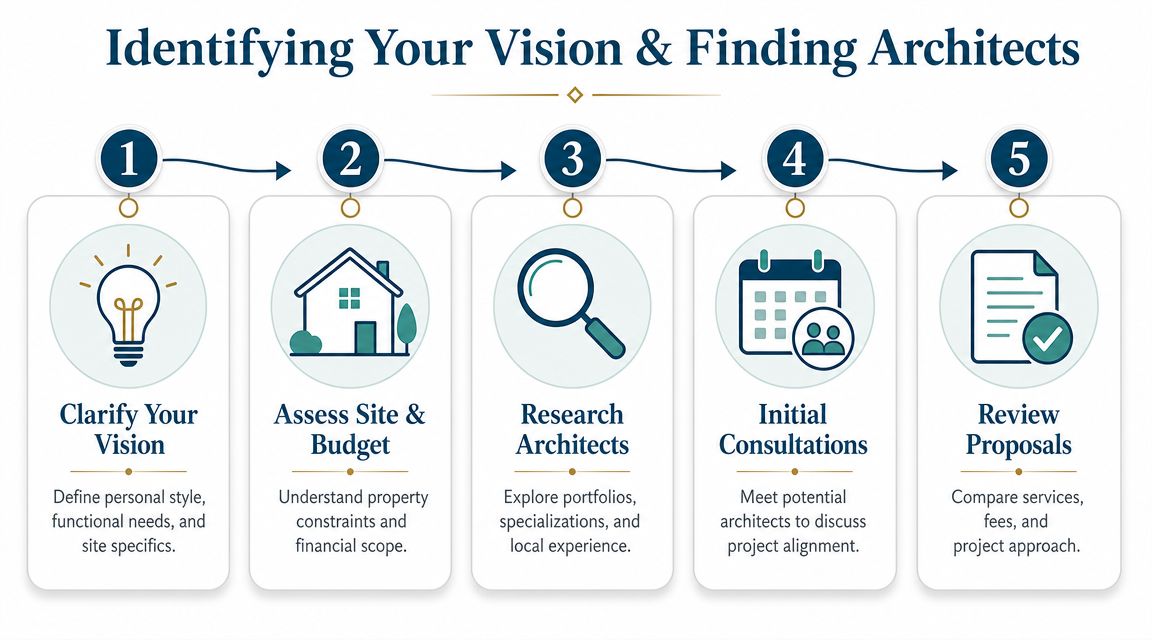
Start with how you want to live
Luxury custom home planning in Naples works best when owners talk about routines, not just rooms. The architect needs to know whether you host large holiday gatherings, want long-term aging-in-place convenience, need a detached guest component, or care more about a dramatic arrival sequence than maximum square footage.
Write down your must-haves in plain language.
Daily use priorities: Where do you enter, gather, work, and unwind?
Privacy expectations: Street presence and interior openness don't always align.
Seasonal living patterns: Full-time occupancy feels different from a home used in shorter stays.
Site-specific goals: Sunset exposure, water views, boat access, and outdoor shade all shape planning.
A homeowner who says, “We want the kitchen, great room, and lanai to function as one space most of the year,” gives an architect something useful. A homeowner who says, “We want wow factor,” is still at the surface.
Define the budget range honestly
This part is where many searches go sideways. If the budget is fuzzy, you'll attract architects whose design assumptions may not match your construction reality. That creates frustration later, especially once structural systems, glazing packages, and coastal requirements enter the conversation.
Your budget discussion should include land conditions, site work, design fees, permitting, interiors, and contingency planning. Even before detailed pricing, the architect needs to know whether the project aims for disciplined luxury or a more expansive brief with fewer constraints.
Owners make better decisions when they know what they're protecting. Budget clarity protects design quality just as much as it protects cost.
Where to look for the right fit
Generic search results tend to surface firms that market well, not necessarily firms that are right for your property or process. Better sources are more filtered and more local.
Try a mix of these channels:
Local luxury builder referrals
Builders see what homeowners don't. They know which architects issue coordinated sets, respond during construction, and design with real permit and field conditions in mind.Project portfolios in your target neighborhood
An architect who understands Old Naples, The Moorings, or similar coastal contexts will usually ask sharper early questions.Professional directories and design associations
These can help you confirm credentials and identify firms with an established presence.Focused local research
If your search is centered on Southwest Florida, this guide to hiring an architect in Naples, FL can help narrow your first round of conversations.
Don't aim for the biggest shortlist. Aim for the strongest three to five candidates who match your style, your site, and the level of coordination your home will require.
How to Interview an Architect and Vet Your Shortlist
Interviewing an architect isn't about asking if they “do coastal modern” or “have luxury experience.” Most firms serving this market will say yes. The essential work is figuring out how they think, how they communicate, and how they handle pressure once design decisions start colliding with code, engineering, and construction.
A portfolio gets them in the room. The interview tells you whether they belong on your project.
What to verify before chemistry takes over
Personal fit matters, but credentials come first. An architect's license is state-specific, so confirm that the person you're considering has passed the Architect Registration Examination, holds a current Florida license, and can be verified through their NCARB Record (NCARB licensure path). That check is basic, but it's also one of the easiest things for owners to skip when a meeting goes well.
Then look past the renderings. Ask who produces the drawing set, who manages consultant coordination, and who responds when permit comments come in. A principal may lead the pitch while a less experienced team handles the hard coordination later.
Ask questions that reveal process
The best interview questions make the architect explain how they work when conditions get messy. That's where you'll hear whether they're practical, collaborative, and organized.
Question Category | Sample Question |
|---|---|
Design Process | How do you move from initial concept to a permit-ready set on a coastal custom home? |
Site Response | What site conditions usually reshape the design after the first concept? |
Code Awareness | How do you account for Florida coastal requirements before permit review starts? |
Consultant Coordination | When do you bring in structural and other engineering input? |
Builder Collaboration | How early do you want the builder involved, and how do you use that input? |
Budget Alignment | How do you respond when a design direction starts pushing beyond the intended budget? |
Permit Experience | What tends to trigger the most comments during local review? |
Construction Phase Role | How involved are you once the project moves from plans to active construction? |
If you want another perspective on making this choice carefully, these tips for builders selecting an architect are worth reviewing because they focus on fit, communication, and practical alignment rather than style alone.
Listen for red flags, not polished answers
A weak interview usually doesn't sound dramatic. It sounds vague. The architect speaks in generalities, avoids specifics, or gives you the feeling that “we'll figure that out later” applies to major coordination issues.
Watch for these warning signs:
They can't explain their permit workflow clearly: If the process sounds improvised, expect friction later.
They dismiss builder input too early: Strong architects don't protect the design by blocking collaboration.
They overfocus on aesthetics in the first meeting: You want design ambition, but not at the expense of constructability.
They avoid discussing revision control: On custom homes, disciplined document management matters.
They don't ask thoughtful questions about the lot: Good architects get curious fast.
A polished presentation is easy to stage. A disciplined process is harder to fake.
Look for signs you've found the right partner
The strongest candidates usually show a few consistent habits. They ask about your lifestyle before talking style. They can explain trade-offs cleanly. They welcome early builder involvement because they know that coordination improves design instead of diluting it.
You should leave the meeting thinking, “This person can guide decisions,” not just, “This person has good taste.”
Understanding Florida Architect Fees and Contracts
Architectural fees are one of the first major pre-construction investments on a custom home, and clients deserve a straight explanation of what they're paying for. In Florida, those fees often reflect more than design talent. They also reflect the time required to coordinate code, documentation, engineering input, and the level of detail expected on high-end coastal work.
For high-end custom homes in Florida with construction budgets between $500,000 and $2 million, architectural fees commonly range from $75,000 to $250,000+ (Florida architect fee overview). The same fee overview says new luxury homes are often priced at 8% to 15% of construction cost, and ultra-luxury projects above $5 million can reach $500,000 to $750,000+ in architectural fees. That same source notes that hurricane codes, flood-zone requirements, and intricate luxury detailing increase design time. As a broader benchmark, the Bureau of Labor Statistics reported a median annual wage of $96,690 for architects in May 2024, or $46.49 per hour, which helps explain why detailed professional design work is a meaningful line item in a serious project.
The fee models you'll usually see
Architects typically structure fees in one of three ways, though some agreements blend them.
Percentage of construction cost
This is common on custom homes because the scope evolves as the design develops. It tends to align well with complex, detail-heavy projects.Fixed fee
This works best when scope is tightly defined and everyone understands what's included. It can create clarity, but only if the contract spells out revision limits and additional services.Hourly billing
Hourly structures often show up for preliminary studies, limited scopes, or highly iterative work where no one wants to pretend the effort is fixed.
None of these models is automatically better. What matters is whether the fee structure matches the project's uncertainty and complexity.
What your contract needs to say clearly
Most homeowner frustration doesn't come from the fee number itself. It comes from unclear scope. If your agreement is vague, you may assume one level of service while the architect has priced another.
Review these points carefully:
Scope of services: Schematic design, design development, construction documents, permit support, bidding support, and construction administration should each be addressed.
Deliverables: Know what drawings, specifications, and coordination items you should expect.
Revision expectations: Design changes after approvals can create real cost.
Additional services: Interior detailing, consultant coordination beyond the base scope, or extended permit responses should be defined.
Payment schedule: Tie payments to milestones that make sense for the design process.
If you want a general primer on reviewing agreements carefully, this overview of Understanding Florida contract requirements can help you think through contract language and obligations before signing.
What works and what doesn't
What works is a fee proposal that explains the architect's role in plain English. What doesn't work is choosing the cheapest proposal without understanding what was removed to get there.
A low fee can mean less coordination, fewer details, weaker permit readiness, or limited involvement once construction begins. On a luxury custom home, those missing services often cost more later than they save upfront.
The Architect-Builder Partnership Navigating Coastal Codes
If you want to avoid painful redesigns, bring the builder into the process before the plans are treated as sacred. In Florida, especially in coastal markets, that early partnership is where many expensive mistakes get caught while they're still easy to fix.
This isn't about reducing the architect's role. It's about strengthening the project before permit review and pricing expose the weak spots.

Why coastal homes punish late coordination
Florida's code environment keeps moving. A major challenge for custom homes is the state's evolving code framework, including the 7th Edition Building Code effective Dec. 31, 2023, and the way code updates can affect design assumptions, product selections, and permit responses. Guidance on Florida construction law also highlights that an architect and builder working together can address coastal risks tied to flood, wind, and material approvals early, which helps prevent major redesigns after permit review (Florida construction law guidance).
That matters in real project terms. A large opening might look perfect in concept, but if structural implications, approved product lead times, and installation details aren't considered early, the design can stall or change after you've already invested heavily in it.
What early collaboration actually solves
When the architect and builder are aligned from the start, they can work through issues before they become formal problems.
Here's what that usually improves:
Constructability review: Can the design be built as drawn without awkward field fixes?
Material planning: Are the specified assemblies realistic for the schedule and coastal conditions?
Budget discipline: Is the design headed toward the intended construction level?
Permit readiness: Are likely review comments being addressed before submittal?
Sequence planning: Does the design support a clean build path once the job starts?
One practical resource for owners evaluating resilience at the planning stage is this guide to hurricane-resistant home plans, especially if your project priorities include long-term durability as much as visual appeal.
The most expensive design problem is often the one everyone sees early but no one owns early.
What this looks like in practice
On a well-run project, the architect develops the design intent and protects the architectural language. The builder contributes real-time feedback on assembly logic, scheduling pressure points, pricing implications, and field execution. The engineer supports the structural side. None of those roles replace the others.
This is also where a construction partner can be useful before the final permit set is complete. For example, JVM Construction LLC works on custom homes, major remodels, and high-end renovations in Naples, which means a builder in that role can review drawings for constructability, coordination, and local project realities before those issues show up in the field.
What doesn't work is a handoff mentality. The architect finishes, then the builder reacts, then the permit reviewer comments, then the owner pays for the drift. In Florida coastal construction, that sequence is where budgets get softer and schedules get longer.
Your Next Steps A Checklist for Hiring Your Architect
The best hiring process is calm, deliberate, and documented. You don't need a giant committee or weeks of over-analysis. You need a clear shortlist, strong questions, and enough discipline to verify the fundamentals before signing anything.
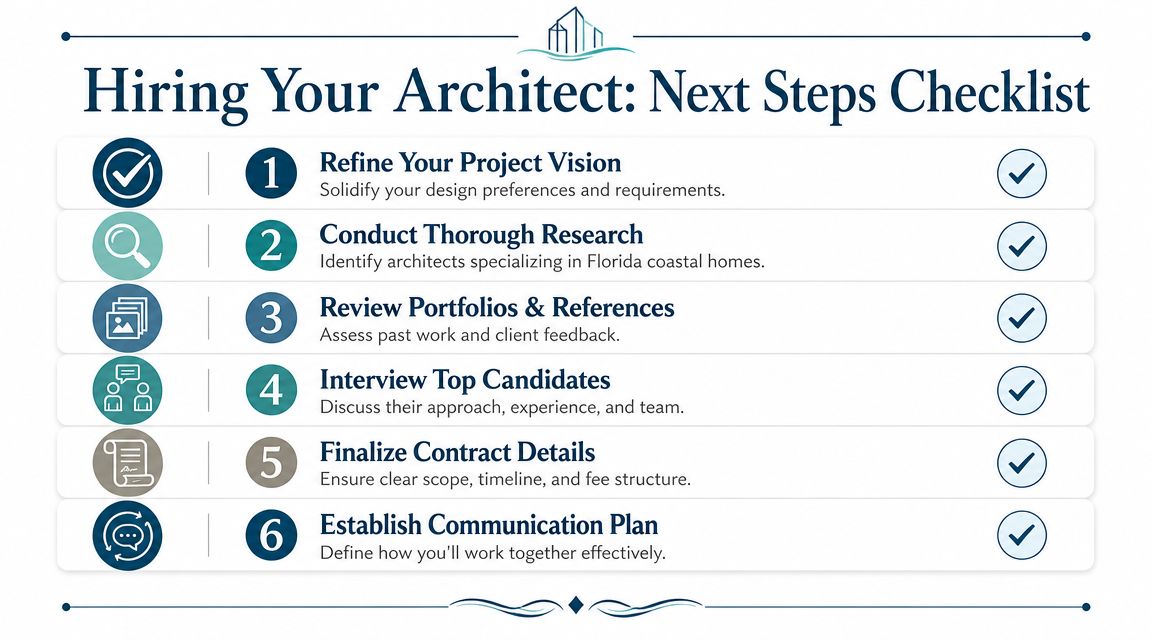
Use this hiring checklist
Refine the brief
Write down your lot conditions, style direction, lifestyle needs, and decision priorities. The clearer you are, the more useful the architect's response will be.Build a focused shortlist
Look for firms with relevant coastal custom home experience, not just attractive websites.Review real project work
Ask to see homes that reflect your level of complexity, not only conceptual imagery.Interview for process
Use your meetings to understand coordination, communication, and permit readiness.Verify credentials
Confirm licensure and make sure you know who will manage your project.Compare proposals carefully
Scope matters as much as price. Review what is included, excluded, and billed additionally.
Don't skip the builder conversation
One of the smartest moves you can make before finalizing the architect relationship is to involve a builder in a pre-construction discussion. Florida building approvals often slow down because the documentation package has code compliance gaps, inconsistencies, or missing detail. Florida-focused permit guidance notes that applicants should expect to submit site plans, floor plans, elevations, and code-aligned construction details, and that errors involving foundation, roof, wind-load issues, or documentation consistency can trigger resubmittals and delay inspections and Certificate of Occupancy issuance (Florida plan approval guidance).
That's why owners benefit when the architect and builder review the permit set together before submission. It's one of the simplest ways to reduce avoidable friction.
What to do this week
If you're serious about hiring an architect in Florida for a Naples custom home or major renovation, take these immediate actions:
Create a one-page project summary with goals, site notes, and design references.
Identify three to five architects whose work fits your property and priorities.
Schedule interviews with the firms that ask the best early questions.
Bring a builder into the conversation before you lock the design path.
A custom home is easier to build when the team is aligned before the plans harden. That's the difference between a project that feels managed and one that feels reactive.
If you're planning a custom home, whole-home remodel, or high-end condo renovation in Naples, JVM Construction LLC can join the conversation early to review plans, discuss constructability, and help align the architect, builder, and permitting path before costly issues surface.