You’re probably reading this from a place that no longer fits.
Maybe it’s a beautiful house in New York, Illinois, or New Jersey. Maybe it’s comfortable, familiar, and taxed from every angle. Maybe winter has gone from charming to annoying. And maybe you’re not looking for a vacation home anymore. You’re looking for a better daily life.
That’s why relocating to Naples Florida has become such a common conversation among affluent families, executives, and retirees who want more control over how they live. They want sun, privacy, design quality, stronger long-term value, and a home that reflects the next chapter.
The strongest buyers I meet don’t start with square footage. They start with a standard. They want a house that works for entertaining, grandkids, visiting family, outdoor living, security, resilience, and easy lock-and-leave travel. In Naples, that usually means one of two things. Buy something with a great address and transform it, or build a custom home that fits your life from day one.
Your Journey to Paradise Begins Here
A lot of people arrive in Naples after years of saying the same thing: “We’ll do it eventually.”
Then eventually becomes now.
A couple from Westchester gets tired of paying high taxes for a house they only enjoy a few months of the year. A family from Chicago realizes they’d rather design one exceptional home than keep splitting time between climates. A retired business owner from New Jersey wants a property that feels refined, easy, and built for entertaining without the baggage of an older northern home.

They’re not alone. In 2025, Collier County saw over 13,000 license exchanges from new residents, with the largest domestic inflows coming from New York (1,157 arrivals, +15%), Illinois (965), and New Jersey (784) as buyers chased Florida’s 264+ sunny days and no state income tax, according to Florida migration trends in Southwest Florida real estate.
Why Naples keeps winning
Naples isn’t just warm. Plenty of places are warm.
Naples works because it combines coastal beauty with a disciplined, polished lifestyle. You can have beach access, boating, golf, serious dining, strong healthcare, and elegant neighborhoods without feeling like you moved into a theme park.
For buyers used to high standards, that matters.
Relocation goes smoother when you stop treating the home as the last decision. In Naples, the home is the center of the plan.
That’s a key distinction. If you’re moving here full-time or for most of the year, your property needs to do more than impress at closing. It needs to function beautifully in every season, stand up to coastal conditions, and support the kind of life you want to build.
Start with the move, but think past the move
Before you choose land, a resale home, or a renovation candidate, get your logistics under control. If you’re coordinating a multi-state transition, household inventory, temporary housing, and timing around a closing or build schedule, this guide to relocating to a new state is a useful starting point.
Then shift your focus to the decision that matters most in Naples: where and how you want to live.
Choosing Your Naples Enclave for a Discerning Lifestyle
Naples has neighborhoods for almost every version of luxury living. The mistake is choosing based on reputation alone.
You shouldn’t pick a neighborhood because someone at the club mentioned it. You should pick it because it matches your routines, your privacy preferences, and the kind of home you want to create.
Naples also attracts a notably discerning population. The city’s median household income is $140,833, 48% of households earn over $150,000, and 27% of residents hold a master’s degree or higher, according to resident data for Naples on Niche. That shows up in the market. Buyers here tend to know what they want, and they expect quality.
Match the neighborhood to your daily life
Some buyers want to walk to dinner and galleries. Others want a dock, a golf cart, or deep privacy behind gates. Those are very different searches.
Use this lens first: What do you want a normal Tuesday to feel like?
Neighborhood | Primary Vibe | Typical Property Style | Best For |
|---|---|---|---|
Old Naples | Walkable, social, classic coastal | Custom homes, luxury cottages, refined renovations, upscale condos | Buyers who want beach access, dining, and culture close at hand |
The Moorings | Established, elegant, waterfront-focused | Waterfront estates, remodeled ranch homes, luxury condos | Boaters, long-term residents, buyers who value location and prestige |
Park Shore | Polished, coastal, amenity-rich | High-end condos, waterfront homes, modernized residences | Condo owners, beach lovers, those who want a club-oriented lifestyle |
Port Royal | Ultra-private, iconic waterfront luxury | Signature estates, large custom compounds | Buyers seeking trophy-level privacy and premier waterfront positioning |
Talis Park | Club-driven, newer, design-conscious | Contemporary estates, golf community homes | Buyers who want newer community planning and an active social calendar |
North Naples enclaves | Spacious, varied, family-friendly luxury | Newer custom homes, gated estates, whole-home remodel opportunities | Families, seasonal residents, buyers prioritizing convenience and new construction options |
If you want a broader overview, this roundup of the best Naples neighborhoods is worth reviewing before you start touring.
A few straight recommendations
Old Naples
Choose Old Naples if you want your life to extend beyond your lot lines.
You can build or renovate a beautiful home there, but the greatest luxury is how close you are to everything people move here for. Beach walks, Fifth Avenue, Third Street, galleries, dinner, coffee, and a polished social scene.
This is a strong fit if you don’t want to get in the car every time you want a good evening.
The Moorings and Park Shore
These neighborhoods appeal to buyers who want established prestige without giving up convenience.
The streets feel settled. The homes can be exceptional. The renovation upside is often strong because many properties sit in prime locations but need a sharper architectural vision, improved outdoor living, and full-system modernization.
If you like boating, beach club access, and a more mature neighborhood fabric, start here.
Practical rule: Buy the lifestyle first, then solve the house. A perfect floor plan in the wrong neighborhood becomes a long-term compromise.
Port Royal
Port Royal is for buyers who know exactly why they’re there.
It’s private, elite, and uncompromising. If your priority is premier waterfront living and a statement property, it belongs on the shortlist. But don’t approach it casually. The bar is high, and every decision about architecture, site use, and execution has to be equally high.
Talis Park and select North Naples communities
If you want a more current community feel, look north.
These areas often appeal to buyers who want a cleaner path to newer construction, active club life, and homes designed for today’s expectations. Open plans, stronger indoor-outdoor flow, and less appetite for heavy legacy renovations.
What most buyers overlook
They focus too much on curb appeal and not enough on fit.
Ask yourself:
How social are you really? If you host often, walkability and guest access matter.
How private do you want to be? Some buyers want visibility. Others want retreat.
Will you renovate or build? Certain enclaves reward one path more than the other.
How do you use waterfront living? A view is one thing. Boating use is another.
How long is the horizon? A legacy home deserves a location that still fits in ten years.
That’s how you narrow Naples the right way.
Understanding Naples' Financial Landscape and Tax Benefits
The headline is simple. Florida doesn’t charge state income tax.
That alone gets many people interested. But serious buyers shouldn’t stop at headlines. They should model the full picture.
According to this Naples relocation tax overview, Florida’s 0% state income tax can yield a 25-35% effective tax savings for relocators from high-tax states. The same source notes that the Homestead Exemption caps annual assessed value increases at 3% or CPI, whichever is lower, which helps stabilize long-term property tax exposure.
What that means in real life
If you’re coming from a state where income, investment earnings, and property costs feel like they’re constantly moving against you, Naples can feel cleaner financially.
Not cheap. Cleaner.
That distinction matters. Luxury coastal living comes with meaningful carrying costs, and anyone pretending otherwise isn’t helping you. But many relocators find that the tax structure gives them more control over how they allocate capital.
Where smart buyers focus
They don’t ask only, “What will this house cost me?”
They ask better questions:
How stable are my long-term ownership costs?
How much flexibility do I gain by leaving a high-tax state?
Does this property deserve a full custom build, or is renovation the better financial move?
What carrying costs should I accept as protection for a premium coastal asset?
That last point is important. Insurance in coastal Florida is part of the ownership equation. You don’t avoid that reality. You plan for it.
The right Naples home isn’t just beautiful. It’s financially coherent. If the tax savings are strong but the house is wrong, you haven’t solved anything.
The practical advice I give
Start your Naples budget with three buckets, not one.
Tax position
Work with your CPA and wealth advisor before you buy. Residency timing, homestead planning, and broader tax implications should be settled early, not after closing.
Ownership costs
Build in room for insurance, maintenance, and the quality of construction required in a coastal environment. Premium homes deserve premium protection.
Capital plan
Decide whether your money is better used on a turnkey property, a full renovation, or a custom build. The cheapest entry point often becomes the most expensive path if the house fights you at every turn.
For many buyers, the biggest financial advantage of relocating to Naples Florida isn’t just tax savings. It’s the chance to place capital into a home and lifestyle they’ll use with enthusiasm.
The Naples Custom Home A Guide to Building vs Buying
This is the decision that shapes everything else.
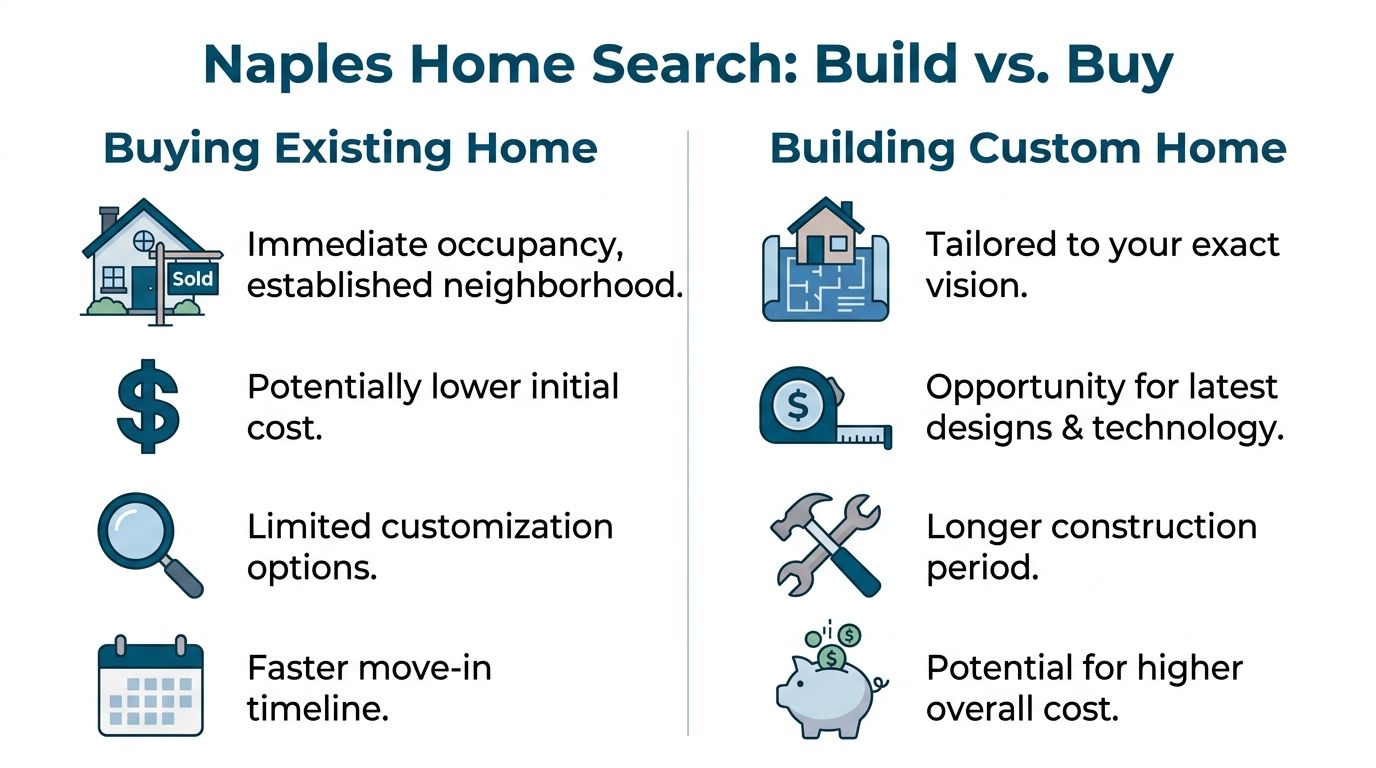
Buying an existing home is faster. Building a custom home gives you control. Neither is automatically better. One is just better for you.
The easiest way to think about it is this. A purchased home is like an excellent jacket off the rack that still needs tailoring. A custom home is the jacket made for your shoulders, your habits, and your future.
If you want a closer look at sequencing, approvals, and execution, review this overview of the custom home building process.
Buying an existing home
Buying makes sense when location is everything and timing matters.
In Naples, that often means securing a property in a coveted enclave, then deciding whether the house is good enough as-is or worth a major transformation.
When buying is the right move
You want immediate access to a specific neighborhood. Some locations are so desirable that securing the address comes first.
You’d rather renovate than start from scratch. If the lot is excellent and the structure has promise, renovation can yield real value.
Your timeline is compressed. Buyers who want to settle in quickly often prefer an existing home, even if work follows later.
The tradeoff
You inherit someone else’s decisions.
That can mean ceiling heights you can’t change, openings that don’t align with how you entertain, dated exterior elevations, older systems, or a floor plan designed for a different era of living.
A beautiful listing photo doesn’t solve a compromised house.
Building a custom home
Custom building is the cleanest path when you know what you want and don’t want to compromise.
That’s especially true for buyers who’ve already owned several homes and are done making expensive concessions.
Why custom often wins
A custom home lets you control what matters most:
Site response for light, privacy, views, and outdoor living
Daily flow so the house works for family visits, entertaining, and quiet living
Architectural expression that feels current, timeless, or regionally appropriate
Performance through modern materials, code compliance, and smarter structural decisions
Buy if the address is irreplaceable and the house is workable. Build if your standards are specific and you want the property to support them without apology.
A side-by-side way to decide
Decision factor | Buying existing | Building custom |
|---|---|---|
Speed | Faster path to occupancy | Longer timeline |
Personalization | Limited unless you renovate | Maximum control |
Neighborhood access | Useful in tightly held locations | Depends on lot availability |
Design quality | May reflect older priorities | Built around your current lifestyle |
Systems and code alignment | Can require upgrades | Designed for current requirements |
Emotional fit | Good if compromises are acceptable | Best when your vision is clear |
My opinion
If you’ve reached the point where you’re relocating for quality of life, don’t underbuild your own future.
If a resale home is in the right place and only needs refinement, great. Buy it and do the work properly.
But if you keep saying, “We can live with that,” you’re probably looking at the wrong house. In Naples, a bespoke home isn’t indulgent. For many luxury buyers, it’s the most rational way to create a property that fits the life they moved here to enjoy.
Building Your Dream Home in a Coastal Paradise
Coastal building in Naples is not forgiving.
That’s why builder selection matters so much more here than in a generic inland market. You’re not just choosing someone to deliver finishes. You’re choosing someone to guide structural decisions, flood compliance, permitting, sequencing, and material choices that will affect safety, insurance, and long-term durability.
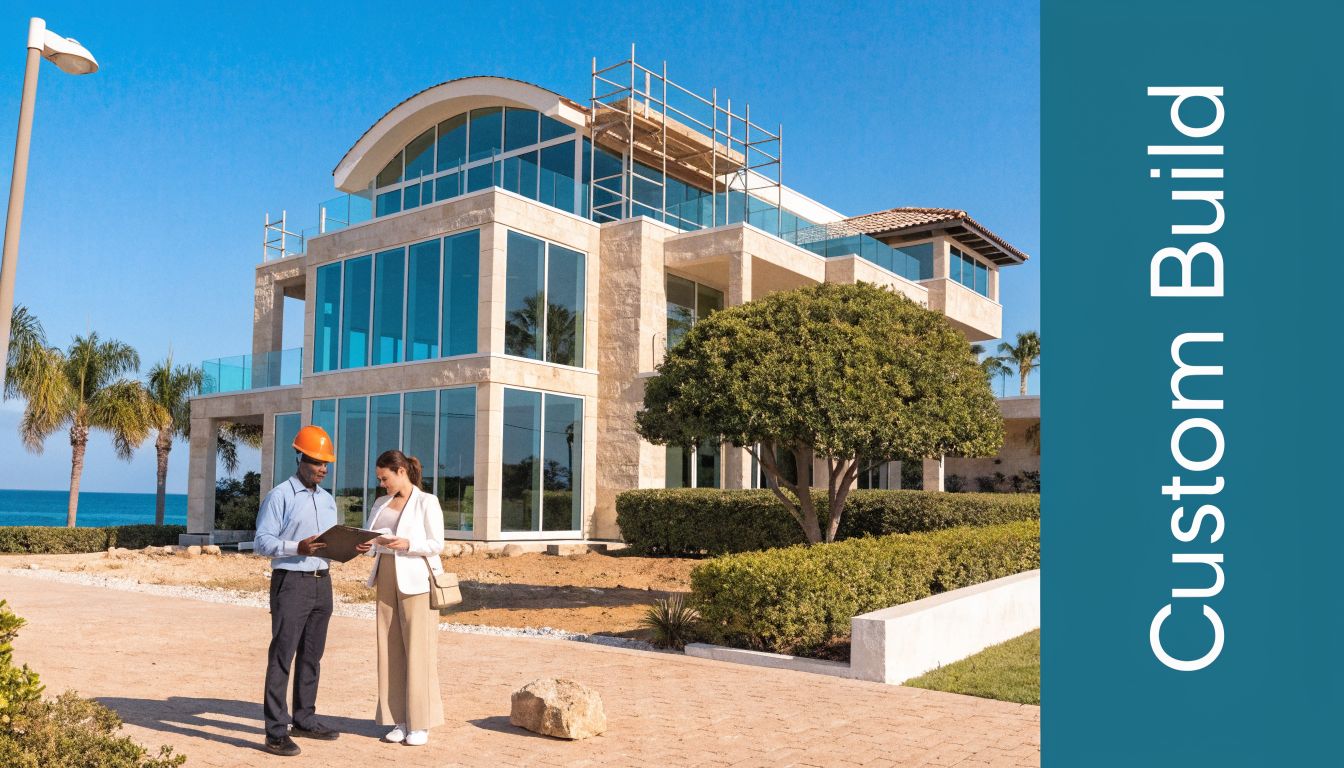
In Naples’ central and beachfront areas, approximately 40% of properties are in V or VE flood zones, and new custom homes often must meet Base Flood Elevation requirements of 12-18 feet. Post-Hurricane Ian data also showed that 95% of code-compliant raised structures survived, versus 40% of non-compliant homes, as cited in this discussion of Naples flood-zone and elevation requirements.
That should settle the argument. Coastal resilience is not a design extra. It’s a baseline requirement.
What a serious coastal build requires
Elevation and structural planning
If the site is in a high-risk flood area, the home needs to be designed around that fact from the start. Not squeezed into compliance later.
That affects foundation strategy, stairs, access, garage configuration, under-home use, mechanical placement, and the visual proportions of the entire residence. Good coastal architecture makes elevation feel intentional. Poor design makes it feel imposed.
Envelope and material discipline
A Naples luxury home needs a strong shell. Impact-resistant assemblies, moisture-aware detailing, durable exterior materials, and thoughtful roofing choices aren’t optional if you care about longevity.
Insulation matters more than many buyers realize, especially in a hot, humid climate where comfort and efficiency depend on controlling heat and moisture well. If you want a practical primer on that piece alone, this guide to attic insulation in Florida gives helpful context.
Permitting and local coordination
Permitting in coastal Southwest Florida rewards preparation and punishes sloppiness.
The homes that move with fewer problems are the ones supported by clean plans, coordinated consultants, realistic scheduling, and disciplined documentation. The process isn’t impossible. It just demands experience.
For homeowners evaluating execution standards, these custom home building services in Naples show the level of coordination a serious project should include.
What owners get wrong
They spend too much energy on finishes too early.
Cabinet styles, slab selections, and lighting are important. But they matter after the big things are right.
Focus on these first:
Siting: privacy, solar exposure, views, setbacks, and outdoor flow
Structural logic: elevation, wind resilience, and long-term durability
Mechanical planning: equipment placement that respects flood and maintenance realities
Window and door strategy: protection, light, and furniture layout all at once
Outdoor living: covered areas, shade, circulation, and storm-aware detailing
A coastal home should be designed from the foundation up for Naples. If it looks beautiful in renderings but ignores flood, wind, and moisture realities, it’s the wrong house.
Renovation deserves the same seriousness
This isn’t only about new construction.
If you’re buying an older waterfront or near-waterfront property, your renovation team needs the same coastal judgment. Renovation can be the smartest route in Naples, but only if the scope respects current code realities and the property’s actual constraints.
Done right, the result feels effortless. Done poorly, the house turns into a chain of expensive corrections.
Embracing the Unparalleled Naples Lifestyle
People don’t relocate here just to change tax residency. They relocate because they want a better day.
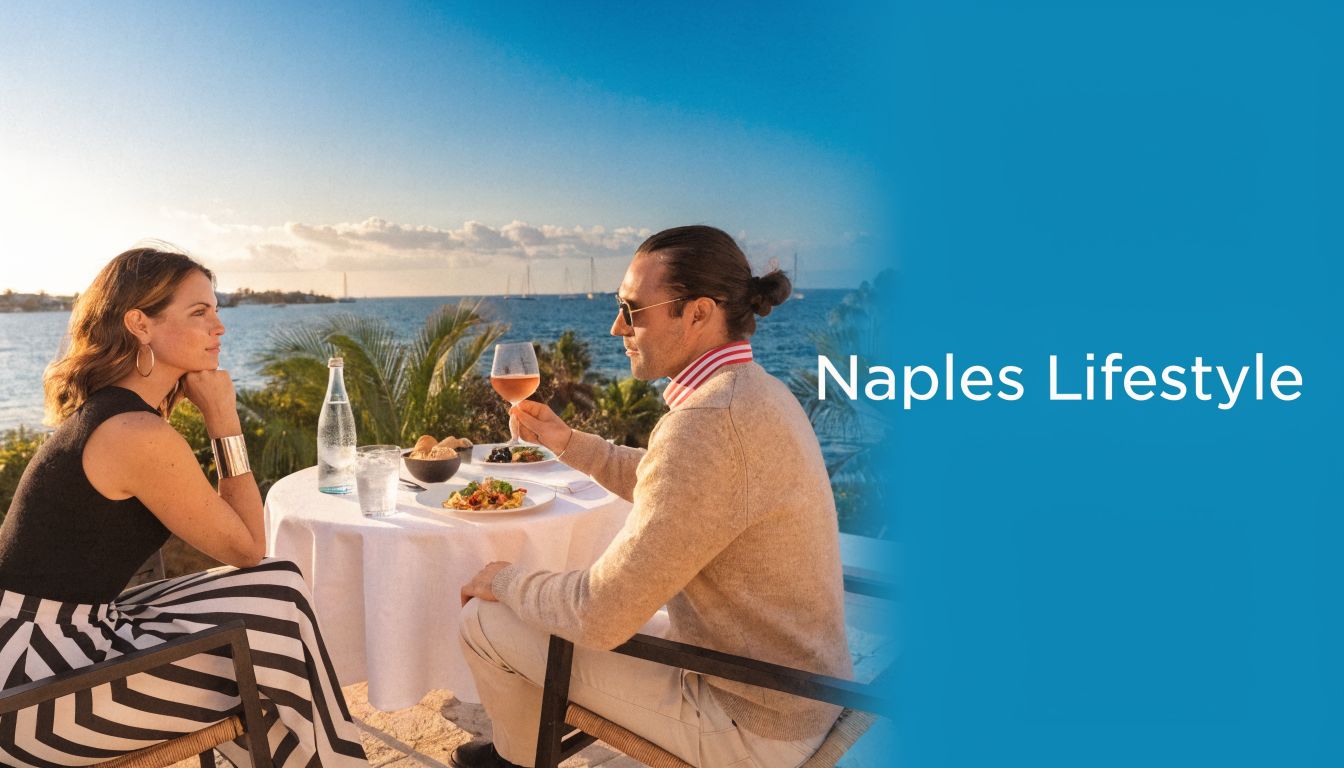
In Naples, a good day is easy to build. Morning coffee on a lanai that sees regular use. A walk near the water. Lunch with friends. Golf or a boat ride if that’s your thing. Dinner somewhere polished but relaxed. Family visiting without anyone feeling cramped or displaced.
That’s why the house matters so much. It isn’t separate from the lifestyle. It enables it.
What daily life actually looks like
Naples has the rare ability to feel both social and calm.
You can enjoy excellent dining, a strong arts scene, respected healthcare, private clubs, and a very active outdoor culture without living in a place that feels frantic. That balance is a major reason people stay once they arrive.
For couples and seasonal hosts
A lot of luxury homeowners want a residence that feels intimate when it’s just the two of them, but expands naturally when family and friends are in town.
That usually means:
Guest privacy through smart bedroom separation
Outdoor entertaining that works in more than one season
Flexible rooms for office use, wellness, or overflow guests
Easy-maintenance finishes that don’t look commercial or cold
For full-time residents
Full-time living changes priorities. Storage matters more. Service areas matter more. Shade matters more. The garage, mudroom, laundry, and mechanical planning suddenly become part of luxury, not secondary details.
The best Naples homes are beautiful where guests see them and smart where owners feel them.
The Naples lifestyle isn’t about showing off. It’s about removing friction from daily living and making the ordinary parts of life feel better.
Why the right home deepens the lifestyle
A generic house can sit in a beautiful city and still feel wrong.
A well-planned Naples residence does something else. It aligns with the climate, supports entertaining without effort, gives everyone a sense of ease, and makes indoor-outdoor living feel natural instead of staged.
That’s the standard I’d hold if I were advising any relocation client. Don’t just move to Naples. Build a life here that fits the place.
Your Naples Relocation Checklist and Next Steps
The cleanest relocations happen when buyers make the big decisions in the right order.
Not all at once. In order.
If you try to solve neighborhood, tax strategy, architecture, moving logistics, and construction planning at the same time, the process gets noisy fast. The better approach is disciplined and simple.
Your high-level relocation checklist
1. Define your version of Naples
Choose your lifestyle before you choose your property.
Do you want walkability, boating, golf, privacy, gated convenience, or a social in-town setting? If you don’t answer that first, every home tour becomes confusing.
2. Decide whether you’re building or transforming
Be honest about your tolerance for compromise.
If the right location has an outdated house with a strong footprint and enough upside, renovation may be the right path. If you want exact room relationships, modern performance, and a house designed for your habits, custom building usually wins.
3. Align your financial plan early
Get your CPA, attorney, and advisor involved before the closing stage.
Residency strategy, homestead timing, entity questions, and ownership structure are much easier to address upfront than after documents are signed.
4. Assemble the local team
A strong Naples relocation usually depends on a coordinated group, not a random set of vendors.
You’ll likely need:
A real estate advisor who understands luxury neighborhoods and off-market nuance
An architect or designer who can respond to coastal context
A builder or remodeler with serious local execution experience
A mover and relocation team who can handle timing and protection of high-value contents
5. Visit properties with a construction mindset
Don’t tour homes like a vacationer.
Tour them like an owner. Notice lot orientation, elevation feel, access, privacy, neighboring massing, traffic patterns, and how the outdoor areas work. Ask whether the house supports your life, not whether it photographs well.
The simplest way to reduce mistakes
Use one filter on every decision: does this move make the future easier?
A lot of bad decisions in luxury real estate happen because buyers chase excitement over fit. They overpay for finishes they’ll rip out, force themselves into neighborhoods that don’t match their routines, or buy homes that need far more intervention than they admitted during the tour.
You don’t need more noise. You need clarity.
What to do this week
If you’re serious about relocating to Naples Florida, do these three things now:
Narrow to two or three target neighborhoods
Choose your path, buy and renovate or buy and build
Start conversations with the professionals who will shape the property, not just sell it
That’s enough to move from dreaming to executing.
If you’re planning a move and want expert guidance on creating the right home in Naples, start a conversation with JVM Construction LLC. Whether you’re building from the ground up or reworking a luxury property in an established neighborhood, their team can help you turn relocation into a well-built, lasting reality.