Deciding to tear down your home and rebuild is a monumental decision, but it's often the absolute best way to get the Naples home you’ve always dreamed of. When a simple remodel just won’t cut it, starting fresh allows you to build a home that perfectly fits your lifestyle, meets today's strict building codes, and will stand strong for decades to come. It’s your chance to stop compromising and start living in a space designed just for you.
Should You Tear Down and Rebuild Your Naples Home?
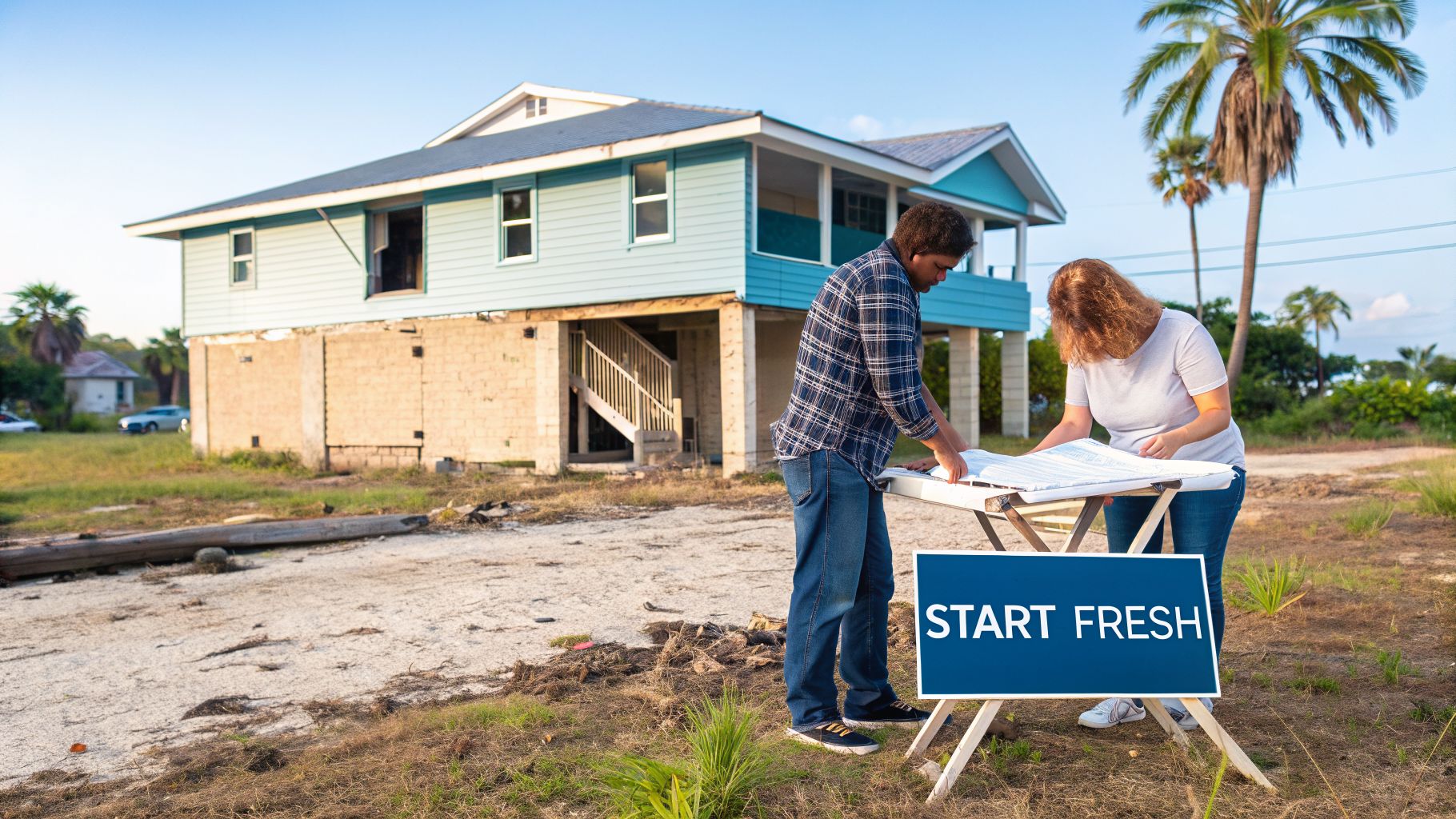
Your Naples home is more than just a building; it's filled with cherished memories. But does it still work for your family today? For many homeowners, asking that simple question is the first step toward weighing a massive renovation against the exciting, and often more practical, choice of starting over.
The decision often becomes surprisingly clear when you’re facing problems that can't be fixed with new countertops and a coat of paint. It’s when the very "bones" of the house are the issue that a rebuild starts to make a lot more sense.
When a Rebuild Is the Smarter Investment
Think about those nagging problems that many older Florida homes have. Are you constantly patching up foundation issues made worse by our humid, coastal climate? Does your home’s layout feel awkward and closed-off, completely out of sync with how modern families live?
For example, a family in the Moorings loved their street but found their 1970s ranch home was a maze of small, dark rooms. They dreamed of a bright, open space where they could cook while the kids did homework at the island. Remodeling would have meant tearing down multiple load-bearing walls, a costly and complex job. A full tear down and rebuild was the more direct path to getting the open-concept kitchen and family room they truly wanted.
Sometimes, the catalyst is major storm damage where a remodel would only be a band-aid, leaving deeper, unseen problems behind. These are the telltale signs that a full tear down is the better long-term investment.
A new build isn’t just about getting a new house; it’s about creating a home that’s designed from the ground up for your Naples lifestyle, built to modern resiliency standards, and completely customized for your future.
To help you sort through this, let's look at the core differences between these two major undertakings.
Rebuild vs. Remodel: A Quick Comparison
This table breaks down the key considerations to help you see which path might be a better fit for your goals and property.
Consideration | Major Remodel | Tear Down and Rebuild |
|---|---|---|
Foundation & Structure | Works within the existing footprint and structural limits. May not fix underlying issues. | A brand-new foundation built to modern codes. No compromises on structural integrity. |
Layout & Design | Limited by existing walls and plumbing/electrical locations. Often involves compromises. | Complete freedom to design a modern, open layout that perfectly suits your lifestyle. |
Resilience & Codes | Brings specific areas up to code, but the overall structure remains "grandfathered-in." | Entire home is built to the latest, most stringent hurricane and flood codes. |
Energy Efficiency | Can add new windows and insulation, but older construction limits overall efficiency. | Can be designed for maximum energy efficiency from the start with modern systems and materials. |
Hidden Surprises | High risk of uncovering costly issues like rot, outdated wiring, or termite damage mid-project. | Predictable process. Demolition removes all old problems, minimizing unexpected costs. |
Overall Cost | Can seem cheaper initially, but change orders from hidden issues can inflate the budget. | Higher upfront cost, but generally a more predictable budget from start to finish. |
Final Value | Increases home value, but it's still an "updated older home." | Creates a brand-new, highly desirable home that commands top market value. |
Ultimately, both paths lead to a better home, but a rebuild offers a clean slate and a level of customization that a remodel simply can't match. If you’re ready for a home that truly reflects who you are, it might be time to start fresh.
Your Practical Decision Checklist
To put it in practical terms, here are a few things I always tell homeowners to think about. This isn't about flipping a house; it's about building your forever home.
Your Lot’s Untapped Potential: Does your current house make the most of your property? A rebuild is your chance to reorient the home for better views, create more functional outdoor living space, and get the perfect flow between inside and out. We dive deeper into this in our guide on building on your own land.
The Cost-Benefit of Major Repairs: Add it up. If you need a new roof, all new electrical and plumbing, and have some structural problems to sort out, you might be surprised. The total cost of those individual projects can easily start to rival the cost of a new build, but without the benefit of a cohesive, modern design.
Future-Proofing Your Investment: Starting fresh lets you build for the future. You can incorporate the absolute latest building codes for wind and flood resistance, design for incredible energy efficiency, and integrate smart home tech from the very beginning. This makes your home safer, cheaper to run, and more valuable for years to come.
This isn't a new idea, but it's a big one, and it's helpful to see how others approach it. This Knock Down Rebuild vs. Renovation guide offers some great additional perspective.
The data shows that homeowners are investing heavily in improving their properties. The U.S. home remodeling market, which includes full tear-downs, was a massive $509 billion industry for owner-occupied homes. Here in Southwest Florida, disaster-related repairs and rebuilds hit $49 billion in 2022-2023, proving that building back stronger and more resilient is a smart, data-backed move. You can discover more insights in the full Harvard JCHS housing report.
At the end of the day, if you love your location more than you love your current house, a rebuild gives you a clear path to getting the perfect home without having to leave the neighborhood you call home.
Getting Through Naples Permitting, Zoning, and Local Codes

If you're planning a tear down and rebuild in Naples, you’ll quickly learn that the real work starts long before the first wall comes down. It's all about navigating the local map of regulations. Think of it less as a single-file line and more like learning the local backroads—knowing the way makes the journey smooth and predictable.
This is where projects either get bogged down in delays or sail through smoothly. It all comes down to getting your permits in order, from the initial demolition approval to the final building permits for your new home. Getting this right from the start is the secret to keeping your timeline and budget from going off the rails.
The Big Picture: Key Collier County Regulations
Building in Naples isn't just about following standard construction codes; it's about respecting our unique coastal environment. Two factors tower above all others: FEMA flood zones and coastal construction lines. These will have a massive say in how, where, and what you can build.
Your property’s specific zoning designation is the rulebook for your lot. It dictates the maximum size, height, and setbacks for your new home. A savvy local builder will perform a zoning analysis right away, showing you the exact boundaries you’re working within—and often uncovering opportunities you didn't even know you had.
Honestly, wading through the web of local codes is often the trickiest part of a rebuild. Your most valuable asset here is a builder with established relationships at the Collier County offices. Someone who knows the people and the process can turn potential roadblocks into simple checkmarks.
Let’s get into the specifics you'll be dealing with.
Flood Zones and Elevation Rules
Most properties in Naples are located in a FEMA-designated flood zone, typically Zone AE or the more restrictive Zone VE. These aren’t just letters on a map; they directly influence your home’s design, construction costs, and even your flood insurance premiums.
Zone AE: If your lot is in this zone, your new home must be built up so that its lowest floor (or lowest horizontal structural member) is at or above the Base Flood Elevation (BFE) for that area.
Zone VE: Found in high-risk coastal areas, this zone comes with tougher rules. Your home must be elevated on engineered piles or columns, leaving the area underneath open to let storm surge and waves pass through without damaging the structure.
You’ll need an Elevation Certificate from a licensed surveyor to prove you’ve met these requirements. This document is non-negotiable for both getting your building permit and locking in affordable flood insurance.
Coastal Setbacks and Historic Districts
On top of flood zones, you might have other local rules to consider. The Coastal Construction Control Line (CCCL) is a big one. It establishes a setback from the dunes, dictating how close to the beach you can build to protect both the coastline and your investment.
And if your property is in a designated historic area, like parts of Old Naples, expect an extra layer of design review. The goal here is to make sure new homes complement the neighborhood’s historic charm. An architect or builder with experience in these districts can be a lifesaver, helping you design a home that feels both fresh and like it truly belongs.
These regulations aren't meant to be obstacles. They’re guardrails designed to ensure our community grows responsibly. The trick is to work with a team that knows the playbook by heart.
Why Your Local Building Partner is Crucial
An experienced Naples builder does a lot more than swing a hammer. They're your project manager and advocate, guiding you through the entire regulatory maze. They handle everything from submitting the initial architectural plans to coordinating the dozens of inspections that happen during construction.
This means they’re also managing:
Zoning Variance Applications: If your dream design needs a small exception to a rule (like a few extra feet of height), your builder will manage the variance application process.
Environmental Clearances: They’ll work with the necessary agencies to handle any issues related to protected species or vegetation on your lot.
Utility Logistics: They coordinate the disconnection of services to the old house and the seamless reconnection for your new one.
This is the kind of proactive management that separates a stressful, chaotic project from an exciting, well-run one. When you have an expert handling the permits and zoning, you’re free to focus on the fun stuff—designing the Naples home you’ve always envisioned.
How to Budget Your Custom Home Rebuild in Naples
Alright, let's get down to the topic that’s on every homeowner's mind: the budget. A detailed financial plan isn't just about paying the bills; it's the very blueprint for a stress-free, rewarding build. When you commit to a tear-down and rebuild, you're making a massive investment in your family's lifestyle and future here in Naples.
Trying to estimate the cost of a custom home with a simple price-per-square-foot number is a common mistake. Those figures are often misleading because they gloss over some of the most critical parts of the project. A truly useful budget is a transparent, line-by-line breakdown of every single expense.
My goal is to give you the clarity you need to invest with confidence, making sure every dollar works toward a home you'll love for years to come.
Where the Money Really Goes
To get a handle on your budget, you need to see your project as a collection of separate cost centers. Each one plays a vital role. Think of your builder as the conductor of an orchestra; the budget is the sheet music ensuring everyone plays their part perfectly and in sync.
Here’s a look at the major categories you'll see on any realistic budget:
Demolition and Site Prep: This is where the action starts. It involves clearing away the old house and getting the land ready. This covers everything from demolition permits and the teardown itself to hauling away debris and grading the site for a new foundation.
Architectural and Engineering Fees: You're paying for the brains of the operation here. Your architect brings your vision to life on paper, and engineers make sure it's structurally sound and meets Naples’ strict building codes. Expect these fees to be about 5-15% of your total construction cost.
Hard Construction Costs: This is the big one—the largest slice of the budget pie. It includes all the labor and materials to physically construct the home, from the concrete and framing right through to the roofing, windows, and exterior stucco.
Interior Finishes and Fixtures: This is the fun part where your personal style really comes through. It’s everything that turns the structure into a home: flooring, cabinets, countertops, appliances, lighting, and paint. Your choices here can dramatically swing the final cost.
I always tell my clients that a detailed, line-item budget from your builder is the single most powerful tool you have. It gives you total control, showing you exactly where your money is going and empowering you to make smart decisions.
Real-World Scenarios and What Drives Costs Up
What’s the difference between a $2 million rebuild and a $5 million one in Naples? It almost always boils down to three things: complexity, finishes, and features. A project in an area like Port Royal, for example, comes with an expectation of world-class architectural design and materials from the very start.
A home with a clean, elegant design will always be more cost-effective than one with intricate rooflines, a complicated footprint, and elaborate custom-engineered elements. In the same way, selecting high-end imported marble and custom-milled cabinetry has a very different price tag than choosing from a builder’s standard luxury options.
For instance, one client wanted a large, cantilevered balcony to maximize their Gulf views. This required significant structural engineering and specialized labor, adding to the hard construction costs. Another family prioritized a chef’s kitchen with top-of-the-line appliances and a built-in wine cellar. These high-end finishes and features are what shape the final investment.
The trick is to identify what you value most and allocate your funds there. This is a perfect time to explore value engineering concepts in construction, which can help you make strategic trade-offs without ever compromising on your vision.
Your Financial Safety Net: The Contingency Fund
I've been doing this a long time, and I can tell you that no matter how meticulously you plan, surprises happen. That's why a contingency fund isn't optional—it's essential. This is a portion of your budget, usually 5-10% of the total construction cost, that you set aside purely for the unexpected.
This fund is your financial cushion. It prevents a small hiccup from causing major stress or derailing your timeline, giving you the flexibility and peace of mind you need to navigate the build smoothly.
When it comes to paying for the project, you’ll most likely use a construction loan, which works differently than a standard mortgage. Funds are released in stages, or "draws," as construction milestones are completed. Lenders will require that detailed budget we talked about before they'll even consider an application.
Choosing the Right Custom Home Builder in Naples
Let's be honest: the single most important decision you'll make in your tear down home and rebuild project is choosing the builder. This is about so much more than just hiring a company to pour concrete and put up walls. You're looking for a genuine partner, someone you click with and can trust to navigate this complex process alongside you.
The right builder is your advocate. They guard your budget, champion your vision, and ultimately turn what can be a stressful undertaking into an genuinely exciting journey. Finding that perfect fit takes more than a quick Google search; it's about digging in, asking the right questions, and knowing what to look for.
Looking Beyond the Portfolio
Every luxury builder in Naples has a stunning gallery of finished homes. While those glossy photos are great for inspiration, they only tell you part of the story. To really get a feel for a builder, you have to look for the narrative behind the pictures.
As you browse their work, think like an investigator:
Is there stylistic range? A truly custom builder isn't a one-trick pony. Look for a portfolio that showcases everything from sleek coastal contemporary to classic Mediterranean. This demonstrates real flexibility and skill.
Do they show you how they work? Look for behind-the-scenes content. Do they post photos of their job sites (and are they clean and organized)? Do they show their team interacting with clients? This is a huge sign of transparency.
What do past clients really say? Testimonials are invaluable. Go beyond the generic "they did a great job" and look for specifics. Do clients mention clear communication, an organized process, or a project manager who really listened? That's the gold you're looking for.
This deeper dive helps you understand not just what they build, but how they build. It gives you a sense of their company culture and whether they truly put the client experience first.
A builder’s true measure isn't just in the stunning final product, but in the seamless, respectful, and transparent experience they provide from the very first meeting to the day they hand you the keys.
Essential Questions to Ask Every Potential Builder
Once you've got a shortlist, it's time to sit down for a real conversation. This is your interview. Don't hold back—the answers you get here will tell you everything you need to know about their experience, process, and communication style.
Questions About Their Experience and Team:
How long have you been building specifically in Naples? You want a team that knows the ins and outs of Collier County's codes, climate challenges, and permitting quirks. Local experience is non-negotiable.
Can you walk me through your team's structure? Who will be my day-to-day contact? Will there be a dedicated project manager on my site every single day?
How do you choose and manage your subcontractors? A top-tier builder has cultivated long-term relationships with the best local tradespeople. This ensures a higher level of craftsmanship and reliability.
Questions About Their Process and Communication:
What does your communication rhythm look like? How often will I get updates? Will we have standing weekly meetings? Is there a client portal I can access for real-time information?
How do you manage the budget and schedule? Ask to see a sample project schedule and a detailed, line-item budget. The level of detail they provide here speaks volumes about their organization.
How are change orders or unexpected issues handled? Problems happen. What you want to hear is a clear, transparent process for addressing them, not a vague promise.
A builder who not only answers these questions but seems glad you asked them is a great sign. It shows they're confident in their process and value transparency. Their openness is a powerful indicator of the integrity you can expect for the entire build. To see how we tackle these very points, take a look at our custom home building services.
At the end of the day, you're searching for a partner who will build more than a house—they'll build a home your family will cherish for generations. Choosing that partner wisely is the first, and most critical, step toward making that dream a reality.
Your Rebuild Journey: From Demolition to Dream Home
Once the plans are approved and the permits are in hand, the real fun begins. It's one thing to see your new home on paper; it's another thing entirely to watch it rise from the ground. Understanding the construction timeline takes the mystery out of the process, helping you feel less anxious and more excited as your vision takes shape.
While every custom home we build is unique, the construction process follows a logical path. Knowing this rhythm helps you anticipate what’s coming next and when we’ll need your input on finishes and fixtures.
From Dirt to Structure
This is the phase where the most dramatic changes happen. We're talking about clearing the old and building the new skeleton of your home.
Demolition & Site Prep (Approx. 2-4 Weeks): This is where the past makes way for the future. The old house comes down, we haul away the debris, and the lot is perfectly graded to prepare for your new foundation. It’s a clean slate.
Foundation (Approx. 3-5 Weeks): We’re laying the literal groundwork. For most homes in Naples, this means forming and pouring a robust concrete slab. For coastal properties, this is when we drive the deep pilings that will elevate your home safely above the flood plain. Everything rests on getting this stage perfect.
Framing (Approx. 4-8 Weeks): This is a huge milestone! Suddenly, your floor plan jumps off the page and into three dimensions. The walls, floors, and roof trusses go up, and for the first time, you can walk through the rooms you’ve been dreaming about.
Exterior & "Rough-Ins" (Approx. 6-10 Weeks): Now your home gets its protective shell. We install the impact windows, exterior doors, and roofing that will keep the weather out. At the same time, an army of tradespeople—plumbers, electricians, and HVAC techs—are busy running all the wiring, pipes, and ductwork hidden inside the walls.
A great builder won't just build your house; they'll manage your timeline. We map out a clear schedule for when you need to finalize selections—like tile, cabinets, and light fixtures—so you never feel rushed. This ensures everything is ordered and on-site right on time.
From Structure to Stunning Finishes
With the "rough-ins" inspected and approved, the interior transformation kicks off. This is where the personality of your home really starts to shine through as all the design details come together.
This is also where a full rebuild proves its worth. You have the power to build a modern, high-performance home from the ground up. Right now, about 14% of renovations are focused on energy efficiency, but with a new build, you can bake in hurricane-hardening and sustainability from the start. And considering the 2 billion tons of construction and demolition waste generated globally each year, a well-planned tear-down allows us to be far more responsible.
The first step, of course, is finding the right team. This process shouldn't be rushed.
Once construction is underway and the framing is complete, the interior finish-out begins:
Drywall and Paint: The walls are finally closed up, textured, and primed. As the first coats of paint go on, your color palette starts to come to life.
Flooring and Cabinetry: Your chosen hardwood, tile, or luxury vinyl goes down. The kitchen and bathroom cabinets arrive and are set in place, defining some of the most important spaces in your home.
Finishes and Fixtures: This is all about the final layer of detail. Countertops are installed, light fixtures are hung, and the faucets and appliances are put in.
A crucial, behind-the-scenes part of this process involves correctly planning utility tie-ins to the city’s water, sewer, and power grids. Getting this wrong can lead to serious and expensive delays, so it's a critical task your builder manages meticulously.
The Final Stretch and Handing Over the Keys
The last few weeks are all about perfection. We work through a final "punch list," touching up paint, adjusting doors, and making sure every last detail is exactly right. After a deep, professional cleaning, we arrive at the moment you've been waiting for.
We'll do a final walkthrough with you and then—we hand you the keys to your brand-new Naples home.
From the first swing of the wrecking ball to move-in day, a typical Naples rebuild takes between 12 to 18 months. The timeline can vary based on the home's size, complexity, and weather, but by understanding the roadmap, you can relax and enjoy the incredible experience.
Common Questions About Rebuilding Your Naples Home
Thinking about a tear-down and rebuild in Naples? It’s a huge decision, and you’ve probably got a million questions running through your mind. We get it. We’ve been guiding homeowners through this process for years, and we've heard them all.
Let's walk through some of the most common things people ask, so you can feel more confident about what this journey really looks like.
Can I Just Reuse My Old Foundation?
It's one of the first questions we always hear, and it makes perfect sense—why not save some money if you can? But in the world of Naples tear-downs, the answer is almost always a firm no.
Foundations in older homes were built to codes from a different era. They simply aren't equipped to meet today's far more rigorous standards for flood elevation and structural integrity. A brand-new, custom home needs a brand-new, expertly engineered foundation to match.
Pulling out the old foundation is a key first step. It gives us a perfectly clean slate to build a new foundation that's level, properly reinforced, and set at the correct elevation according to current FEMA flood maps. It's the only way to ensure your new home is safe, resilient, and built to last.
What Happens to All the Mess from the Demolition?
This is a great question. You’re not just wondering about the logistics, but about the environmental impact, too. A professional demolition isn't the free-for-all you see in movies. It’s a very organized process.
We take sustainability seriously and make sure everything is handled responsibly.
We Sort Everything: Materials are carefully separated right there on site. Concrete is often crushed for reuse as aggregate, while metals like old copper pipes and steel are sent to recycling centers.
Responsible Disposal: Anything that can't be recycled is hauled away to a licensed facility. We follow the rules to the letter.
A Clean Slate: Our job is to leave you with a lot that is completely clear and ready for the next phase. No debris, no leftover mess—just clean dirt ready for your new home.
Once the old house is gone, the next practical question is always about your living situation.
Where Am I Supposed to Live During All This?
This is a crucial piece of the puzzle you’ll need to solve before we break ground. You'll need to move into a temporary home for the entire construction timeline, which typically runs between 12 to 18 months.
From demolition day until we hand you the keys to your finished home, the property is an active, and unsafe, construction zone.
Most of our clients end up renting a house or condo right here in Naples. Staying local makes it easy to keep your routines, swing by the job site for updates, and feel connected to the process. Budgeting for this rental expense from day one is essential.
We always tell our clients: Plan for a comfortable rental. The last thing you want is to be stressed about your living situation while you’re making exciting decisions about your dream home. Getting this sorted out early is a game-changer.
How Involved Do I Need to Be?
You can be as hands-on or as hands-off as you want, but your input is the driving force behind the project. While we handle the day-to-day management and chaos of the build, you’re the visionary. Your main job? Making design decisions on time.
We’ll give you a clear schedule that shows exactly when we need your final choices for things like:
Tile and flooring
Cabinets and countertops
Light fixtures and faucets
Appliances and, of course, paint colors
Popping by for regular site meetings is a fantastic way to see the progress firsthand. A great builder’s goal is to manage all the complexity for you, so you can actually enjoy the creative journey of bringing your vision to life. This should feel like a partnership, not a second job.
Ready to see what a custom home rebuild could look like for you and your family? The team at JVM Construction LLC combines decades of local Naples experience with a genuine commitment to our clients. We're here to answer all your questions and help you build the home you’ve always wanted.